

This post may contain affiliate links. If you make a purchase through links on our site, we may earn a commission.
When you see a caterpillar on dill in your garden—or other plants—you may be startled, grossed out, or annoyed that your plant is being systematically decimated. I get excited. Because I know it’s a black swallowtail caterpillar (Papilio polyxenes) that’s going to turn into a beautiful butterfly. And that butterfly is going to become one of many valuable pollinators in my garden.
I see a few types of swallowtail butterflies fluttering about my property, landing on various annuals and perennials. They are among the largest and most common butterflies we see in our gardens—there are about 550 swallowtail species in the world! The black swallowtail (often referred to as the Eastern black swallowtail) can be found throughout much of North America.

The tails on the hind wings of a swallowtail butterfly look like that of a barn swallow, which is how they got their common name.
What is a host plant?
A lot of articles focus on plants that attract bees, butterflies, and hummingbirds. But it’s also very important to provide plants and trees for the larval caterpillar stages. These are called host plants. My article about butterfly host plants explains the importance of these plants in a butterfly’s life cycle.
What’s important to note is that every butterfly and moth species has its own host plant or plants where the female will lay her eggs. Once an egg has hatched, the baby caterpillar will eat the egg shell and then start to consume the host plant its on. The most famous host plant in recent years is milkweed. Milkweed plants are the only plants where a monarch butterfly will lay her eggs.

A female butterfly will lay her eggs in clusters or as single eggs, depending on the species. You will often find them underneath a leaf or along a plant stem.
Finding and identifying a caterpillar on dill or other black swallowtail host plants
Where I live in Southern Ontario, I have found caterpillars on my dill plants anywhere from early June to the end of August. There are two generations or broods of swallowtail butterflies over the growing season.
Finding the eggs is tricky—I usually end up just finding the caterpillars. But if you’re looking, the eggs look a bit like tiny yellow fish roe. Caterpillars go through five “instars” or stages of development. And they can look very different in their younger stages than when they’re plump and ready to form a chrysalis.

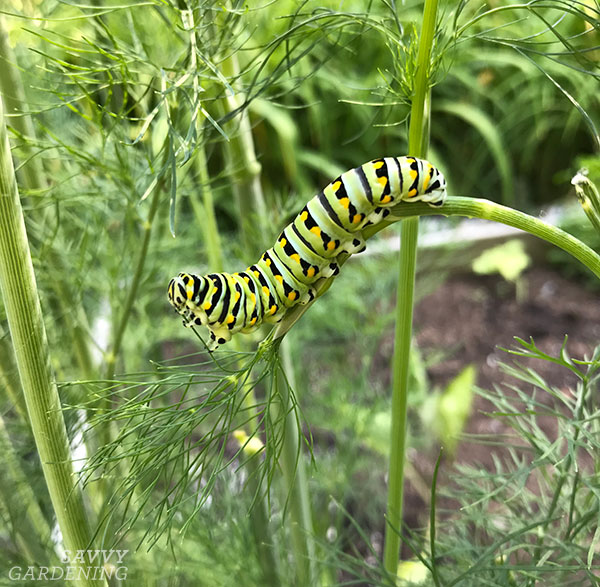
Through each instar stage, the caterpillar molts its skin. In the early instar stage, caterpillars look a bit like bird droppings, probably to deter predators. They’re black in color with orange dots and a white center, and it looks like they have little spines on their back. As they grow, the middle instar swallowtail caterpillar stage still includes spines, but the caterpillar is more black and white striped with yellow spots.
During later instar stages, the swallowtail caterpillar becomes a lime green color with black and yellow stripes. That spiny back disappears. And they are closer to forming a chrysalis. My hope is always that they pupate before the birds find them!

What to grow to feed black swallowtail caterpillars
One type of plant does not feed all butterfly caterpillars. They all rely on different, specific plant species, known as host plants. For example, the aforementioned milkweed is the only larval host plant of the monarch butterfly caterpillar. Black swallowtail caterpillars rely on members of the Apiaceae or Umbelliferae family, which include dill, carrot tops, parsley, fennel, rue, and Queen Anne’s lace.
There are also some native plant species that are host plants to black swallowtail caterpillars, including golden Alexander (Zizia aurea) and yellow pimpernel (Taenidia integerrima). The blooms of both resemble dill flowers.

My recommendation if you’re growing herb plants, like parsley and dill, is to spread out your plants in different places of the garden. That way you’ll have lots to enjoy on your plate and the swallowtail caterpillars will have lots to enjoy as they move through their instar stages.
What to do if you see a caterpillar on dill and other host plants
The short answer is to let them eat! The other answer is grow more of what they like to eat if their appetite is interfering with your crops. I let my dill go to seed in the garden, so I have a LOT of dill plants from spring through fall. I simply pull the ones that get in the way of planting other veggies and herbs, but there is plenty left over for the caterpillars to eat—and to enjoy in my meals.

You can also (gently) move a swallowtail caterpillar on dill to another host plant, though they don’t like to be moved when they’re ready to molt. When alarmed, what look like little orange antennae come out. And they’ll emit an odor to warn off whoever is disturbing them. Those “antennae” are actually an organ called an osmetierium, a warning sign for predators.
It’s unlikely you’ll see a black swallowtail butterfly emerge from its chrysalis in your garden, but hopefully you see the butterflies enjoying the nectar provided by your garden. Unlike caterpillars, the butterflies are not as picky about what they eat.

More pollinator-friendly advice, identification, and growing tips
The book Gardening For Butterflies by the Xerces Society is helpful when it comes to identifying the types of butterflies you may find in your garden, as well as what to plant to support both the caterpillar and butterfly stages of life.
- Foraging habitat for pollinators: What to plant in sun and shade
- Pollinator garden design: How to get started attracting bees, butterflies, and birds
- Attracting more bees and pollinators: 6 ways to help our native insects
- Types of bees commonly found in yards and gardens
- Hummingbird flowers to add to your garden
- Building a garden for caterpillars
- Planning a habitat garden
- Welcoming fireflies aka lightning bugs to your garden

Am I able to keep caterpillars of different stages together?
I think so… I’ve seen them in nature on one plant together…
I have some caterpillars about to wrap up for the metamorphosis going into that shape and still on the dill. It’s time to plant other things where that dill is. I’ve been happy to let them eat as much as they want and holding out removing the flowered dill waiting for them to finish and move along to chrysalis elsewhere. It seems they like it on the dill too much & want to stay on. Once they go into chrysalis, would they be ok if I gently cut the dill plants out of the garden and put them nearby to finish out until they emerge as butterflies? I would think so, yet I’m ignorant on butterflies. Thank you for sharing your knowledge!
Hi Kelly, I find that when they’re ready to form a chrysalis, the caterpillars usually disappear from the garden and I don’t see where they end up. But if you do happen to spot one, I have found some videos online that explain how to safely move a chrysalis.
I found a black swallowtail caterpillar on dill in my garden this week, but the nights are down in the low 30’s and daytime highs in the mid 50’s. And of course, the temps will be dropping more soon. What should I do with him? He’s still small and dark. Should I leave him outside by the dill (which is pretty much done for the season) or bring him in and provide dill inside? I’d love to keep him alive if possible! Thanks! 🙂
Hi Leah, It’s probably best to leave him outside… if you bring him inside, you’ll have a butterfly to care for all winter…
Hello Leah, you did not have to leave the caterpiller outside. Nor would you have to take care of a butterfly all winter. Butterflies do not live in the winter. The caterpiller would soon form a Chrysalis and stay dormate all winter in the Chrysalis cocoon. And emerge in the spring. Most all butterflies only live 10 to 20 days but in that time can lay 200 to 400 eggs. Some species do live 45 days. Only about 1 in 100 make it to become a butterfly. Most will be spotted by birds.
Well, here it is, the end of October and I’m cleaning out my garden which has a lot of dill, planted just for the butterflies. And what did I find? A caterpillar. What do I do with it? I left it outside, but found some baby dill still growing, so I put it on that and the last I saw, it was munching away quite happily. Do I leave it outside all winter? Bring it in? What? Please help both of us. Please reply by e-mail if possible. Thanks
Hi Betsy, I think you should probably leave him and let nature do its thing. If you bring him inside, you’ll then have to raise a butterfly all winter…
This article was very informative. I live on the coast of Eastern Central Florida. I’ve planted Dill, Fennel, Parsley, Rue and several flowering plants that Swallowtails love.
I have everything EXCEPT the Swallowtails! How else can I attract them? Is there a “Season” for Swallowtails? Even in Florida?
Hi Kathryn,
There are swallowtails in Florida, but I’m not sure when they’re most prevalent. I would look for a regional newspaper or online article to learn more about the swallowtails where you live. 🙂
Ashamed to admit that I made Diane’s mistake (previous post). Found tiny worms on both my parsley plants as well as my dill. Yep, threw them in the grass not knowing that the plants would recuperate. Then I researched and won’t do that again. I’m a brand new Gardner dabbler. Thanks for educating me.
I’m sorry I read the article after I threw them over the terrace! I hope they landed on the shrubbery below.
Thank you so much for this article!
I just went out to my garden and spotted tiny little caterpillars all over my dill and parsley plants. At first I thought it was bird poo!
My plants are giant, so I have plenty to share! I just love swallowtails!
Wonderful article! Very informative and helpful. Thank you!
Great article… I have two 3×8′ raised beds and ONLY grow wild flowers, parsley, dill and milkweed for caterpillars… black swallowtails, monarchs and yellow sulphurs. I also live in a bird sanctuary and have 6 feeders away from the gardens and have bluebird, mockers, warblers, thrashers, wrens, etc., which I feed mealworms. Tho I feed the birds I worry about them eating the caterpillars. How do I protect them or should I just let nature take its course? Thanks.
As sad as it is, I just let nature take its course.
This philosophy should extend to other caterpillars as well. Shift to thinking of them as baby butterflies or moths if that helps bring a positive change to your perspective.
With the exception of a rare army worm outbreak (which your county extension dept will handle) , these host plants evolved with Caterpillar herbivory activity and it won’t kill the plant. Even when pipevine cats eat every leaf, the plant bounces back very quickly.
Beautiful article. Have seen queries on facebook from people who want to know what to do with the cats they find, not knowing what they are. I like to plant extra parsley and dill to lure them in…so beautiful