
This post may contain affiliate links. If you make a purchase through links on our site, we may earn a commission.
Knowing when to plant carrots for autumn and winter harvesting is the difference between a bumper crop of sweet, crisp roots, and a disappointing harvest of under developed carrots. I’ve been planting carrots for fall and winter for decades, and have learned exactly when to plant for the best quality crop. In this article I’ll share my expert tips on timing, boosting germination in hot weather, caring for the seedlings, and protecting carrots for harvesting into winter.

Why grow carrots in autumn and winter?
The best tasting carrots (Daucus carota) aren’t bought in grocery stores. They’re homegrown roots that have matured in cool temperatures. Low temperatures, combined with frost, causes the starches in the roots to turn to sugar, meaning extra sweet roots. Therefore my fall and winter harvest of carrots is the best tasting of the year. And it’s not hard to enjoy cold hardy carrots into winter, especially when they’re mulched with straw or planted in a season extender like a cold frame. Need more reasons to plant carrots for autumn and winter? They’re also an easy crop, extremely versatile in the kitchen, and growing your own can help reduce your grocery bills.
It also lets you maximize your garden space by following spring and summer vegetables like beans, tomatoes, squash, and cucumbers with a new crop. Succession planting is the key to a non-stop harvest. Read all about my season extension and year-round harvesting in my award-winning book, The Year-Round Vegetable Gardener. In my book, I also dive into the exact timing for many crops including when to plant carrots for autumn and winter harvesting.
Why you need to know when to plant carrots for autumn and winter
Carrots are a popular late season crop, but if they’re not planted at the right time, the harvest will be disappointing. If you sow the seeds too early, the roots can get overmature and split or become woody. Wait too long to plant and the roots won’t have time to reach a harvestable size before the cold weather sets in and growth stops. This article will help you time when to plant carrots for autumn and winter so you have the best quality crop.

When to plant carrots for autumn and winter
The most important factor for success is timing. You need to figure out the best window for when to plant carrots for autumn and winter for your region. To do this, you need to know your first average frost date and the days to maturity for the carrot variety you wish to grow.
Once you have these two pieces of information, you can discover the best planting date. Let’s say that your first frost date is October 1 and you are growing a carrot variety with a days to maturity of 60 days. That means you need to count backwards by 60 days from your first frost date, or about August 1st.
However, because plant growth slows in autumn as the days get shorter, you need to account for this in your calculations. I add an extra week of grow time to ensure the roots have time to size up. Therefore I would plant my carrot seeds around the 2nd or 3rd week of July. Easy peasy!

How to plant carrot seeds
Seed spacing and depth for fall and winter carrots is the same as those planted earlier in the season. Prep your seedbed first. Carrots need full sun and deep, loose soil to form long taproots. The soil should have good drainage, with sandier soils preferred over heavy clay soils. I add an inch of compost or rotted manure, cultivating that into the top couple of inches of soil. You can also add a slow release organic vegetable fertilizer to provide a consistent supply of nutrients like phosphorus and nitrogen.
Sow the seeds in 2 inch wide bands, planting them about 3/4 of an inch apart and a 1/4 to a 1/2 inch deep. Water well and follow the directions below to help boost germination rates.
Getting carrot seeds to germinate in summer
Growing carrots for autumn and winter harvesting does differ slightly from planting them in the spring. The biggest difference is that a midsummer-planted carrot crop deals with high temperatures and dry soil. Carrot seeds germinate well when temperatures are in the 60 to 86 degrees F (15 to 30 degrees C) range. When the mercury climbs above 86 degrees F (30 degrees C), germination slows or stops. This can make it very difficult to establish a fall crop of carrots during a heat wave.
Below I offer two simple solutions to overcoming high temperatures when sowing carrot seeds in mid to late summer.
- Watering – The most important step to good germination of fall and winter carrots is watering so grab your hose! The seeds germinate quicker than a spring crop, usually in 7 to 10 days. But if you don’t keep the soil lightly damp for that entire period, you risk losing the majority of the just-germinated seedlings. I use a long handled watering wand to make watering quick and easy.
- Create shade – Use row covers or a length of shade cloth floated on wire hoops overtop the carrot bed. This shade slows water evaporation from the soil and helps keep those newly planted carrot seeds damp. When the seeds have germinated and the seedlings are about an inch tall, remove the covers to encourage healthy plant growth. You can also lay row cover, cardboard, or even a length of lumber on the soil surface to hold moisture and boost germination. Check underneath daily and remove as soon as you see green.

Expert growing tips
- Weed – As the seedlings grow, you’ll need to hoe or pull any weeds that pop up. These compete with carrots for sunlight, water, and nutrients. And if the bed is filled with weeds, your carrot roots won’t size up.
- Water – Carrots need water, but it’s not a good idea to give your veggie patch a daily light sprinkle. Instead, deep water once or twice a week, giving the plants about an inch of water each time. This promotes long deep roots.
- Thin – It’s very easy to over plant carrot seeds and end up with dense clumps of seedlings. Oops! If this happens to you, don’t worry, just use a pair of garden snips to clip off the extras at ground level. Pulling them can dislodge nearby carrots so it’s best to snip the foliage instead. Aim for a distance of 1 1/2 to 2 inches between roots.
- Watch for pests – Carrot pests like slugs, carrot rust fly, and wireworms are serious issues. Regular inspection of your carrot crop helps you see if the plants aren’t growing well so you can take action as early as possible.

The best carrots to plant for fall and winter harvesting
Any carrot variety can be grown for fall and winter carrots, but certain ones offer higher quality roots and a sweeter flavor. Here are 5 carrot varieties I grow for fall harvesting.
- Napoli (60 days) – Of all the carrots I grow for fall, Napoli is my favorite. It’s reliable, cold hardy, and the 7 inch long roots are ridiculously sweet! You just can’t beat the taste of Napoli. This variety is perfect for garden beds, cold frames, and greenhouses.
- Bolero (75 days) – Bolero is a variety that holds its quality for a very long time in autumn and winter. The roots grow up to 8 inches long with blunt ends and a cylindrical shape. Expect sweet, juicy orange carrots that store well.
- Scarlet Nantes (65 days) – This is an heirloom variety that’s been a staple for vegetable gardeners for decades. The plants form 7 inch long roots with a 1 to 1 1/4 inch diameter. It’s ideal for cold season harvesting in the garden or dig them in late autumn and store them in sand in a root cellar.
- Yaya (60 days) – Another early maturing variety, Yaya produces smooth orange roots up to 6 inches long. They’re sweet, crunchy, and delicious.
- Autumn King (70 days) – As the name suggests, this variety is best planted in summer for fall harvesting. The lengthy roots, up to a foot long, taper to a point. The hold their quality and flavor in the ground or in storage for months.

How to protect carrots in autumn and winter
The final point I want to cover is whether you need to protect your late season carrots and if so, what is the best type of season extender. First, you don’t need to cover fall carrots if you intend to eat them in a timely matter. This is before the ground freezes. Fall carrots can be eaten as baby roots or as mature carrots.
If you wish to harvest the roots into early winter, or even later, it is a good idea to protect them from extreme cold temperatures with a layer of mulch or other structure.
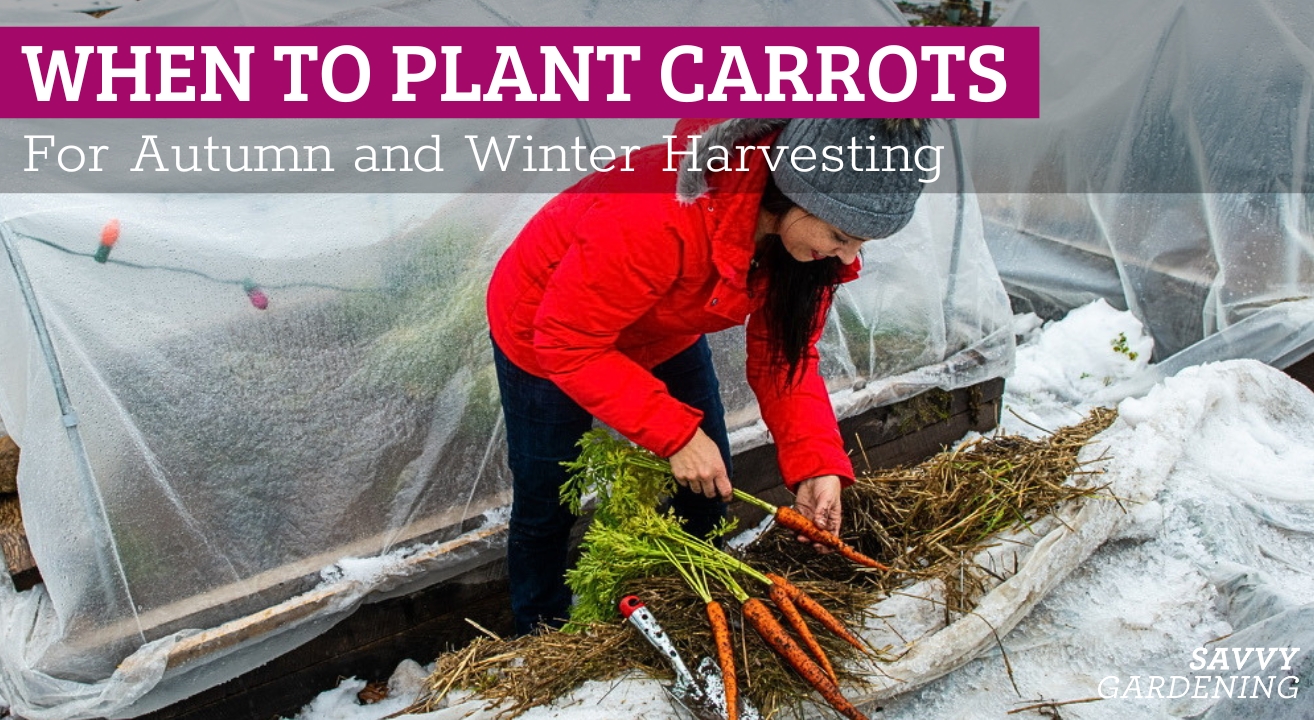
- Mulch – The easiest and cheapest way to extend the harvest of fall carrots is to deep mulch them. Apply at least a foot of straw or shredded leaves in late autumn before the ground freezes. Cover this with an old row cover or length of cloth to stop the insulating mulch from blowing away. You can then harvest as needed over the winter months.
- Cold frame – Cold frames are handy for winter carrots. If you have a portable cold frame, such as one made from polycarbonate, just pop it overtop the carrot bed in late autumn. If your cold frame is a permanent structure, plant carrot seeds directly in the cold frame in the time frame recommend above.
You can also set up mini hoop tunnels, plant in a greenhouse or polytunnel, or harvest your fall carrots and store them in damp sand in a root cellar or cool basement.
Now that we know when to plant carrots for autumn and winter, here are more articles on growing your best carrots ever:
- How to grow carrots in raised beds
- What is the right carrot spacing
- When to plant carrots for fresh eating

Leave a Reply