
This post may contain affiliate links. If you make a purchase through links on our site, we may earn a commission.
I hosted a radio program on KDKA Radio in Pittsburgh for fifteen years, and the most common question my co-host and I were asked on-air is “Why doesn’t my hydrangea bloom?” Upon further inquiry, we would often come to learn the caller was asking about a big-leaf hydrangea, Hydrangea macrophylla. While these old-fashioned hydrangeas bear gorgeous balls of pink or blue flowers, they’re notorious for their unreliably here in the northern U.S. Some years they bloom beautifully, while other years there’s not a single bud in sight. If you’re a USDA zone 5 or 6 gardener who has faced this experience yourself, here are a few tips you can use right now to get better blooms from your hydrangea.

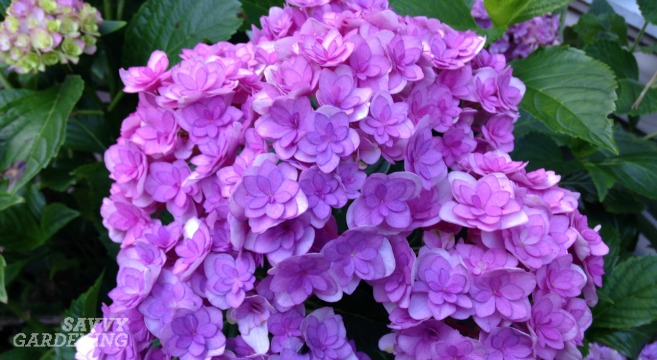
1. With few exceptions, Hydrangea macrophylla varieties (like the double-flowered cultivar ‘Paraplu’ featured in the main photo of this post) form their flower buds on old-wood. This means that next year’s flowers are already formed inside the buds of those seemingly dead sticks. If you prune off any branches now – or in the spring – you’re cutting off future flowers. Here’s more about the proper time to prune hydrangeas to keep their buds intact.
2. The dormant flower buds housed inside those brown sticks are prone to damage from cold temperatures and drying winds. Of particular harm are the late-spring freezes that occasionally occur. To protect your hydrangea’s dormant buds, surround the plant with a layer of protection. Hammer four 1″x1″ hardwood stakes around each plant, and use a staple gun to attach a perimeter of burlap, plastic sheeting, or black landscape fabric to the posts (see photo above). Make sure the fencing is as tall as the shrub itself. Do not cover the top unless the structure is very well supported; the weight of any accumulated snow can send the whole thing toppling down on top of your plant. It’s okay for it to be open on top as any snow that enters will serve as added insulation. The idea is to protect the plant from damaging winds. However, if your protective box is sturdy enough, you can cover the top with a piece of foam board or something similar. Leave this protective fortress in place until late spring, when the hydrangea’s buds start to swell.
3. Big-leaf hydrangeas tend to perform better when located in a more sheltered spot. If possible, relocate any non-blooming specimens to a nook that’s protected from high winds and located near a heat-absorbing wall or driveway. Hydrangeas are best moved in the early spring, before the foliage emerges, or in the autumn, a few months before the ground freezes.
4. For more reliable bloom production, you may want to consider adding a few different types of hydrangeas to your landscape. Hydrangea arborescens is a slightly hardier species that produces massive, white, snowball-like flower clusters. ‘Annabelle’ is my favorite cultivar. H. quercifolia, the oak-leaf hydrangea, is another uber-reliable bloomer with a stunning fall color and white conical blooms. There are, however, a few H. macrophylla cultivars currently on the market that have been selected to produce blooms on both old- and new-wood. I’ve had the most success with a newer introduction called ‘BloomStruck’. Click here for an article that offers more tips on caring for hydrangeas through the fall and winter.

Tell us about your favorite hydrangea and how you help protect it for the winter.


Hi! My two Star Gazer lacecap hydrangea macrophylla bloom on old and new wood. I live in zone 6a and we had a mild winter which caused both shrubs to bud out early. Then we had two hard late spring freezes which killed the early buds. We tried putting up sheets to protect them but it clearly didn’t work. I got a few flowers from the new growth buds, but nothing like the year before. I’ve learned my lesson and now have stakes up wrapped with burlap just slightly higher than the bushes. I’ve read elsewhere that I should also fill the area with shredded leaves as high as the plants – but they are 4′ high and that’s a ton of leaves!! So we’ve just filled about 12″ high, knowing it will compact with snow. The bushes have a mix of green and burned leaves from the three freezes we’ve had in this odd fall – a week of upper 70s in November?! – just nuts. Sorry – so my question is, does it sound like I’ve protected them sufficiently or too much? These two have such gorgeous flowers – I want to keep them thriving! THANK YOU!
Hi Chris – I think your technique sounds great! I’ll keep my fingers crossed for you. Let us know how it works out next season.
We have very little success getting our big leaf hydrangeas to bloom. We’ve mulched deeply for the winter (zone 5b) but still no luck. We are considering digging them up and potting them and bringing them into our unheated 3 season room for the winter. We do this with mums and it works great (mums don’t winter outside well here either). This room gets down into the 20’s at the worst part of winter. Any thoughts on how this plan might work?
I think that’s a great plan. As long as the room doesn’t get too hot early in the spring and you remember to water the pots lightly every 6 to 8 weeks.
I moved into a house with four established very large hydrangeas. None bloomed until late in the summer, ONE bloom on the bottom of ONE plant. Now (in October) that one plants has many buds on it that are flowering. It seems super late for a hydrangea to bloom?
J am in southern Ohio – so, if I do the burlap and stakes before first front, I leave that on until after last frost? And the old leaves will have fallen off? And then do I cut down or no? I believe mine grow on new growth because after they started growing this year, I went in and cut back the sticks inside the green. Did I mess up? I just want them to come back healthy!!
Yes, put the burlap on in the fall and leave it up until the spring. The leaves will all fall off, but the buds will (hopefully) remain viable. Do not cut the branches back in the spring, even if you think they’re dead. They could be holding the flower buds for later that season. Just leave them be. At the very least, the stems will form a support scaffolding for new branches.
I live in Oklahoma and do not know what my zone area is. Can you supply me with
what zone I live in?.
Here is a link to the USDA hardiness zone map that you can use to determine your growing zone: https://planthardiness.ars.usda.gov/PHZMWeb/
I have a big-leaf that I received as a gift. It was small, so I put it in a pot outside and it has done well this summer. Should I put it in the ground now (September) in NW Massachusetts, or bring the pot inside for the winter and plant in the spring? Thanks.
Yes. I would plant it in the ground as soon as possible. Another option is to sink the pot into the compost pile or veggie garden as a temporary holding area. This insulates the roots for the winter until you can plant it in the spring.
i have a late summer blooming hydrangea – i don’t know when to prune? some say early spring – but when is that? March? we live in zone 3-4- near Canada – very cold winters, last year the hydrangea was huge, as we had a lot of rain – very tall, but still pretty. Should I just leave it from year to year and not prune at all?
It’s difficult to say without knowing exactly which species of hydrangea you have. If it blooms that late in the season, it may be a species that blooms on new wood (arborescens or paniculata grandiflora, as examples) in which case you can prune in the early spring. But if it’s a species that blooms on old wood, pruning in the spring would cut off that season’s flowers.
My Annabelle’s get a big puffy green flower on it but they do not turn white like they were the year I planted them. I do not cut them the fall, or the spring. How can I get the flower to turn white?
Interesting. The genetics of your Annabelle must be slightly different than typical. If they continue to not turn white, you may want to swap it out for another Annabelle. There’s nothing you can do to change the flower color on Annabelles other than perhaps trying to give it more sun.
My bigleaf hydrangeas haven’t bloomed for 2 yrs now and my lacecap (Bits of Lace) 5 yrs since we moved it! I haven’t cut them back and they should have adequate sunlight but my husband fertilizes 4 time a yr and goes right into the flower garden. I was just told that is why no blooms so I bought Holly Tone for acid loving plants. I have faith they will all bloom next year except I’m worried about my Lacecap! Any tips that would bring that beauty back to life. I’m in Zone 5!
My hydrangea gets blooms but they look like the bottom right photo. The bloom only partially flowers. Any idea why? It does this year after year. Thanks!
Hydrangeas that have blooms only on the outer edge of the flower cluster are a specific type known as lace-cap hydrangeas. There is no way to make them larger; it’s just the way that variety blooms.
This was a very helpful article 🙂 I now know why our Hydrangeas aren’t blooming. We cut them for bouquets to take to the cemetery for my Mom. She loved them.