
This post may contain affiliate links. If you make a purchase through links on our site, we may earn a commission.
Whether you’re growing heirlooms like Cherokee Purple or more common hybrids such as Early Girl and Better Boy, understanding how often to fertilize tomatoes can make or break your plans for a huge harvest. Tomatoes are heavy feeders, so getting the hang of when and how often to fertilize tomatoes—not to mention with what exactly—really matters. Get it wrong and you could end up with fruits that are undersized and underwhelming. But, if you get it right, you’ll be rewarded with robust plants that are less susceptible to disease and insect damage and much more productive.

The importance of knowing how often to fertilize tomatoes
By fertilizing your tomatoes during their different developmental stages, you can ensure that they have the nutrients they need in order to grow into large, healthy plants ASAP. Plants with lots of lush foliage can take advantage of warm, sunny days to photosynthesize and put on flowers sooner than weaker, smaller specimens. That, ultimately, means you get more tomatoes—and sooner!—than you otherwise might. Fruit from well-fed plants often tastes better, too.
Understanding tomato plant nutrient needs
Tomatoes need the essential nutrients nitrogen, phosphorus, and potassium. They also need calcium, magnesium, and smaller amounts of trace elements like iron and zinc. Represented on fertilizer packaging as “N,” nitrogen is necessary for green growth. Represented as “P,” phosphorus kickstarts flowering and fruit set. And the “K” in “N-P-K” represents potassium—essential for processes such as plant rooting and cell wall development, among others.
Young tomato plants benefit from a boost of nitrogen to help them put on lots of green leaves; however, once it’s time for your plants to start flowering and fruiting, you should reduce the amount of nitrogen and increase their access to bloom-stimulating phosphorus instead.

When to start fertilizing tomatoes
You should begin fertilizing once your young plants have at least two to three sets of true leaves. Choosing a nitrogen-rich fertilizer—Espoma Organic Chicken Manure All Natural Plant Food (5-3-2) for example—is a safe bet for this stage of your plants’ growth. For tender seedlings, dilute any fertilizer products by half for the first few feedings.
You’ll need to fertilize again when flowers start to appear on your growing plants. The fertilizer you choose now should have more phosphorus than nitrogen. A product like Burpee Organic Tomato + Vegetable Granular Plant Food (3-6-4) is a great choice at this point.
How often to fertilize tomatoes
How often to fertilize tomatoes partly depends on the kind of fertilizer you pick. If you use a dry, slow-release fertilizer, your plants will get a nutrient boost each time you water. This boosts lasts over several months. Liquid fertilizers like Neptune’s Harvest, on the other hand, provide a quick infusion of nutrients that lasts two to four weeks.
Whether your plants are growing in a container or a larger garden bed also makes a difference. For instance, you may need to feed plants grown in containers more frequently than those grown in the garden. This is because pots require more watering sessions which means nutrients are being washed out faster.

Making a fertilizing schedule: Frequency and timing
As you look into how often to fertilize tomatoes, you can take some of the guesswork out by creating a fertilizing schedule like this:
- Vegetative growth stage—Work a nitrogen-rich, slow-release fertilizer into the soil at least once and then water regularly. If you opt for a mild, liquid fertilizer instead, mix and water in about every other week during the next month or so.
- Flowering stage—Work a phosphorus-rich, slow-release fertilizer into the soil at least once when flowers first appear and then water regularly. If you’d rather use a liquid fertilizer, mix and water this in about every other week until you begin harvesting.
Types of tomato fertilizers
Now you may have a better sense about how often to fertilize tomatoes, but what about the types of fertilizer to use?
- Organics or synthetics?—Because organic fertilizers come from natural ingredients like bat guano and bonemeal, their overall N-P-K ratios are usually lower than those of their synthetic counterparts. As such, you’re less likely to “burn” or damage your plants when using a milder, organic fertilizer. Read our guide to natural fertilizers.
- Slow-release—Available in powdered, pelletized, and granular forms, slow-release fertilizers gradually release nutrients each time they get wet.
- Liquid and water soluble—Concentrated liquid fertilizers are intended to be diluted with water and then applied to give plants a fast-acting meal. Similarly, some dry fertilizers are water soluble. This means they can be mixed with water and used like a liquid fertilizer.

How to apply fertilizer to tomato plants
Besides how often to fertilize tomatoes during their different life stages, you need to know how to apply the fertilizer you choose.
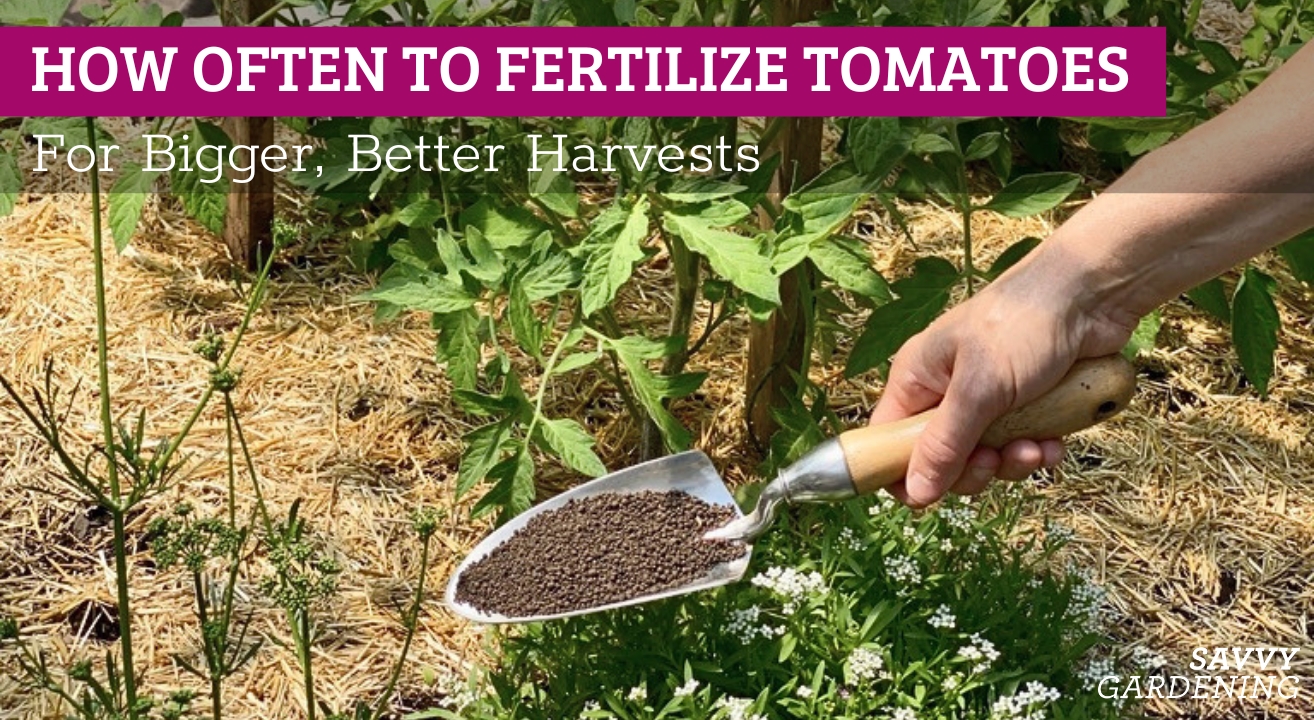
- Slow-release fertilizers—Carefully break up any compacted soil around your plants, measure out the correct amount of product per label instructions, scatter evenly, and mix into the top one to two inches of soil. To avoid fertilizer burn, don’t allow product to directly contact the plant stem. Water in well.
- Liquid and water soluble fertilizers—Follow package instructions to dilute liquid concentrate or to mix water soluble products. I use a large watering can for mixing fertilizer. You can simply water plants with the mixture or spray on as a foliar feed.

Signs of over or under fertilizing
As gardeners work out how often to fertilize tomatoes, they can be tempted to overdo it. (Psst! It’s also possible to under-do it!) Watch for:
- Pale green leaves and spindly growth—too little nitrogen
- Deep green leaves with delayed or absent flowering—too much nitrogen and/or too little phosphorous
- Pale yellow leaves coupled with burned-looking or curled edges—too much fertilizer overall
- Deformed leaves with purplish tinge—too much fertilizer overall
Additional tips for feeding tomatoes
- Check pH—Your tomatoes may have access to plenty of nutrients, but they may still be unavailable. If your soil pH gets out of whack, plants can lose the ability to take up certain nutrients. Don’t add more fertilizer—just correct the pH. (The ideal for tomatoes is 6.0 to 6.6.) Use a soil testing kit to check your pH if you’re having issues or are unsure of its pH range.
- Water well—Seeing the blossom ends of your fruits become sunken and black is one of the most common fruiting problems. Known as blossom end rot, this condition is usually caused by a lack of calcium. Rather than adding more calcium to your soil, which is likely already there, you just need to water more frequently and consistently. This is because, without adequate water, your plants can’t access calcium.

Final thoughts on how often to fertilize tomatoes
If you’re serious about growing the perfect slicers, cherries, or paste tomato varieties, how often to fertilize tomatoes will most certainly come up for you. By applying slow-release fertilizers or liquid or water soluble mixes, you can provide the right blend of nutrients during your tomatoes’ vegetative and fruiting stages.
Remember, for lots of leafy, green growth, your tomato plants require adequate nitrogen. And, when it’s time to start fruiting, phosphorus is especially important. Of course, potassium, calcium, iron, and other essential elements all will play a part when it comes to harvesting your biggest—and tastiest—tomato crop yet.
For more information on growing great tomatoes, be sure to check out these articles:

Leave a Reply