
This post may contain affiliate links. If you make a purchase through links on our site, we may earn a commission.
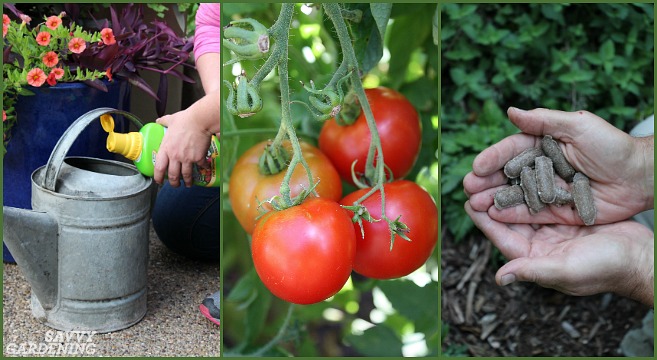
When it comes to organic fertilizers for container gardening, you have two basic choices: granular or liquid. Let’s talk about each of them in detail.
This post is an excerpt from Container Gardening Complete by Jessica Walliser
Complete Granular Fertilizers for Container Gardening
There are dozens of different brands of complete granular fertilizer blends. Most of these products combine assorted plant, manure, animal, and mineral-based ingredients, and depending on the brand, they may have an N-P-K ratio of 4-5-4 or 3-3-3 or something similar. What makes them “complete” is that they contain a combination of ingredients that provides some amount of all three macronutrients (nitrogen, phosphorus, and potassium), in addition to many trace nutrients, vitamins, and other things. All of these products have different formulations and compositions, so be sure to chose appropriately according to what plants you’re growing in your container garden. Some complete granular fertilizer blends are even tailored for specific crops, such as tomatoes or flowers or bulbs, and are labeled as such.

For the best results, add granular fertilizer to your containers according to the label instructions. Many gardeners find they get the best results by fertilizing their containers with granular fertilizers two or three times throughout the growing season.
With granular products, it’s possible to have too much of a good thing. Even natural fertilizers can be easily over-applied, leading to several different issues, including nutrient deficiencies, pH imbalance, and/or fertilizer “burn” (yes, even some natural fertilizers are capable of this). To avoid these issues, don’t overdo it by applying too much, too often. Again, be careful to follow all label instructions.
Liquid Organic Fertilizers for Container Gardening
Liquid fertilizer products are absorbed into plants via both their roots and their foliage. In general, nutrients provided to plants via a liquid solution are more readily and rapidly available for plant use. Like all fertilizers, water soluble ones provide plants with some of the necessary nutrients for increasing yields and improving growth and vigor, but not all liquid fertilizers are created equal.
While chemical-based, water soluble fertilizers certainly supply plants with the macronutrients specified on the label, these products are made from salts that can harm beneficial soil organisms. Instead of chemical salt-based fertilizers, look for organic or natural-based liquids which can reduce the risk of fertilizer burn and offer a more balanced “diet” for your plants. In addition to the three macronutrients, most natural liquid fertilizers for containers also contain dozens of trace nutrients, vitamins, amino acids, and plant hormones, each of which plays a vital role in the health and vigor of a plant.

There are many different types of liquid fertilizers available on the shelf of your local garden center, or, in some cases you can even make your own. Here are some of the most popular types of natural liquid fertilizers.
Liquid kelp or seaweed
Fish emulsion
Fish hydroslate (or liquid fish)
Compost tea
Earthworm castings tea
The above products useful on their own, but they’re also quite valuable when combined with other ingredients. Natural liquid fertilizer combinations blend these products with ingredients such as liquid bone meal, blood meal, feather meal, and rock phosphate to create a well-rounded fertilizer and growth stimulant.

When using any natural liquid fertilizer, follow label instructions for mixing rates and application instructions. Generally, most liquid fertilizers are applied either by mixing the product in a watering can and watering by hand, or by using a hose-end fertilizer distribution system to automatically deliver the fertilizer with the irrigation water.

Liquid fertilizers are best absorbed when the plants growing in your containers are not under stress. Do not fertilize your plants when they’re wilting or suffering from heat stress. Water them first, a few hours before fertilizing them, to maximize their absorption of nutrients.
Though over-applying organic liquid fertilizers for container gardening is seldom possible in terms of plant health, overdoing it can be hard on the budget. Don’t use more than you need. Most liquid fertilizers should be applied every two to four weeks throughout the growing season.
To read more from Jessica about growing in containers, purchase a copy of Container Gardening Complete via Amazon, Jessica’s website, or your local bookseller.

For more on tips on container gardening check out these posts:
Recipes for Making DIY Potting Soil
The Best Fertilizer Schedule for Houseplants
Container Garden Maintenance Tips
7 Best Herbs for Containers
Crops in Pots: Success with Vegetable Container Gardening
Pin it! 

I love succulent and cacti containers! I would really like to try peppers, tomatoes, and maybe guava in 2018. I would love to have this book for some guidance! I am a U.S. resident.
I enjoy growing flowers in containers here in Erie pa.
I love to grow tomatoes in containers. Here in Calgary we often get hail and cold nights. With my tomatoes in containers I can easily move them inside to keep them safe. I have often thought an interesting idea would be to combine vermicomposting with container gardening. Have you ever tried something like this? I am from Canada.
I grow cabbage, sweet potatoes, broccoli, peppers, lettuce, radishes, and more in containers! I’m in the U.S.
I enjoy growing herbs, flowers and tomatoes. I am from Canada.
Northern Ontario, Canada! We are new to gardening and tried container gardener of Peas, Beans, Tomatoes, Broccoli and Green Peppers. This winter I hope to complete cold frames! (Somehow the deer got most of our in ground carrots and potatoes!)
🌞
Hi there,
I garden in “growing” Kitchener, Ontario. Herbs are what drew me into container gardening, as well as houseplants, but we have been trying some veggies too to extend our beds. And now we have a few small nut trees (after visiting a tree farm) that we hope to plant in future on a country property.
I love growing tomatoes in containers on my deck, I am Canadan
A resident of Pennsylvania, USA, I rent and cannot plant a fruit/veggie garden in the lawn. So I need to learn all about container gardening. Thus far I have only tried tomatoes and herbs — neither a smashing success. Obviously, I need a book like this to educate and guide me.
Thank you for the offer.