
This post may contain affiliate links. If you make a purchase through links on our site, we may earn a commission.
Millions of gardeners compost. They save their kitchen scraps, pile up their leaves, collect their grass clippings, and hoard their coffee grounds. Then, they put all this “stuff” into a pile or a bin, and they wait. They wait for the process of decomposition to turn it into “black gold.” Maybe they turn the pile from time to time. Or maybe they don’t, because they know that eventually, they’ll get compost. But, do all of those gardeners really know what they’re doing? Do they understand the science behind composting? Do YOU? Many gardeners are surprised to discover how excitingly complex composting really is. To help demystify the composting process, I’d like to present this compost how to guide based on the science behind creating the “black gold” all gardeners covet.

Understanding the basics of the nutrient cycles
Most of us learned about nutrient cycles in middle school. We learned how ecosystems naturally recycle nutrients through the processes of life and decay. Plants are major players in both the carbon and nitrogen cycles as they photosynthesize, grow, transpire, decompose, or become part of the food chain. In an undisturbed ecosystem, plants are self-feeding, so to speak. In a nutshell, carbon, nitrogen, and many other essential plant nutrients are released back into the soil upon a plant’s death (or upon the digested plant being excreted by whatever organism ate it). As plant matter decomposes, the nutrients it contains go on to nourish another generation of plants.
Composting creates a sort of semi-artificial nutrient cycle. Yes, the nutrients are eventually recycled back into the soil, but instead of allowing plant and animal waste to sit around and naturally decompose wherever it falls, composting makes all the decomposition take place in one spot. The “waste” is condensed into a small area to break down, and then, once it’s fully decomposed, it’s spread back onto the garden where it can help nourish further plant growth.
These basics of nutrient cycling are important to understand because in order to maximize the speed and quality of your homemade compost, both the carbon and nitrogen cycles play an important role. Let me explain.

Compost how to guide: Begin by selecting the right materials
Any good compost how to guide will tell you that the first step in building a quality compost pile is choosing the proper ingredients. Different materials bring different things to the process of decomposition. There are two basic classes of ingredients constituting a proper compost blend: the carbon suppliers and the nitrogen suppliers.
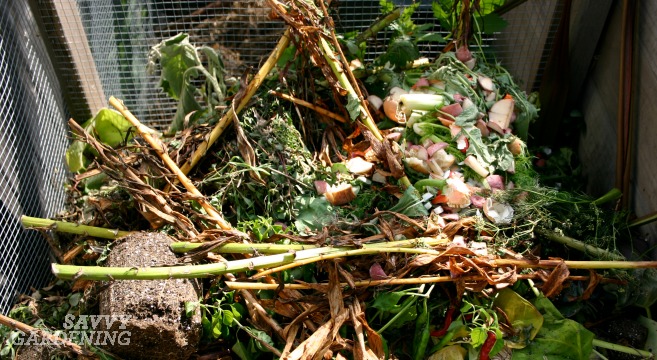
- Carbon suppliers are materials added to the compost pile in a non-living state. They’re usually brown in color and have low moisture content. Carbon suppliers are generally high in lignin and other slow-to-decompose plant components, so they take longer to fully break down. Carbon suppliers include fall leaves, straw, hay, shredded newspaper, small amounts of sawdust, chopped corn stalks and cobs, and shredded cardboard.
- Nitrogen suppliers are those ingredients used in a fresh state. Nitrogen suppliers are often green in color (except in the case of manures) and have high moisture content. Because they contain many sugars and starches, they’re quick to decompose. Good nitrogen suppliers include untreated grass clippings, plant trimmings, farm animal manures (but not dog or cat waste), kitchen scraps, coffee grounds, rinsed seaweed, and other plant material.

Properly made compost piles have the right ratio of ingredients.
The relative proportion of carbon suppliers to nitrogen suppliers is an incredibly important factor in determining both how well your compost pile breaks down and the quality of the finished compost. This ratio is called the C:N ratio, and it’s far more important than most gardeners realize. The target C:N ratio for a compost pile is 30:1 (meaning it contains thirty times more carbon than nitrogen). You can get this ideal ratio by building a compost pile that contains about two to three times more carbon-based brown ingredients than nitrogen-based green ingredients by volume (brown matter contains more carbon than green matter contains nitrogen, hence the seemingly odd ratio). So, for every five-gallon bucket of grass clippings you put in your pile or bin, you need to add two or three five-gallon buckets of straw or leaves to make the most of the science discussed in this compost how to guide. The ideal C:N ratio of 30:1 is not achieved by adding thirty times more brown matter than green matter since there is more carbon present in brown ingredients. It is achieved by adding two to three times more brown matter by volume.
Here’s why having the right C:N ratio in a compost pile is so important:
- The microbes love it. First and foremost, the microbes and other organisms that process whatever ingredients you add to your compost pile, use these carbon materials as a source of energy, and they need A LOT of it to work efficiently and quickly (more on these composting microbes in the next section). If the ideal C:N ratio is created, the days to finished compost are reduced because these organisms will be working at the fastest pace possible. In addition, piles with a C:N ratio of 30:1 reach up to 160 degrees F, while those with a C:N ratio of 60:1 will seldom get above 110 degrees F. Decomposition occurs faster at the ideal temperature of 160 degrees F, and perhaps most importantly, more pathogens and weed seeds are killed, an important item that should always be mentioned in a compost how to guide.
- There won’t be any nitrogen “borrowing”. If your compost pile doesn’t have the right C:N ratio, the finished compost will not have it either, and this can lead to some pretty unfavorable situations. For example, if finished compost with a C:N ratio much above 45:1 is spread on the garden, the microbes will actually “borrow” nitrogen from the soil as they continue to break down the organic matter in the compost. Microbes need nitrogen too, and if it isn’t in the compost, they’ll take it from the surrounding soil which may negatively affect plant growth. On the other hand, if the C:N ratio is too low (below 20:1) the microbes use all the available carbon in the compost and release the extra, unused nitrogen into the atmosphere, depleting the finished compost of this essential nutrient.

Whether you compost in a bin or a pile, microbes are hard at work breaking down the ingredients. - You’ll get quicker – and better – compost. Finished compost used on certified organic farms must have a measured C:N ratio between 25:1 and 40:1, but home gardeners don’t necessarily need their C:N ratio to fall exactly within this range. However, if your compost does, you’ll discover the pile finishes faster and the resulting compost is of exceptional quality.
- You won’t need to “water” your compost pile. The appropriate C:N ratio also prevents the need for additional supplies of water. However, if your compost pile ever appears dry, don’t hesitate to add extra water. Your pile should consistently feel like a wrung out sponge.
This compost how to guide cannot stress enough the importance of having three times more carbon suppliers than nitrogen suppliers in your compost pile. But, to get the best compost, it’s also important to understand and encourage the microbes who are doing all that work on your behalf.
Meet the composting microbes
Once the right ingredients have been used to create your compost pile, it’s the job of billions of microbes and other soil-dwelling organisms to break it down into compost. The organisms needed for this decomposition process are already present in most compost ingredients. However, throwing some finished compost into your pile as it’s being built may increase populations more quickly.
There are literally thousands of different decomposers at work in the typical compost pile, and they number in the tens of billions. They all do their part, and they do it year-round. Some species of bacteria continue to work even in freezing temperatures. Fortunately, in a properly constructed compost pile, these bacteria usually generate enough heat to support other species of bacteria that prefer warmer temperatures. The most rapidly decomposing bacteria work between 100 and 160 degrees F. At 160 degrees F these rapid decomposers are happiest and the decomposition process is at its fastest. These microbes require very little from you. In fact, they only ask for two things: food and oxygen.
Aerating your compost pile
The ingredients you add to your compost pile provide plenty of food for these microbes, but they also need oxygen. The decomposition of a compost pile is an aerobic process, meaning the microbes inhale oxygen and exhale carbon dioxide while decomposing. To maintain aerobic conditions, oxygen must be provided by turning or otherwise aerating the pile on a regular basis (ideally, at least once a week).
If the pile is not turned and no oxygen is present, your compost pile’s decomposition switches to fermentation. Different organisms are at work during fermentation, and they release both methane and ammonia, and as a result, your pile will stink. In addition, fermenting piles don’t generate enough heat to kill pathogens or weed seeds, creating more than one potential problem. Decomposition does not smell bad when adequate oxygen is present. A good, science-based compost how to guide will always tell you to turn your pile.

Good compost is hot… until it’s not
The process of decomposition naturally creates heat, so properly constructed compost piles are hot to the touch and should reach up to 160 degrees F. Sustaining this temperature for 10-15 days is enough to kill most human and plant pathogens, as well as most seeds. If you want to make sure your pile gets hot enough, invest in a good compost thermometer and check the temperature daily.
One sign that a compost pile is done “cooking” and the contents are ready to spread on the garden, is a drop in the pile’s temperature. Finished compost will not be hot.
The amount of time it takes for a compost pile to finish decomposing depends on several factors, including the particle size and C:N ratio of the ingredients, the moisture content of the pile, and how often the pile was aerated. You can get finished compost in as little as four weeks, if you pay attention to all of the factors discussed in this compost how to guide.
A word on pile-it-up-and-wait composting
Before you tell me that you’ve always gotten wonderful compost by simply dumping whatever ingredients you have in a pile somewhere, I should let you know that this pile-it-up-and-wait method is technically called “cold” or “slow” composting. Since all organic materials will eventually decompose, it’s a legitimate way to compost, and it’s part of many a compost how to guide. However, though the finished compost may be dark and crumbly, the C:N ratio is probably not ideal. And, extreme caution should be used when “cold” composting with animal manures as these piles don’t get hot enough to kill human pathogens, including E. coli, nor do they get hot enough to kill most plant pathogens and weed seeds.
If you don’t have enough room for an outdoor compost bin but still want to keep food scraps out of the landfill, check out our article on indoor, small-space Bokashi composting.
For more on making great soil, please visit the following articles:
- Feeding your soil: 12 creative ways to use autumn leaves
- How to build a worm bin
- Building a DIY compost bin
- Bokashi composting indoors
- Soil amendments for the garden
We’d love to hear about your composting process. Tell us about it in the comment section below.

My garden soil is so good after tilling but as the growing season continues my soil becomes hard as a rock van I put 4 year old grass clippings on it add manure and peat moss will this be enough to keep my soil from becoming rock hard
Over time, tilling destroys the soil’s natural structure. I recommend learning about no-till gardening techniques and using them if possible. I’ve been no-till in my vegetable garden for the past 12 years and love it.
Our local land fill makes a cold pile of lawn waste and has compost mulch for the asking. When the yard gets completely full they incinerate it. Is there a way to determine the composition of this compost? I don’t think they care about cn ratio or aeration much but after a year sitting in the yard it looks like decent compost. Thanks
The only way to confirm the C:N ratio of a finished pile is to have it tested at a lab. If you’re going to be using it on flower beds and the lawn, I wouldn’t worry about it too much. If you’re going to use it in a vegetable garden and can’t test the compost itself, make sure you test your garden’s soil every 3 to 4 years to check it pH and overall nutrient levels.
Does the C:N ratio need to be 30X or 3X ??
For example, do I use 1 gallon of N to 30 gallons of carbon, or use only 3 gallons?
In the article it said, “If you use a 5 gallon bucket of N. Then you need 3X as much Carbon.”
The target C:N ratio is 30:1 and you achieve that ratio by having 3 times as much brown/carbon-rich material in your pile. So 1 gallon of green materials should be balanced with 3 gallons of brown/carbon. If you use a 5 gallon bucket to measure green materials, then you’ll need three of those buckets (15 gallons) of brown materials to achieve your 30:1 ratio.
I’m confused by this also, but maybe I’m remembering faulty math? I thought that a 30:1 ratio meant 30 parts C: 1 part N. I would have thought a 3:1 C:N ratio would be what she was explaining in the article (3 parts carbon to one part nitrogen; i.e., 3 5-gallon buckets of carbon to every 1 5-gallon bucket of nitrogen).
I’m definitely willing to concede that I’m forgetting some essential step in ratio formula, but could you please clarify? In my mind, I’m thinking 30” of browns to ever 1” of greens in my bins. Is that completely incorrect then?
Hi Ali. It’s important to remember that the volume (parts) of any material is not a direct correlation to its carbon or nitrogen content. In other words, 1 cup of leaves doesn’t equal 1 measure of carbon. You’re thinking in terms of volume but what matters is the carbon or nitrogen content of the material itself, not its volume. A 3:1 ratio of brown to green ingredients results in a C:N ratio of 30:1 essentially because there is generally more carbon in brown materials than there is nitrogen in green materials.
My compost pile gets pretty hot , but in the winter it’s really a very big work box. Only the core of the like stats warm. The worms love it
Awesome lady
This is a great article! Thanks so much. So I have had a compost bin for 3 years now, i’m not too great when it comes to consistently putting items in, but this summer I have. What I have gathered is I have all carbon. Things are decaying, but slowly. Can the past 3 years be saved? I can go put leaves in, but is it too late? Should i just empty it and try again? Also – Do I need to have 2 bins so I don’t keep adding unbroken down stuff to stuff that is almost ready?
Having two bins definitely makes it easier to keep the “cooking” compost separate from the new stuff. I suggest mixing what you already have with some nitrogen-based ingredients to get a C:N ratio that’s closer to the target, even if it means you’re mixing partially decayed stuff with “fresh” stuff. Then, moving forward, try to do a better job keeping the ratio in mind. The good news is that eventually everything rots, so even if you don’t do it perfectly, that’s okay.
Thank you for an excellent article! My problem is that in the summer I have a lot of nitrogen rich material but very little carbon. I do have access to softwood scraps which I turn into biochar (charcoal) for use as a soil amendment. Would this work as a source of carbon in compost? Would it work to add the raw wood to the pile then sift them out and add to a new pile when I use the finished compost? The pieces are on average 2x3x5.
You could add small amounts of biochar to your pile, but don’t go overboard. I like to save autumn leaves in bags next to the pile and use those as an additive when I have an excess of green materials. A bale of straw or heap of shredded newspapers would serve the same purpose.
Thank you for the well-written explanation. One problem I’ve been having lately with my compost piles: Soldier Fly larvae. Once they take over a pile, it gets wet and stinky and no amount of turning the pile seems to dry it out and get it hot composting again. I just started a new pile using more “brown” material as you suggest and it seems to be working so far.
I used to live near a stable, and getting some hot compost from their compost pile was an idiot-proof way to jumpstart my own home compost pile.
If you add things like newspaper and cardboard what effect do the inks, dyes, glues, resins, etc contained in these items have on the compost?
Modern newsprint inks are soy or plant-based inks that break down easily. However, do not use glossy, colored newsprint as those inks and coatings may contain heavy metals. Most glues are easily digested by the microbes in the pile.
Hi I live in the caribbean and your article really helps as I have been composting for quite a few years now but it does not break down for about 3 months. I recently heard that adding milk and yogurt helps, can you tell me your thoughts? I think it would make it smell??
Yes, that would make the pile smell sour and rancid. I would definitely not recommend it. However, adding some more nitrogen-rich materials, such as grass clippings, and turning the pile weekly should help get it cooking.