
This post may contain affiliate links. If you make a purchase through links on our site, we may earn a commission.
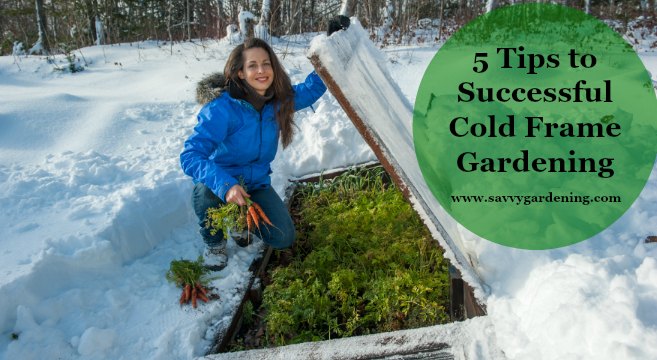
Cold frame gardening is an easy way to extend the homegrown harvest into late fall and winter. A cold frame is just a box with a clear top. It’s unheated, but captures solar energy and shelters crops from the elements – cold temperatures, frost, wind, ice, and snow. You don’t need a large garden to accommodate a cold frame. Even a small, urban garden will benefit from this simple structure and allow you to extend the growing season. In my books, The Year Round Vegetable Gardener and Growing Under Cover, I offer a lot of tips and ideas for gardening with cold frames. Here are a few of my favourites…
Cold frames are structures you can DIY or buy as a kit. The box of a cold frame is often made from wood, but even straw bales can be put to use to create a temporary frame. I use sheets of twin wall polycarbonate for the tops, or lids, of my frames, but you could use old windows. I attach the tops to the wooden frames using hinges and screws. When planting a cold frame for fall or winter harvesting, I like to focus on cool season crops like kale, spinach, radish, winter lettuces, scallions, arugula, chard, and mache.
5 tips to successful cold frame gardening:
1 – Pick the right site – To get the most out of your cold frame, you’ll need to pick the right spot. Look for a site that offers full sunlight and shelter from prevailing winds, and face the frame towards the south. You can place it against a house, deck, shed, garage, greenhouse, or allow it to stand free in the garden. My frames are free-standing structures but I do pile straw bales or bags of leaves on the north side for added winter insulation.
Related post: Mustard greens for winter harvesting
2 – Choose your materials wisely – The box of a cold frame can be made from many materials; wood, polycarbonate, straw bales, bricks, and so on. I’ve found that material selection can play a large role in successful cold frame gardening. For example, many gardener centres sell frames made with polycarbonate sides and tops. These are great in spring and fall, but in my region, they aren’t insulating enough to shelter salad greens throughout winter. Instead, I’ve gotten great results from cold frames built with wood and topped with polycarbonate.

3 – Ventilate – I can’t stress the importance of proper ventilation in a cold frame, especially in autumn or spring when the daytime temperature can fluctuate dramatically – even in cloudy weather! For me, I prop my cold frames open when I know the daytime temperature is going to reach 4 C (40 F). If you’d rather be more ‘hands off’, you can purchase an inexpensive automatic vent opener to open top of your frame when the temperature reaches a certain point.
Not ventilating your frames can result in several issues. The biggest one, of course, is frying your plants! But, inadequate ventilation can also lead to your fall and winter crops growing in conditions that are consistently too warm. This encourages soft growth which is easily damaged in cold weather. Crops that are given a bit of ‘tough love’ and grown with proper ventilation under cooler conditions will be better prepared to deal with the frigid temperatures of late fall and winter, and be less prone to cold damage.
Curious gardeners may find it fun to use a digital thermometer to monitor the minimum and maximum temperatures in their cold frame. It’s amazing how much the inside of a frame can warm up – even in January!
Related post: Cold frames for spring gardening

4 – Keep tops clear – My garden is surrounded by tall, deciduous trees and when the leaves begin to fall in mid-autumn, the tops of my frames are quickly covered. They’re easy to clear away, but if they were left on top of the cold frame sashes for too long, the crops may suffer for lack of light. Come winter, the same rule applies. Brush off or remove snow from frames regularly to prevent ice build up. I use a a sturdy push broom for this quick task.
5 – Foil Mother Nature – There are many easy ways to boost light and heat retention in cold frames. To reflect more light onto the plants, you can paint the inside walls of the structure white or line them with aluminum foil. To capture more heat, leave room for a few black painted one gallon water jugs. Once filled with water, they will absorb heat during the day and release it slowly during the night, raising the temperature inside the cold frame.You could also line the inside of a cold frame with styrofoam or another insulating material to provide extra insulation for winter.
For more on cold frame gardening, check out this brief video tutorial:

Do you have any tips on cold frame gardening to share?

Tips seem great. I am ordering your book and am going to try the cold frame this year. Maybe a 4 x 8 sized cold frame. Too big? I hate that the growing season is so short in the Northeast (especially for veggies that I like).
Thanks so much! A 4 by 8 is pretty big – the top is heavy and hard to prop up when the weather is nice. I prefer 3 by 6 foot. But if you want to build bigger, go ahead, but you’ll likely need two strong props to keep it open on mild days. Good luck! 🙂 Niki
I live in Central Michigan. Zone 5. Can I successfully follow your book to get the same results?
Great article! Just one question: What about watering??
Do you need to water the plants in the cold frame during the colder late-fall early-spring days? What about in the dead of winter? Or do the plants just get the moisture they need from the soil somehow? (I’m in SW Ontario with lake-effect snow, btw.)
Great question!! And no, I don’t water in winter… my last watering is usually late November and then again in early March… although with climate change this has been shifting a bit. – Niki
Really nice article. Just one question. Where can I find a cold frame for the greenhouse as the link you mentioned is no longer available. Or can you share the guide on how you made wood and polycarbonate?
Thanks for asking! The plans are in my book, The Year-Round Vegetable Gardener. 🙂 – Niki
How do you deal with small rodents tunneling under the cold frame and eating the vegetables?
I know some people use hardware cloth (similar to chicken wire, but with a finer weave) stapled underneath their raised beds to keep rodents out. Not sure if anyone has had success doing this with cold frames…
try looking for blood meal at your local garden centre, the smell repels small rodents
Same question… in the ground or above the ground?
Hey Aaron – geeze, I had answered Rob’s question months ago.. don’t know where that went! However, the answer is that my frames are sunk down in the ground. The back of the frame was built to 18 inches tall, the front to 12 inches. They were sunk about 6 inches down for added protection from the elements. Hope that helps! Niki
Hello,
My wife and I are having a debate: She says your frames are down in the ground, the edge level with the ground. I say they are above and you are standing on snow pack. Which is it?
I was wondering how far north you are. Winter days can regularly hover around -15 to -20 Celcius (with nights gooing down to -30 or -40) and I’m wondering how cold it can get before a cold frame simply isn’t enough.
Hi, great question! I’m on the east coast and it does get cold here in the winter, typically down to -20C, sometimes colder. See if your local library has a copy of my book, The Year Round Vegetable Gardener, it details how I use season extenders like cold frames. You are in a colder area than me, so you will have a smaller variety of veggies to pick from for winter harvesting. Likely, you will only be limited to the super cold tolerant in winter – mache, claytonia, scallions, kale, tatsoi, etc. But, even if you find it too cold to still harvest in mid-winter, you can still extend your harvest by months in late autumn and push back spring with a cold frame. Hope that helps! Niki
Thanks for your useful tips. Plan to have a cold frame gardening this cold season. I will share those with my husband and kids. Can’t imagine how funny & interesting it will be.
Wonderful tips. A cold frame is on my wish list (together with a greenhouse!) – perhaps next year.