
This post may contain affiliate links. If you make a purchase through links on our site, we may earn a commission.
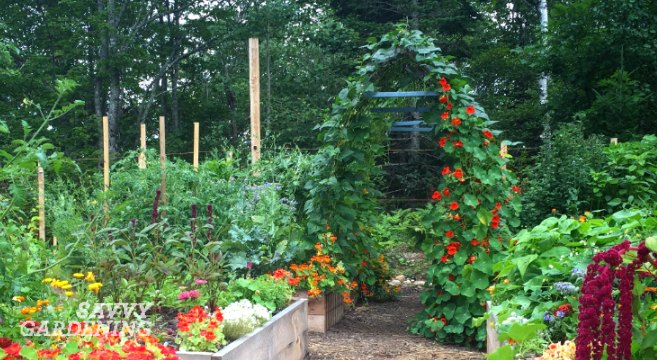
When I redesigned my vegetable garden this past spring, I knew I wanted two things; raised beds and plenty of vertical structures, including bean tunnels. Vertical vegetable gardening allows a very efficient use of space, helps prevent insect and disease problems, and adds beauty to the garden. Plus, easy-to-build structures, like bean tunnels, are so much fun!
There were, however, a few speed bumps along the way. The biggest issue was sourcing my chosen material. I could have gone with pre-made garden arches, but I was looking for something more rustic. My initial plan was to form the tunnels from 16 foot long by 4 foot wide cattle panels, which could be bent over the spaces between my raised beds to make an arch. They provide a strong support for climbing vegetables like beans and cucumbers, but they are also much cheaper than more elaborate trellises and arbors… or so I thought.

Vertical vegetable gardening; building the bean tunnels:
Once I was ready to erect the tunnels, I called around a dozen farm, building, and garden supply stores around my province, but only found one that offered the panels at a cost of $140.00 each. They also didn’t deliver and I would have to factor in the cost of a truck rental to pick them up. With four tunnels in mind, that would cost me $560.00, plus tax and transportation. Not so cheap after all.
Related post: Pole vs runner beans
With that idea scrapped, I began to look at other materials that could be upcycled for vertical vegetable gardening. In the end, it came down to the 8 foot long by 4 foot wide concrete reinforced mesh panels that I have used as trellises for years. Bonus – they cost a mere $8.00 each! I used two panels per tunnel, joined at the top with zip ties. To ensure they would be sturdy, the bottom of each panel was secured to the raised bed with a strip of wood. (see pic below).

Initially, the two pieces of mesh bowed in – not such a pretty, or sturdy structure. Knowing that this would affect their ability to support vertical crops, we installed wooden spreaders. The wood strips turned each tunnel into a gothic arch shape, which I love! They were then painted a gray-blue colour to help them blend into the foliage (the stark unpainted wood was distracting) and I quickly jotted the phrase, ‘Muster Point’ on the first piece of wood. It’s a phrase often used by the Canadian military to signify a meeting place. What better place to meet than in the garden?
Related post: Growing cucumbers vertically

The fun part – planting the beans:
Now that the tunnels were ready for beans, it was time to get planting! I picked a handful of bean varieties; Gold Marie, Emerite, Blauhilde, Fortex, French Gold, and Purple Podded Pole. I also made another tunnel for cucumbers which is now smothered with the dense vines and dangling fruits of varieties like Lemon, Suyo Long, and Sikkim.
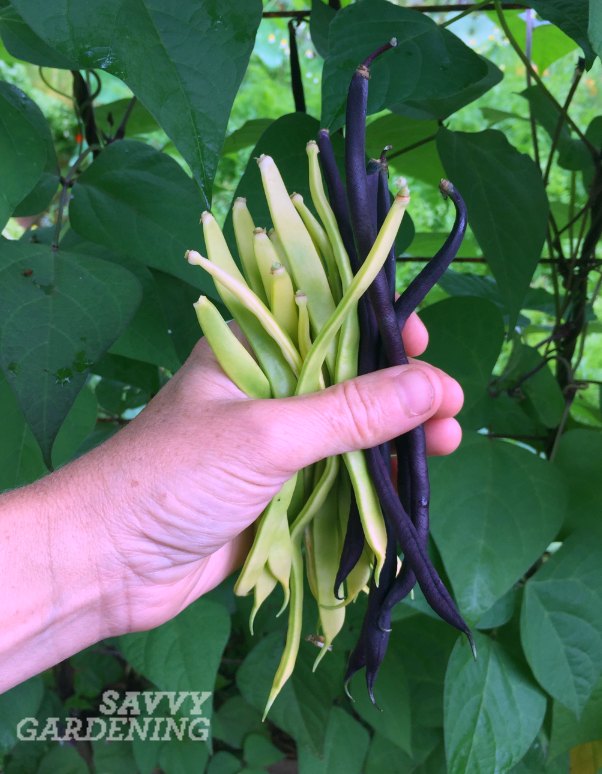
The bean tunnels have become my favourite shady place to sit and read. Usually when I’m in the garden, I’m working, watering, or puttering. Sitting under the tunnels has given me a new perspective on the garden and gives me a chance to really observe and appreciate the many creatures that visit the space; pollinators, hummingbirds, butterflies and more.
Do you practice any vertical vegetable gardening?


Retired to my home town in central Texas where we bought a 1947 house on a .5 acre plot. While the house is getting the necessary upgrades & remodels for 2023 life, I’m tackling the yard that has been severely neglected for 20 plus years. Getting rid of 3 different kinds of bamboo and removed the china berry trees (totally toxic, that even the bird won’t eat the red berries in the fall)! Removed 16 white oak trees, but still have over a dozen for strategic shade.
Since I’m starting from scratch & had very successful raised beds at our New Mexico home, garden plots will all be raised beds with all sorts of annual & perennial flowers strewn about to draw in the pollinators.
Since we have a local Tractor Supply Company, I will be utilizing this cattle panel idea for a variety of shade tunnels. The mid-summer heat in Texas is brutal & my side yard gets sun ALL day. Will create these tunnels to provide shade between the 11A-3P time frame. I will also be building some portable PVC-parachute frames (easy break down for winter storage) for the beds that won’t be close to the tunnels.
I LOVE the look of this. I’d also love a you tube video or more detailed step by step pics so the process explained to me like I’m a toddler. 😂 (more for the bottom/attaching to the beds)
my pole beans produced a lot the first 2weeks of June, here in north east Texas, I still have a lot of blooms but no beans for the last week. It has been in the upper 90’s, I do water every morning. Will they start to produce again or is my season over and can I replant?
With rising temperatures this is going to become a more problem issue, but in high temperatures – even with consistent moisture – bean plants don’t set pods well. so unfortunately, your plants may not continue to crop. If you expect temperatures to decline soon you can leave them and they’ll probably start to set pods again. If you’re in for a long, hot summer, it’s going to be best to pull them, replace them with a heat-tolerant veggie and then replant when temps are more in the 60-80F range.
Hello, I am in Scotland and we are building our first raised beds this week! The tunnel looks a fantastic way to optimise space and add vertical interest. As a permanent structure how does this work with crop rotation or do beans grow happily in the same place each year? Best wishes from Scotland (where we don’t have humming birds!!!) PS do you need a step to harvest the top beans, it looks very high!
Gosh Carol, I wish I gardened in Scotland 🙂 I’m hoping to get to your region this fall or next spring for a visit. But congrats on your new raised beds! And that is a great question. I find my beans are less afflicted by disease than other types of crops (like tomatoes and cucumbers) so I do often plant them in the same location a couple of years in a row. I give them a break every 3rd year by planting climbing squash, cucumbers, cucamelons, gourds, or other climbing crops at the base of the tunnels. I have 4 tunnels and a lot of vertical trellises so that still allows me plenty of space for pole beans. And you’re spot on – it can be tricky to grab those top beans. I grab someone taller than me or a sturdy step stool. Best of luck! – Niki
How did you attach the wire to the wood you used for support?! Love this idea and really want to try it 💖
Hi there,
Did you plant beans either side of the arch or just on one side?!
Hi, both sides. 🙂 – Niki
Hi Niki, just picked up the 8×4 mesh panels from Kent and was surprised that they were already rusted. The staff didn’t think there was a galvanized type. Did yours rust?
Hi Meghan… yes, I’ve bought new panels and rusted panels.. but the new ones rust rather quickly. I like the look it gives and they tend to blend into the garden better when rusted. I have some that are 15 years old and going strong, so they should still last a long time. 🙂 – Niki
Question about your rebar cucumber teepee. Do the cukes just climb up the rebar alone or do you wrap the rebar with rope or wire in the open spaces also for them to climb on? TIA 🙂
Hey Cheryl… This trellis didn’t have rope/string, just the rebar lengths. 2 plants per post. If you made a very wide trellis, I’d wrap with strong twine, but this was a pretty compact one in a home garden. Just be sure you have vining varieties and not bush cucumbers. They don’t climb so well 🙂 – Niki
I’m just reading this post. How many beans would I plant per trellis? Do I do several varieties in one area? Thank you for any insight.
Have you ever tried using hog wire to make your tunnels an arbours?
Hi Nancy… I have wanted to, but been unable to find it reasonably priced in my area. I’m always on the lookout for it though 🙂
Niki