
This post may contain affiliate links. If you make a purchase through links on our site, we may earn a commission.
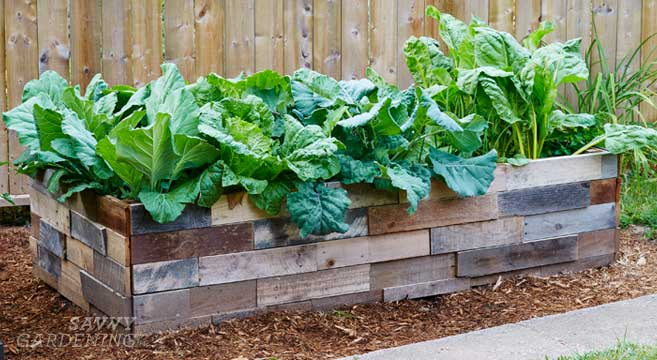
Are you planning to build and/or install a raised bed? I like to emphasize that raised beds can go anywhere that gets six to eight hours of sunlight a day. And they can be any size you like. However, for the purpose of this article, I’m going to talk about the standard rectangular raised beds that are generally built from untreated, rot-resistant wood (like Niki’s amazing raised bed setup) or concrete blocks, as well as what you might want to think about when preparing a raised bed garden.
When I made my first raised beds, these are a few tips I gathered, as well as things I wish I had thought about beforehand.
Things to think about when preparing a raised bed garden
1. What size will it be?
Raised beds are generally three to four feet wide by about six to eight feet long. This allows you to easily reach into the raised bed from the side to plant and dig and weed, without having to step into the garden where you risk compacting the soil.
The height can also be important. If you are putting your raised bed on a hard surface, like a driveway, or over hard-packed soil, you want to make sure it’s deep enough for plants (especially root vegetables like beets and carrots) to root. If it’s too shallow those roots will reach down into that subsoil (or hard surface) and hit a brick wall. I usually recommend at least 10 to 12 inches.
2. How do you pick the perfect spot?
When preparing a raised bed garden, location is everything, but it doesn’t have to be your backyard. Your raised bed could go in a sunny side yard, your front yard, or even your driveway.
You’ll want to make modifications if you have a slope and assess whether the area drains well. Here are some tips for planning where to put your raised bed.
3. How will you get rid of grass?
Good question because this is a common concern. If you’ve ever tried to cut out and lift sod, you know what an enormous task it is. An easier way to get rid of grass is to outline the space and cover it with a layer of cardboard and cover that with a layer of soil. The grass will break down and voilà! A new garden site. Doing this in the fall will allow everything to break down over the winter.
4. Do you want to install irrigation?
If you want to set up a whole drip irrigation system with a line running from your tap or rain barrel, you might want to do this before your raised bed areas are finished and filled. That way you can run hoses under pathways or layers of mulch, and adapt the bed around where the hose attaches to the irrigation system.
5. How much soil will you need and what kind?
There are some handy soil calculators out there that will help you determine how much you need to fill your raised bed, like this one from Gardener’s Supply Company.
As far as type of soil, I like to emphasize buying the best quality that you can afford when preparing a raised bed garden. When I had multiple raised beds to fill, I ordered triple mix from a local supplier (after chatting with them on the phone about my options) and top-dressed it with organic vegetable compost. I like to recommend leaving some in reserve to replenish your raised beds throughout the season. Please visit this link if you want more details on the best soil for raised beds.
6. Should you stake the sides?
One thing I wish that I had done when I built my first two raised beds is install a couple of midpoint stakes to prevent the beds from shifting over time. This is one of my number one raised bed tips!
Not sure how many vegetables you can grow in each one of your beds? Here are several illustrated 4×8 raised bed layout plans you can use to determine the placement and spacing of your veggie plants.
For more information on gardening in raised beds, check out the following articles:
- Elevated raised bed gardening: The easiest way to grow
- Fabric raised beds: An easy, inexpensive way to get started
- The benefits of raised bed gardens
- 5 tips for growing tomatoes in raised beds
- How to start a vegetable garden FAST
Do you garden in raised beds? Share your experience in the comment section below.
photography by Donna Griffith for Raised Bed Revolution
Pin it!


I have built 5 each, reinforced 10′ x 2′ x 30″ high raised beds. I will put them in the back yard which is fairly level. I was planning on placing them on 6″ of leveled rocks and gravel for drainage with mesh wire underneath and 2 ft past boxes to prevent rodents. Are rocks necessary? I also plan to fill half the boxes with regular dirt from the fields and remainder with a good organic dirt. Are there any other tips you can give me?
Hi Barbara, Do you mean other rocks besides the ones mentioned for drainage? That’s a good tip for the soil. we have other raised bed articles on the site where you may find some other tips! https://savvygardening.com/tag/raised-bed-gardening/
Hi there,
I am building a U shaped raised border on top of a concrete yard. If I do it 2 feet tall and fill with soil what should I do about drainage of excess water during heavy rain? Do I put in a fairly thick layer of shingle under the soil, and any holes in the wooden frame at the base? Or is this not a problem?
Many thanks Nick – Devon
If it’s on concrete, water should flow out the bottom, no problem, as it won’t be airtight. However, if you find drainage is an issue, you can drill holes up diagonally into the wood near the base, so that water flows out.
Hi what size bed recommended fo a fruit tree
I’m not sure I’d recommend planting a fruit tree in a raised bed as the tree will last longer than the wood, and you want the roots to be able to reach into the subsoil.
Hi Tara, we built just built our first raised planter box with legs (2′ x 4′ x 1.5′) out of cedar. We have horizontal cedar slats at the bottom with adequate gaps for drainage, and we’ve put pea gravel on top of that held up by chicken wire. We’re just about to fill the soil but we were wondering if it would help to put plastic liner along the inside walls?
We’ve read conflicting accounts of it helping prolong the life of the planter box, but other people say that it traps water between the plastic and the wood and that speeds up wood rot?
Thanks! Really great article.
Hi Cass and Amrith,
I know people use plastic liner if they’re worried about anything leaching into the soil from the construction materials. I agree that the plastic could trap water. But honestly, either way, your box is eventually going to succumb to the elements.
Hi. I started an indoor jiffy garden with my 11 yr old daughter last weekend and we are first time gardeners. It contains 4 each of green beans, okra, bell peppers and squash. The green beans are about a foot tall so I think it’s time to move them outside but not sure what to put them in. I thought about a deck planter but my husband doesn’t want water draining from it to ruin the new deck. My other option is a raised garden but I’m not sure if it needs to sit on the ground and if it should have a bottom or no bottom. Could you please provide some guidance on how we can make this transition easy?
Hi Isanita, A raised garden would be a great option, but you could also plant beans in an in-ground garden, too. A standard raised bed is generally just a frame with sides, but no bottom. My neighbour plants his green beans in those 1/2 whisky barrels you can get at garden centres and big box stores, and makes supports from bamboo stakes. If you have a perennial garden by a fence, you could sneak beans in there an use a support against the fence to keep them upright. Do make sure to Harden off the green beans before planting them outside. Best of luck!
Hi!
I have been reading your blog the last couple of months and a few others as I am getting into gardening with our new backyard. The only problem is I didn’t really read up on the OS of wood and assumed I should get pressure treated wood so it withstands the harsh winters. I am now finding out that it could be bad for the vegetables? What do you know about this and what would you recommend? They’re already built and filled and was about to plant my seedlings this weekend and now I’m at a little bit of a loss.
Thanks 🙂
Hi Yasmin, There is at least one brand of pressure treated wood where the process used to make it is supposed to be more food safe. You could find out what type you got. There is the option of pulling back the soil one side at a time and covering the wood with plastic. I found this article on Fine Gardening that discusses using pressure treated wood in food gardens. https://www.finegardening.com/article/are-pressure-treated-woods-safe-in-garden-beds
Received a raised garden for Mother’s Day 4×10 36 inches off the ground, made of cedar – has a wood bottom ( which is cedar). This is all new to me – need to know how to prepare this box – some say plastic with holes for drainage others say mulch with garden fabric. Just want to make the best decision so that this bed last a long time.
Hi Paulette, some people will line their raised beds with plastic to protect the wood. If you do that, be sure not to use it at the bottom as it won’t allow for drainage. I think a bottom layer of mulch is a good idea to fill it, but keep in mind it’s wet wood against the cedar as the water drains and the bed dries out.
Hi. I took a class on square foot gardening, and was taught that landscape fabric was never meant for use with raised garden beds. A couple of issues with the landscape fabric was that 1) It discourages garden-friendly earthworms 2) It prevents biodegradation of natural organic mulch. 3) Weed seeds can still be blown in to the soil, and the roots can adhere quite strongly to the fabric, which in turn would be difficult to pull out without ripping the fabric as well.
Considering these issues, is it still worth it to use landscape fabric? I had not known that landscape fabric was not recommended for use with raised garden beds until I had taken that class. Before then, any and all resources I found online recommended using the fabric.
I’m torn on whether to use it or not. Is this just a matter of preference?
Hello, I put landscape fabric under one of my raised beds to smother the weeds, and though permeable, I have found that the raised bed is slower to drain after a heavy rain. I used to recommend it, but now I think that it may be better to just lay cardboard overtop of the site as it will break down over time.