
This post may contain affiliate links. If you make a purchase through links on our site, we may earn a commission.
Angel trumpets are prone to stopping people in their tracks. I grow one in a big patio pot, and more visitors to my garden ask about it than anything else I grow. The big, trumpet-like blooms of this plant are show-stoppers, and their fragrance… well, let’s just say it makes an evening on the patio about as sensational as you can get. But, purchasing a large angel trumpet plant can be pricey. If you want to save some dough and stretch your green thumb, try growing angel trumpet from seed. You may be surprised at how easy it is.

What is an angel trumpet plant?
Angel trumpet is the common name for two distinct, but closely related, species of plants: Brugmansia and Datura. Both are members of a plant family known as the nightshade family (Solanaceae.) These two beautiful flowering plants share the same plant family as familiar edibles such as tomatoes, potatoes, eggplants, tomatillos, and peppers. But, the Solanaceae family is also home to many poisonous and toxic plants, including nightshade, tobacco, and mandrake. Unfortunately, all plant parts of both species of angel

trumpet are toxic, too, but neither of these species produce fruits that look even remotely edible and many gardeners enjoy growing them despite their poisonous nature. Still, heed fair warning about the toxicity of angel trumpets and never ever ingest any part of the plant, lest you want to take a very dramatic trip to the hospital (or worse!). You may even want to wear gloves when working with angel trumpet plants, just to avoid as much exposure as possible.
Toxicity aside, both types of angel trumpets are among my most favorite tropical plants, and I really enjoy growing angel trumpet from seed. It’s very rewarding to see a plant that grows from a tiny seed into a tall and dramatic plant in just a few months.
The difference between Brugmansia and Datura
While both species of angel trumpet have large, trumpet-shaped flowers, there are several easy-to-spy differences between the two. Here are some defining traits of each species:

Brugmansia
• Can grow 10 or more feet tall
• Produces large, pendulous flowers that face downward
• Has seed pods that are elongated and smooth
• Typically does not self-sow
Datura
• Grows 3-4 feet tall
• Has flowers that face upwards, toward the sun
• Produces seed pods that are round and covered with spines
• Self-sows easily and can even become weedy

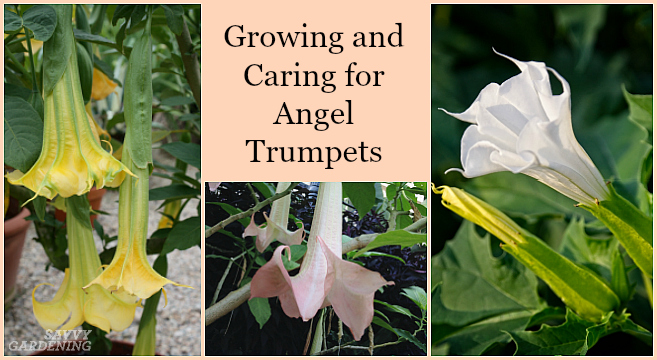
There are many gorgeous cultivars of both Brugmansia and Datura that produce a wide range of flower colors. Brugmansia blooms can be yellow, apricot, white, orange, lavender, or pink. Some of my favorite cultivars include ‘Day Dreams’, ‘Pink‘, and ‘Jean Pasko‘. The blooms of Datura are most typically white, but there are cultivars that produce lavender and purple flowers, too. As an added bonus, cultivars exist in both groups that bear double flowers. Among my favorite double Brugmansias are the double pinks.
Growing angel trumpet from seed
When growing angel trumpet from seed, it’s important to start with a reliable seed source. Seeds of both Brugmansia and Datura remain viable for many years, as long as they’re stored properly. Aside from the seeds themselves, when growing angel trumpet from seed you’ll also need a bag of high-quality seed-starting potting soil, some 3″ plastic pots, a tabletop set up of grow lights (or fluorescent shop lights), an inexpensive heat mat like this one, and a piece of clear plastic large enough to cover all the pots.
Here’s the step-by-step plan I use when growing angel trumpet from seed:
Step 1: Presoak the seeds. Brugmansia seeds have a thick, pithy seed coat around them that can make germination a bit difficult. Datura seeds do not have the same seed coat, but soaking the seeds prior to planting does improve the speed of germination for both species. Soak the seeds in a cup of slightly warm water for 24 hours prior to planting. After soaking, if you want, you can peel the pithy seed coat from Brugmansia seeds, but this isn’t necessary.

Step 2: Plant the seeds. The most critical step in growing angel trumpet from seed is to plant the seeds correctly. Angel trumpet seeds require light to germinate. If you bury them too deeply, your germination rates will be greatly reduced. After filling the pots with potting soil, simply press the pre-soaked angel trumpet seeds firmly against the soil, but don’t cover them. Water the pots immediately after planting and then cover them with a piece of clear plastic to keep the humidity high around the seeds.
Step 3: Give them heat. Angel trumpets are tropical plants, native to South and Central America. Warm soil temperatures improve germination rates and speed. I use a seedling heat mat to warm the soil 10-20 degrees above room temperature, just enough heat to make growing angel trumpet from seed a successful endeavor. Leave the heat mat under the seed pots until the seedlings germinate, then remove it. It will take 3 to 4 weeks for angel trumpet seeds to germinate, so don’t lose patience!
Step 4: Turn on the lights. Because both types of angel trumpet seeds need light to germinate, put the pots under grow lights or fluorescent shop lights immediately after sowing. Position the lights so they’re just 2-3 inches above the plant tops, raising them as the plants grow. Leave the lights on for 18-20 hours per day (use a timer like this one, if you want to automate the lights). It is possible to grow angel trumpet seeds in a sunny windowsill, but the seedlings are often leggy and pale. I highly recommend using lights, if at all possible.

Step 5: Water as necessary. One of the most important aspects of growing angel trumpets from seed is to make sure the seeds don’t dry out prior to germination. Because they aren’t buried in the potting soil, newly planted Brugmansia and Datura seeds can become desiccated before they even germinate. Make sure the pots stay well-watered, but don’t allow them to become water-logged either or the seeds could rot. Once the seeds have sprouted, remove the piece of plastic and the heat mat, and continue to water as necessary.
Step 6: Fertilize every two weeks. As your angel trumpet seedlings grow, fertilize them every other week with a half-strength solution of a liquid organic fertilizer. Don’t over-fertilize when growing angel trumpet from seed or you could burn the tips of the plant’s leaves.
Step 7: Harden plants off before moving them outdoors. Both types of angel trumpets are extremely sensitive to frost. Do not move them outdoors until the danger of frost as passed. The biggest disappointment when growing angel trumpets from seed is moving them outdoors too quickly and watching them wither and die (ask me, I know; it’s a very sad thing to experience!). To harden off angel trumpet plants, as soon as the danger of frost is gone, move the pots outdoors for a few hours every day and put them in a shady spot. Over the course of 10-14 days, gradually increase the amount of sunlight they receive and the amount of time they spend outdoors until they’re out in full exposure both day and night. Only then are your angel trumpet plants ready to stay outdoors for the season.

What to do with angel trumpet plants at the end of the growing season
How to overwinter Brugmansia:
If you grow Brugmansia and live where frosts occur, at the end of the gardening season, you’ll have to move your plant into a sheltered spot for the winter. I move my potted Brugmansia plant into my garage, usually in September, when frost is looming on the horizon. My garage is not heated, but it stays just above freezing all winter long. The plant drops all of its leaves when it’s moved into the garage, and shifts into dormancy automatically. Don’t worry when this happens; the plant will not mind this rest period. Simply water your Brugmansia once or twice throughout the entire winter and let it “sleep” until spring’s arrival when you can gradually move it back outdoors and increase irrigation.
You can also overwinter Brugmansia plants in your house, but make sure it’s in a cool-ish room with lots of light. When overwintering plants this way, they will not shift into dormancy and will continue to grow (and maybe flower) all winter long. Be careful with pets, however, as this plant is highly toxic to them, too.
If your angel trumpet was planted in the garden instead of in a pot, dig it up, plant it in a pot, and move the potted plant into a garage or cold cellar for the winter. Come spring, you can always plant your Brugmansia back out into the garden.

How to overwinter Datura:
For Datura, there’s no need to overwinter the plant at all. As long as the seed pods cracked open and dropped seed at the end of the growing season, you’ll automatically have new plants pop up in your garden when spring arrives. In fact, Datura self-sows quite prolifically, so you may want to trim off all but one or two of the seed pods before they mature, just to make sure the plant doesn’t become weedy.
Growing angel trumpet means you’re helping nighttime pollinators, too
Angel trumpet and pollinators
One final word about angel trumpets and their value to wildlife. Unless you’re a night owl or a vampire, you won’t always be privy to the pollinators that feast on the nectar from both types of angel trumpets. The fragrance of both Brugmansia and Datura isn’t emitted until evening’s arrival, when it beckons in a very specific group of pollinators: moths. If you’re willing to sit in your garden after the sun sets and let your eyes adjust to the darkness, you’ll find some pretty fabulous moths sipping nectar from your angel trumpet blooms. It will be a sight not easily forgotten. You should be aware, though, that double-flowered versions of Brugmansia and Datura tend to be less welcoming to pollinators as the insects may have difficulty accessing the nectaries through all those layers of flower petals. Plant single-flowered versions for maximum pollinator power.
For more great flowers to grow from seed, please visit these articles:
- Planting sweet alyssum seeds
- Growing calendula from seed
- Sowing pansies
- The easiest flowers to grow from seed
- When to plant sunflower seeds
As you can see, growing angel trumpet plants is exciting and rewarding. Do you already grow this plant? Tell us about your experience in the comment section below.

I have a pink Datura that popped up unexpectedly on a landscaped mound and it’s beautiful. But it’s kind of out of place there and I don’t want the offspring to take over the mound next year. Can I remove the pods at the point of maturity, store them and spread the seeds elsewhere in the Spring? Or should I prepare a location now and spread the seeds when ripe to over-winter?
You can absolutely remove the pods and save the seeds for next year. I think both techniques would work, but why not hedge your beds and sow some seeds this fall and a few more next spring and see which does better?
How do you know when datura seed pods are fully ripened and ready to be removed?
They will crack open slightly at the tip. That’s the perfect time to harvest. Just make sure the pods don’t fully open and drop their seeds onto the ground.
I am growing angels trumpet. Mine are pink and cream colored. The pink is around 20ft tall. When it blooms what a show. I love this site. Very very informative….
I received a datura yesterday as a birthday gift. It has 2 seed pods on it. Do I need to remove them in order to coax it back into bloom, or will it continue to set flowers even with the seed pods on the plant?
Removing the seed pods will encourage the plant to produce more blooms faster. If you want to save the seeds, though, you’ll have to let the seed pod fully ripen while still attached to the plant.
Hi I’m in south Florida and I started a purple angel trumpet from seed. I have three small sprouts about 2-3 inches tall and they have been that size for about a month. They look sturdy and healthy but they aren’t growing. What should I be doing?
I would move them to full sun and pot them up into a larger container. Fertilize with fish emulsion every three weeks. They’ll get growing soon!
I have a plant that just came up in one of my potted plants. I think maybe a bird dropped a seed. It’s a beautiful flower looks like maybe a Ballerina datura, not sure. Would like to post a picture.
I have been growing an angel trumpet for 4yrs in a pot, it has an off shoot that is now taller than the original but neither has no flowers. How long does I take for them to star flowering.
They should bloom within a year or two of planting. I suggest starting a fertilization program in the spring and repotting the plant with some fresh potting soil.
Some flowering vines – morning glories for example – will produce vines and leaves but no flowers if you fertilize them. Happened to me until I read what I was doing wrong. For what it’s worth.
can someone clarify how many seeds of Brugmansia should be planted in the 4 inch pot? thanks
Fred
Plant 2 to 3 seeds per pot. Then, thin the seedlings down so you’re just left with the strongest one.
Have you ever heard of scoring the seeds with an Emory board instead of soaking them? I read about it and decided to try it, not sure how it will work out but I am hoping for the best. I will let you know if I get seedlings or not. Keep planting smiles
Scoring the seeds with a metal file is known as scarification and yes, it will work to improve germination. Plus, it’s fun!
I just got my Brugmansias Datura seeds I don’t know if it is just 1 plant or 2 different ones seeds are different.
If the seeds look difference, it may be two different varieties.