
This post may contain affiliate links. If you make a purchase through links on our site, we may earn a commission.
Confession – I have a goutweed problem. Like many gardeners, I wrestle annually with this invasive perennial, but I don’t think I’m winning. In fact, I probably didn’t take it quite as seriously as I should have when I first noticed it growing in a corner of the garden about four years ago. It took mere weeks for that tiny patch to double in size and it’s now conquered three areas of my yard. After watching its steady progression in my garden, I realized last summer, that I needed to get serious about getting rid of it.
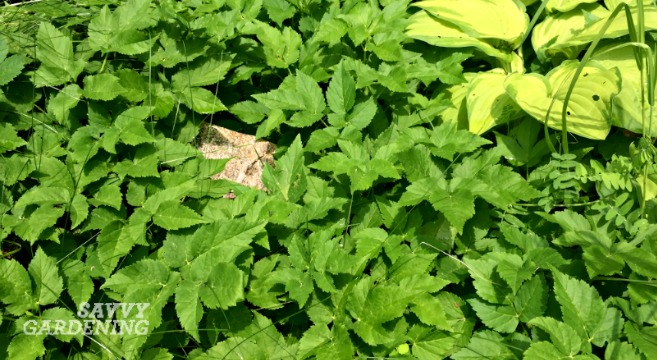
Goutweed was originally introduced to North America as an easy care groundcover, thriving in shade, partial shade, and full sun. It will also grow in a range of soils, but spreads quickest in cultivated garden soil. In terms of survival skills, goutweed is the cockroach of the botanical world. It produces a web of underground rhizomes from which each leafstalk emerges. The leaves are comprised of three groups of three leaflets and can be green or variegated.

Green goutweed, the type that I (unfortunately) have is a beast to eradicate, yet is not considered a noxious weed in Canada. Certain states, like Massachusetts and Vermont, have added it to their ‘Prohibited Plant List’ and it can no longer sold or traded. Incredibly, there are still garden centres in my province that sell goutweed as a groundcover! The variegated type, often called Bishop’s Weed or Bishop’s Curse, is slightly less thuggish, but if allowed to go to seed, it can produce all-green, super-aggressive seedlings.
Related Posts: Smack Talking Weeds
Three ways to deal with invasive weeds like goutweed:
- Cook ’em – Solarizing invasive weeds is among the most effective of the organic methods, but it requires time, heat, and the ability to put up with an ugly piece of plastic in your garden for several months. Begin by finding a sheet of black or clear plastic that is large enough to cover the patch, plus a few extra feet in every direction. Water the area well and cover with the plastic, burying the edges to lock in the heat and moisture. You can also use bricks to weigh down the plastic if burying isn’t possible. Under the plastic, the temperature can rise to 130 F (55 C), killing weed seeds, pests, disease pathogens, and hopefully, goutweed. Remove the plastic after 6 to 8 weeks and wait several weeks to see if the goutweed rhizomes survived and will re-sprout. If there are no signs of goutweed after a month, you might, just might mind you, be in the clear.
- Smother ’em – This is the first goutweed-busting method that I decided to try, with varying success. Begin by mowing or weed-whacking your goutweed into submission, cutting it as short as possible. Cover the area with cardboard, again being careful to expand several feet past the goutweed, and top with a thick layer of mulch – bark nuggets, shredded leaves, etc. Wait. Smothering can take a long time – up to two years. If using an organic mulch like shredded leaves, you can add some soil and plant directly in the materials after a year or two, but only IF NO GOUTWEED HAS EMERGED.
- Spray ’em – Now before you get your knickers in a twist, I’m talking about natural sprays made with citrus oil or vinegar, 20% horticultural vinegar to be exact. I have had modest success with this industrial strength vinegar, but it also takes time, perseverance and hot, dry weather. I’ve got the time and the perseverance, but the hot, dry weather can be tricky in Nova Scotia. Last summer I sprayed one of my goutweed patches with vinegar three times – mid-July, early August, and late August. The first dose did nothing. The second dose curled and browned the leaves within days of spraying. The third dose knocked it down, and up until a few days ago, I thought it was gone… but then I noticed the sprout in the above photo. That said, this was a dense 5 by 20 foot forest of goutweed last summer and I’m down to one sprout. I think it’s time to pick up more vinegar and tackle those other two patches.
Bonus advice – Move. This is the only known method for 100% elimination of goutweed.
Do you have goutweed? What have you found effective for controlling this obnoxious weed?

I need help. It’s been 4 seasons, 4 seasons! And all I can grow iny veggie garden are tomatoes as the goutweed I have dug out every year just keeps coming back more matted In my veggie garden. After weeding for 6 hours yesterday and another 5 hours today I may be 1/3 of the way through my garden pulling out goutweed and all its little tendrils, and I’m not getting it all! There are so many tiny little roots, are those the rhizomes that everyone talks about? cuz if so I think I’m going to losing…again:( . It makes me so sad. I love gardening as nature therapy and this feels kind of like the opposite. This evening we pulled out to goutweed roots that were as thick as your thumb and middle finger making a circle. Can you believe that?! One was maybe 4 ft long and the other a little shorter. So in regards to the help I need – I have a little bit of a curveball that we live in a termite zone and can’t use cardboard or most mulches. I have considered moving 🙁 I also really really want to Garden and grow veggies but I’ve been so unsuccessful because the gout weed loves the newly turned soil. In regards to native plants that compete with invasive plants is that a wise idea? Or what about are there any perennials, hopefully food bearing like strawberries or blueberries or ground cherries etc that you’d recommend (I’m in zone 5ish) that I could plant that would give the gout weed a run for its money? Thanks y’all
Oh Kelly!! That is so frustrating. And if you continue to dig and pull it will continue to re-grow from small root segments. I would recommend solarizing the site. You can google it for specific instructions but essentially you cover the bed with clear or black plastic to ‘cook’ the soil. This *should* kill the goutweed. It may take a couple of months however… but it’s best done in late spring-summer so we’re coming into the right season. Good luck!! Niki
I haven’t seen anyone mention using a below ground barrier to “contain” the goutweed; that is, dig a trench, lay in a vertical semi-rigid plastic. I was wondering what depth might work to contain a batch is on a far part of my regular garden and lawn, preserving this remaining area from encroachment. Letting it have a piece of land, instead of trying to totally eliminate it.
Hey Frank, I have had success containing it by doing a vertical barrier. If possible, I’d suggest a metal one if you can. I used old metal siding and flattened out an old gutter. While both plastic and metal can leak toxins into the ground, I have seen places in which goutweed has grown through cracks in the plastic. I cannot be certain that the goutweed was responsible for that crack but can say with confidence that it founds it way through.
I have also had great success with the dig and sift method. It is invasive and does disturb the area you are working in. I would recommend watching closely for 2-4mths post sift and encourage replanting (of another species), adding more soil (if necessary) and compost, along with mulch. In areas in which I performed a significant dig and sift, I did find a few dozen stragglers 1 year out and only a handful 2 years out but all could be traced back to 2 trees, one shrub and a heavy rock retaining wall (all of which I don’t have permission to move).
I cannot stress enough that replanting is necessary and I wish I didn’t wait until year three to replant. I ended up with other invasives coming in to access this disturbed but recently improved soil.
I have goutweed around the foundation of my house.
Does goutweed kill other plants – especially shrubs? I am losing a snowball bush, and have already lost a serviceberry – both were several years old and well established…
I’ve had a good amount of success removing goutweed from large areas of our yard, first by pulling up as much of the plants and rhizomes as I can (it’s about impossible to get them all). Then I cover the area with two layers of cardboard, on top of which I lay down a thick layer of mulch (about 4 inches). I started doing this about three years ago and have mostly defeated the diabolical stuff. When I see new goutweed leaves appear, which are thankfully few and far between, I pull them up and usually smother the spot with cardboard and mulch again.
I have 2 contained garden beds filled with tall Ostrich ferns with variegated gout weed underneath. I actually get compliments on the combination. But the ferns have spread and actually crowded out and smothered the gout weed, so much so that I have to plant more gout weed to get the same effect.
My neighbor has the same, but green goutweed. It is beautiful. BUT, the goutweed has grown under her mowed grass to our shared wooded property line and invaded my property. I now have a huge problem. In the backyard her goutweed grows taller than the ferns and has stampeded into my garden. My areas are now smothered and topped with leaves. This has created an enormous amount of work for me with no certain outcome.
Good news, Lynn. What’s your zone and how much rain do you get?
Does anyone think periwinkle could choke out goutweed? Just a desperate idea…
wow. thank you so much. I am also at war with gout weed. I’m writing about it – because i see it connected to my releasing fear – it’s so deep AND also on the surface but i can’t get it all out – some of it will remain, down by the foundation, where i can’t reach it. Maybe in my next life time.
For now, i am literally digging up beds and tossing hostas – not giving away to anyone. I wouldn’t wish gout weed on anyone. but it is therapeutic to dig and pull out those white roots. and to release my fear. That’s on a good day. 🙂 janet
One very important step no one has mentioned is that you must BURN any and every part of the plant that is removed. My goutweed grew from bits of the weed transferred to my yard by the ride-on mower. The last area mowed next door was always around goutweed and then our mowing always began beside a flower bed. It took a few years for it to get started, but cuttings thrown from the mower was how it got there. I always burn any portion of the removed plants – especially after having found some still alive and growing tied up in a clear bag for several months. Also, my concern with having it excavated and trucked away is that it will thrive wherever they dump it, thereby making it someone else’s problem.
Poor you. Feel your pain as I had the same issue a few years ago and had to bite the bullet. Took all plants out of the garden, washed all the soil and took out any roots of the gout weed then placed them in pots. Put a few layers of heavy cardboard then covered with a black taro. Placed the pots on top of the tarp so it wouldn’t be as ugly. I waited two years before I saw no sign of the goat weed then took the cover off and replanted checking there was no gout weed in the pots. It’s been a few years and I am watching very carefully at first sign of any new leaves emerging. A few pop up around the granite rocks so I immediately dig until I find the end of the root. I did the same to other bed but I couldn’t move the large rhododendron in the middle so I circled the rhododendron with the cardboard and tarp, leaving a few feet beyond the drip line. I cut the goat weed as soon as it emerged. It’s been a few years and a few pieces still grow under the Rhoda but I am still cutting and it is almost gone. Good luck!
Wondering if anyone can provide some feedback. I’m going to tackle my front garden. The dreaded goutweed came along with a gift from a friends’ garden (I am very confident they did not know it was coming along with the irises). I have been fighting it for the past 3 yrs… It has spread from just a small area to about 6 ft, and ack, it has now headed very close to the lawn (I am terrified that it will take over if I don’t annihilate right away). I know I have to take fast action, and pulling out the underground rhizomes has not worked well for me (so hard to keep them from breaking). It first hit at a time I just couldn’t get at it the way it really needed (I had no idea how invasive it was). Unfortunately, the roots are now extremely entangled with my hydrangea and perennials. I have resigned myself to digging out everything, and solarizing the whole shebang. Wondering whether black tarp or clear tarp would be better in HRM? If after 2 months I see any action, I realize that I may need to try and smother the rest (possibly for the next couple years). My neighbour suggests carpet… I am sincerely hoping that this is a blessing in disguise, will allow me to replant and form my front garden, which needs clear borders. But, this is only a blessing in disguise if I can kill all the stuff and not have to fight with it every year. Any thoughts on this would be appreciated.
Hi Jennifer, so frustrating!! I ended using a combo of smothering and solarizing and it worked quite well – took awhile though! Clear plastic for sure. And here’s a recent post I wrote for Troy-Bilt Canada that has some details on how to solarize . https://www.troybilt.ca/webapp/wcs/stores/servlet/KnowledgeCenterArticleView?storeId=40001&catalogId=44102&langId=-1&pageName=en_US/knowledgeCenter/knowledgeCenterArticles/DealingwithInvasiveWeedsandPlantsintheLandscape.html – good luck! Niki
Niki, you mention three methods for eradication, but you’ve missed one, and it’s worked rather successfully for my husband and me. We’ve mostly conquered our goutweed problem. You must find ‘goutweed headquarters’, then dig it all up like you would sod, going down about six inches. Burn it. Then, working down from ‘headquarters’, carefully cultivating the bed, and around all plants you want to keep, removing all roots and shoots. That’s not the end of it, of course. Make it your daily mission to hunt down, and remove, any new shoots and roots you see. Yes, every day. You must do it every day, there’s no other way to beat it. It’s quite a feeling of accomplishment, for sure.
Interesting. Do all goutweed patches have a ‘headquarters’? It would follow that one ought to begin battle in the middle, rather than on the fronts.