
This post may contain affiliate links. If you make a purchase through links on our site, we may earn a commission.
Confession – I have a goutweed problem. Like many gardeners, I wrestle annually with this invasive perennial, but I don’t think I’m winning. In fact, I probably didn’t take it quite as seriously as I should have when I first noticed it growing in a corner of the garden about four years ago. It took mere weeks for that tiny patch to double in size and it’s now conquered three areas of my yard. After watching its steady progression in my garden, I realized last summer, that I needed to get serious about getting rid of it.
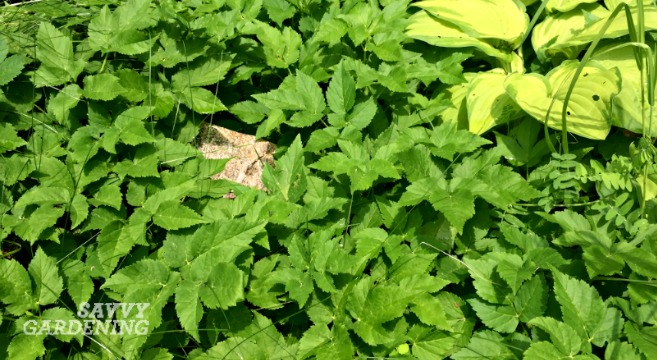
Goutweed was originally introduced to North America as an easy care groundcover, thriving in shade, partial shade, and full sun. It will also grow in a range of soils, but spreads quickest in cultivated garden soil. In terms of survival skills, goutweed is the cockroach of the botanical world. It produces a web of underground rhizomes from which each leafstalk emerges. The leaves are comprised of three groups of three leaflets and can be green or variegated.

Green goutweed, the type that I (unfortunately) have is a beast to eradicate, yet is not considered a noxious weed in Canada. Certain states, like Massachusetts and Vermont, have added it to their ‘Prohibited Plant List’ and it can no longer sold or traded. Incredibly, there are still garden centres in my province that sell goutweed as a groundcover! The variegated type, often called Bishop’s Weed or Bishop’s Curse, is slightly less thuggish, but if allowed to go to seed, it can produce all-green, super-aggressive seedlings.
Related Posts: Smack Talking Weeds
Three ways to deal with invasive weeds like goutweed:
- Cook ’em – Solarizing invasive weeds is among the most effective of the organic methods, but it requires time, heat, and the ability to put up with an ugly piece of plastic in your garden for several months. Begin by finding a sheet of black or clear plastic that is large enough to cover the patch, plus a few extra feet in every direction. Water the area well and cover with the plastic, burying the edges to lock in the heat and moisture. You can also use bricks to weigh down the plastic if burying isn’t possible. Under the plastic, the temperature can rise to 130 F (55 C), killing weed seeds, pests, disease pathogens, and hopefully, goutweed. Remove the plastic after 6 to 8 weeks and wait several weeks to see if the goutweed rhizomes survived and will re-sprout. If there are no signs of goutweed after a month, you might, just might mind you, be in the clear.
- Smother ’em – This is the first goutweed-busting method that I decided to try, with varying success. Begin by mowing or weed-whacking your goutweed into submission, cutting it as short as possible. Cover the area with cardboard, again being careful to expand several feet past the goutweed, and top with a thick layer of mulch – bark nuggets, shredded leaves, etc. Wait. Smothering can take a long time – up to two years. If using an organic mulch like shredded leaves, you can add some soil and plant directly in the materials after a year or two, but only IF NO GOUTWEED HAS EMERGED.
- Spray ’em – Now before you get your knickers in a twist, I’m talking about natural sprays made with citrus oil or vinegar, 20% horticultural vinegar to be exact. I have had modest success with this industrial strength vinegar, but it also takes time, perseverance and hot, dry weather. I’ve got the time and the perseverance, but the hot, dry weather can be tricky in Nova Scotia. Last summer I sprayed one of my goutweed patches with vinegar three times – mid-July, early August, and late August. The first dose did nothing. The second dose curled and browned the leaves within days of spraying. The third dose knocked it down, and up until a few days ago, I thought it was gone… but then I noticed the sprout in the above photo. That said, this was a dense 5 by 20 foot forest of goutweed last summer and I’m down to one sprout. I think it’s time to pick up more vinegar and tackle those other two patches.
Bonus advice – Move. This is the only known method for 100% elimination of goutweed.
Do you have goutweed? What have you found effective for controlling this obnoxious weed?

Dealing with goutweed as well!! I’ve been digging it up consistently for years now. I hate the stuff! The owners of the land 30+ years ago planted it and it’s trying to take over our garden.
We are digging a border around the whole garden and using very thin coated aluminum to keep it out. It’s not permanent, because the thought of metal in the ground freaks me out- but it will block it long enough for me to eliminate it inside my garden. With that being said- DUCKS LOVE GOUTWEED! And they will eat all the leaves and anything sticking up out of the ground of the gout weed. They actually eat the rhizomes like spaghetti too. We built their duck run on two sides of our garden, the worst of the areas where the goutweed is. If I have to, I’ll extend it all the way around the garden, I just don’t want to have to do that if I don’t have to. I hand dig almost daily in the spring, so hopefully with the ducks, the metal around the garden & the hand digging, I’ll eliminate it eventually!
Goutweed is awful, to be sure!
That said, I’d take it (again) over the creeping bellflower that I have been battling for 9 years.
I bought a propane torch like they use for roofing work . 2 seconds of that flame roasts the weeds! Just be careful when working with open burn..you’ll need to have a water hose handy and on but not wetting the area you’re trying to eradicate the weeds from I also had a couple of buckets of water within a few feet of me just in case things went awry with the flame. you’ll need a helper to man the hose in case you need help so there are a lot of safety precautions when working with an flame however if you can and local ordinances allow this is a very fast effective way to get rid of weeds. If they r stubborn it might take 2 passes of the flame.
I’m reading your post in June, 2022. I have one of those “volcano” torches you mentioned. Did you have much success with it against the goutweed? Had you mowed the plants at all before starting? That might keep the fire hazard you described so well under control by limiting the material to be burned.
I have patches of goutweed , tried burning it with a propane torch, done a great job getting rid of what was above ground , but alas a few days later new sprouts , now I’m thinking where as I have small patches , I will put water around the perimeter and place burning charcoal briquettes inside the perimeter , moving them around over the surface for complete coverage of the roots/runners , my thinking is that very high temperatures will penetrate the ground thereby killing the runners, then being it is fall I will add and mix some good quality lawn soil and seed or maybe sod … thoughts anybody ???
my neighbor told me she planted Nasturtium seeds in her garden and the goat weed disappeared, going to try this next spring
How is the Nasturtium working? I’m going to put down double black landscaping material but not counting on it working entirely.
How do we write to the Halifax or NS gov to officially ban this monster weed? Can someone start a petition?
I heard about the nasturtium solution for goutweed on CBC gardening phone-in (Maritime Noon) last year, but just a mention – no details. I have not been able to find info on it anywhere else. I was hoping to try out that method this year, and ordered one of the larger sized bags of nasturtium seeds. Wouldn’t you know, that has been on back order for months, so I don’t know if I will be able to carry out my plan. I was figuring on just chucking down a *huge* lot of nasturtium seed and waiting to see what happens. Luckily, my gout weed patch is more or less contained in one area. I have used hostas all around the edge of it, and they shade it out fairly well, though I still dig and pull regularly.
Has anybody heard of planting nasturtiums to control goutweed. A friend of mine mentioned that she had heard about this as a possible solution to my goutweed problem. Can’t imagine how this would work and just how many nasturtiums would you have to plant.
I just finished off the 4×12 (or so) plot that was nothing but goutweed. I dug it out and screened the dirt. I am certain that I did not get every last bit, it’s cleaned out really well. Then I laid down cardboard and shredded paper before reapplying the cleaned dirt (and some more to fill the bed up). Lots of physical work, but worth it, I think.
Thanks Niki. 1 weed at time🤞
Kelly