
This post may contain affiliate links. If you make a purchase through links on our site, we may earn a commission.
Confession – I have a goutweed problem. Like many gardeners, I wrestle annually with this invasive perennial, but I don’t think I’m winning. In fact, I probably didn’t take it quite as seriously as I should have when I first noticed it growing in a corner of the garden about four years ago. It took mere weeks for that tiny patch to double in size and it’s now conquered three areas of my yard. After watching its steady progression in my garden, I realized last summer, that I needed to get serious about getting rid of it.
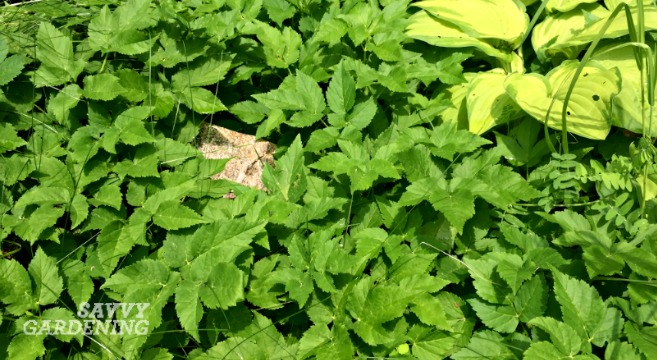
Goutweed was originally introduced to North America as an easy care groundcover, thriving in shade, partial shade, and full sun. It will also grow in a range of soils, but spreads quickest in cultivated garden soil. In terms of survival skills, goutweed is the cockroach of the botanical world. It produces a web of underground rhizomes from which each leafstalk emerges. The leaves are comprised of three groups of three leaflets and can be green or variegated.

Green goutweed, the type that I (unfortunately) have is a beast to eradicate, yet is not considered a noxious weed in Canada. Certain states, like Massachusetts and Vermont, have added it to their ‘Prohibited Plant List’ and it can no longer sold or traded. Incredibly, there are still garden centres in my province that sell goutweed as a groundcover! The variegated type, often called Bishop’s Weed or Bishop’s Curse, is slightly less thuggish, but if allowed to go to seed, it can produce all-green, super-aggressive seedlings.
Related Posts: Smack Talking Weeds
Three ways to deal with invasive weeds like goutweed:
- Cook ’em – Solarizing invasive weeds is among the most effective of the organic methods, but it requires time, heat, and the ability to put up with an ugly piece of plastic in your garden for several months. Begin by finding a sheet of black or clear plastic that is large enough to cover the patch, plus a few extra feet in every direction. Water the area well and cover with the plastic, burying the edges to lock in the heat and moisture. You can also use bricks to weigh down the plastic if burying isn’t possible. Under the plastic, the temperature can rise to 130 F (55 C), killing weed seeds, pests, disease pathogens, and hopefully, goutweed. Remove the plastic after 6 to 8 weeks and wait several weeks to see if the goutweed rhizomes survived and will re-sprout. If there are no signs of goutweed after a month, you might, just might mind you, be in the clear.
- Smother ’em – This is the first goutweed-busting method that I decided to try, with varying success. Begin by mowing or weed-whacking your goutweed into submission, cutting it as short as possible. Cover the area with cardboard, again being careful to expand several feet past the goutweed, and top with a thick layer of mulch – bark nuggets, shredded leaves, etc. Wait. Smothering can take a long time – up to two years. If using an organic mulch like shredded leaves, you can add some soil and plant directly in the materials after a year or two, but only IF NO GOUTWEED HAS EMERGED.
- Spray ’em – Now before you get your knickers in a twist, I’m talking about natural sprays made with citrus oil or vinegar, 20% horticultural vinegar to be exact. I have had modest success with this industrial strength vinegar, but it also takes time, perseverance and hot, dry weather. I’ve got the time and the perseverance, but the hot, dry weather can be tricky in Nova Scotia. Last summer I sprayed one of my goutweed patches with vinegar three times – mid-July, early August, and late August. The first dose did nothing. The second dose curled and browned the leaves within days of spraying. The third dose knocked it down, and up until a few days ago, I thought it was gone… but then I noticed the sprout in the above photo. That said, this was a dense 5 by 20 foot forest of goutweed last summer and I’m down to one sprout. I think it’s time to pick up more vinegar and tackle those other two patches.
Bonus advice – Move. This is the only known method for 100% elimination of goutweed.
Do you have goutweed? What have you found effective for controlling this obnoxious weed?

It started in my prairie. then it expanded to my flowerbeds in the back yard (around the corner and 15 feet away). I did not have any luck with hand removing. Finally covered the prairie section for 2 years with ground fabric. The grass. so far ok there. The flowerbeds are a different issue. Went to 3 garden centers. Started with Roundup, No luck. Finally got the poison ivy killer. Painted every leaf , it sort of came back. Repainted each leaf, it looked sicker. Painted them again. Just pulled up the 2 new sprouts I saw. Hoping to have luck as it is now too cold to even think that I can poison it again with any effect. Waiting for spring to see if I was successful.
The goutweed was everywhere in our small front garden in Vancouver, with another smaller patch under the back deck. We have a lot of mature shrubs which would be difficult to dig up, and nowhere to put them temporarily anyway, so solarization was out. Also, to “solarize” you have to have “sol”, which can be a challenge here. I asked some professional gardeners working next door for their thoughts, and they recommended simply pulling off the leaves and whatever you can reach of the stalks, repeatedly – the theory being that the interference with photosynthesis will eventually weaken the goutweed enough that it doesn’t spread so vigorously. Much to my surprise, this seems to have worked. I do it now 2 or 3 times a year, generally mid-spring, mid-summer and late fall. There’s always some goutweed, though, and to preserve mental health I’ve had to have an attitude adjustment and look at it as a nuisance to be controlled rather than a mortal enemy to be exterminated.
The Goatweed War is on! We didn’t realize how invasive it was and over the last couple years got lazy with our front garden. We also have ground dwelling bees in some areas so round-up and solarization are out. Here is what we’ve done so far. We dug. And dug some more. We saved a few of our favorite plants, but any that were thoroughly entwined we just pulled out. Including a large Cotoneaster:( We pulled out a lot of roots and got rid of a lot of soil. We bought bags and bags of black earth and put a good 2 – 3 inches down to build the garden back up. Now we are watching for the sprouts to pop back up and when we do we are digging down to find forgotten roots. Weeding twice a week is working as it is much easier to spot in our dirt and hosta landscape. Its not an exciting garden but once we know it’s gone, we will rebuild! After a few weeks of this, the hope is to put 3 inches of mulch down. Now what did we do with all that goat weed laden soil you ask? It’s currently behind our shed getting ready to be solarized with black plastic. My fingers are crossed….
I’m so pleased to see that another comment has recommended manure and mulch to loosen the soil. Then repeated weeding. I don’t have to dig out the roots. Every year I knock the goutweed back another 5 feet or so. Often I will dig a shallow trench to mark my goal.
Dealing with several thousand square feet of this stuff across two relatively large properties – the plant has taken over more than 2/3rds of all land in one of the two. At this stage, solarising would mean turning vast areas into barren wastelands (God knows what would colonise the areas once the covers are lifted) and vinegar would need to be applied in truly ludicrous quantities.
Thus, the gameplan is simple: it looks like the plant is kept at bay if it is mowed down regularly. There are entire areas of the garden which, thanks to regular lawnmowing, are utterly free of it.
Now, a lawnmower isn’t an option in some areas, so instead a heavy trimmer/brushcutter is being used. It’s astonishing how much sheer biomass you end up cutting down – several cubic metres of pure plant material.
The battle has gone on for a few years now with mounting seriousness. Whacking it down a couple of times a year already slowed down spread considerably, and doing it every few weeks for the past year or so has started to bring a certain desperation to the plant – it is regrowing much more slowly, perhaps to conserve energy.
The hope is that weakened enough, other plants will finally be able to outcompete it. Very clearly this approach isn’t an option for all cases, but for truly vast areas, it is looking reasonably promising. Plus, whacking down vast amounts of the plan is a certain way to let off steam: love the smell of murdered goutweed in the morning.
I just planted some in my neighbors garden last week while he was on vacation. Not a particularly frindly man who sued the condo association. Should be fun to observe from a distance. I do sort of feel bad, but not after paying out 5k with 140 others over nothing. He may find the fish under his deck sooner than the Goutweed invasion.
#revengeplanting could become a thing! Ha ha.. ok we need updates on this situation. And we appreciate that you’re in it for the long game… this could take awhile (maybe not for the fish).
I think that’s a terrible thing to do. There is so much strife in the world as it is. Why be vindictive?
Your *neighbour’s* garden, you say?
It is a cruel idea, and I am sure you will derive great satisfaction from watching him try to suppress it. However, I think that satisfaction may be somewhat tempered by your realising this stuff *will* spread across boundaries of legal land ownership and plots laid out in city plans. Indeed, it will likely even cross the road if it is allowed to seed – and it probably will be, at least once he is a broken man and gives up.
Agree with Niki, updates are definitely needed! Looking forward to hearing about the mix of emotions you will experience watching your neighbour weed goutweed as you, too, are weeding that same goutweed in your own garden.
This was a silly thing to do. That goutweed is eventually going to find it’s way (through rhizome roots and seeds) to other peoples’ yards and gardens – maybe even your own. Goutweed spreads – if it didn’t, it would not be considered invasive. You should be jailed for ecosystem terrorism and stupidity, IMHO.
With two properties infested thanks to neighbours and many many bags of digging I have finally solved my got weed problem. Roundup is thy name. Multiple careful applications. Multiple reuse on new growth. Had to pull my garden out. Kept at it but now it is gone. I say that as I am just clearing out the last bits now. A big patch of brown but goutweed free.
I wish you all luck .
Thanks Mike – I pulled my landscaping out too.. just glad my large veg garden is far from any goutweed. Almost winning the goutweed war, appreciate your tips!
Hello,
I am trying to find the 20% vinegar. I bought it before in Nova Scotia . I think it was Lower Sackville. I can not find it in any of the garden centers. Thanks for any help tracking it down.
Check Bloom Greenhouse on Hammonds Plains Road, I saw it there. Also, Halifax Seed prob has some. Hope that helps! 🙂 – Niki
This was a silly thing to do. That goutweed is eventually going to find it’s way (through rhizome roots and seeds) to other peoples’ yards and gardens – maybe even your own. Goutweed spreads – if it didn’t, it would not be considered invasive. You should be jailed for ecosystem terrorism and stupidity, IMHO.
Oops, my previous response was meant for the person who posted about how he planted goutweed in his neighbor’s garden as a vindictive act.
I have two treatments I follow: I found a recipe for what I call ‘goutweed-getter’: 4 cups regular Vinegar, 1/4 cup salt, and 1 teaspoon dish soap. Shake well and spray on goutweed leaves when you know it’s going to be sunny day (not easy in Vancouver). I spray it a couple of times on a sunny day. It’s been effective on burning and killing my green goutweed in the areas that I use it for several weeks. It doesn’t get rid of the rhizomes, just the leaves above ground. It weakens the rhizomes, though. Note it will burn other plants and deplete your soil, so use caution around other plants. I’ve gotten completely rid of goutweed in a few garden beds by following and pulling those rhizomes like I’m on the lamest treasure hunt ever.
I have gotten rid of 98% of my goutweed by persistently doing the following: I put a good layer of homemade compost on the soil. This serves to soften the ground due to worms and microbes. It takes several months or more to work. Next, when the soil seems softened, take your weeder – that long sturdy metal shank with the serpents tongue point – and push it as deep as you can at the same time lifting the ground under the goutweed. Remove the weeder and gently pull the plant to remove the long goutweed root in one piece. This takes some practice and you must have that softer soil for it to work because in hard soil the plant simply breaks off at ground level. In my experience unless you get out that entire root that plant will be back. Interestingly if you have a number of plants in the same locale as soon as you get five or six long roots out the rest will come much easier as the labyrinth begins to untangle and they no longer support each other. When you locate a plant, be sure you grasp the two or sometimes three stems and leaves that grow close together to have a better chance to extract the entire root without having it break off. I cleared my yard of this plant long ago – it took a number of years and persistence to do this every spring for years. And you must do this in spring when the plants are young and vulnerable – by summer they are usually too tough to get out. In summer you can try cutting the goutweed at the ground and then covering the ground with a newspaper mulch, leaving your keeper plants uncovered. You can cover the newspaper with cedar bark mulch for better appearance. This also aids in soil softening for easier root removal. Just rip the paper sections into the size strips you need – use a thickness of at least 7 or 8 pages. This whole thing eventually composts itself. I have two clueless neighbors with wall to wall goutweed gardens so no chance my war will end soon as a continual campaign against creepers is necessary. Best of luck – victory will be ours!
I have been a goutweed warrior since moving to this property in 2011. It was growing EVERYWHERE!!! and still is really… but I have made some ground. I cleaned out (pulled rhizomes) from the front yard garden (60 sq feet). Within two years it was goutweed free. In other areas I covered it with a heavy woodchip mulch and continuously snipped/pulled every goutweed plant poking through. I have a stretch (border) of our property about 200 feet long and 40 feet wide that is shaded and sort of wild. This area is overrun with goutweed. I have a flock of 12 chickens and yarded them up over half of this area. The hens eat goutweed (and almost everything else), and after a few years they really knocked the goutweed back. I’m hoping a few more years of this will kill it off and I can rehab the area. I don’t think I’ll ever get rid of it totally. I have also sparingly used glyphosate on it and while it is somewhat effective, repeated applications are likely necessary and this method is likely only effective over small areas, which could be easily dug up for rhizome removal.
Thanks for sharing this Myles! I haven’t tried chickens! ha ha, maybe I need to get a flock. But yes, it’s just tenacious and you really need to keep on top of it, as you mention. Thanks again, Niki