
This post may contain affiliate links. If you make a purchase through links on our site, we may earn a commission.
It’s been a spectacular year for the butterflies in my garden. I believe we’ve seen more species this year than ever before. I’ve worked very hard over the years to create a garden that’s welcoming to all creatures and includes lots of flowers that attract pollinators. The huge diversity of plant material in my garden provides a variety of food sources for all of the pollinators hanging around our place.
From trees to groundcovers, we’ve got a plethora of flowers from which adult butterflies can source nectar. But, we also have many of the plant species used as food sources for butterfly larvae. You see, monarchs aren’t the only butterflies with caterpillars who have specific food needs. The larvae of many other butterflies can feed on only one or a small handful of plant species.
Today’s post will show you how to build a garden for caterpillars, instead of focusing only on providing nectar sources for adult butterflies.
Butterfly Larvae
Everyone seems to be focused only on planting for adult butterflies, but the truth is that when it comes to flowers that attract pollinators, it’s not just about the grown-ups. Yes, everyone is on a mission to plant milkweed (which is great, don’t get me wrong), but in the meantime, there are dozens of other butterfly species aside from the monarch who have nowhere left to lay their eggs because we aren’t growing the right plants in our yards. And, in some cases, we’re purposefully killing the sole larval food source of some of North America’s most beautiful butterfly species.
While there are articles all over the internet listing flowering plants that are great nectar sources for adult butterflies, only a handful of articles listing plants for butterfly larvae are reaching the masses. Very few gardeners seem to know about the danger some of our butterfly species are facing because of a lack of food for their caterpillars.
So, today, it’s my mission to change that. Here, in a simple, easy-to-use format, is a list of larval food sources for some of North America’s butterflies and a handful of useful ideas for how to incorporate these plants into your landscape. Rather than butterfly gardening, I like to call this caterpillar gardening!

Flowers That Attract Pollinators: Caterpillar Gardening 101
To build a caterpillar garden of your own, follow these simple steps.
Step 1: Begin with these tips
- Locate your caterpillar garden in a place that receives a minimum of six hours of full sun per day. As you’ll soon see, most of the plants used as a food source for larval butterflies require full sun.
- You should also try to place your caterpillar garden in a slightly sheltered site, away from strong winds. This helps adult butterflies navigate their way to the garden and keeps the caterpillars protected.
- Avoid hanging any birdhouses in or very near the caterpillar garden. While birds are mighty good for the garden (they consume a lot of pest insects), each pair of chickadee parents require 6000 caterpillars to raise each brood. I’m sure you’d prefer they eat gypsy moth caterpillars instead of butterfly larvae, so keep birdhouses in the veggie or flower garden rather than near the caterpillar garden.
- Size matters… but not as much as you think. If you can manage to dedicate just 1% of your total landscape area to a caterpillar garden, the butterflies will thank you. And, if you don’t want to create a dedicated garden just for caterpillars, then add as many larval host plants as possible to your existing landscape. Tuck them in your perennial garden, around your veggie patch, in foundation beds and shrub islands. Heck, you can even plant them in containers! I have several containers dedicated to flowers that attract pollinators and host butterfly larvae – one includes a hops vine and dill, and another is filled with milkweed and borage.
Step 2: Plant these plants
As promised, here’s a handy list of what kinds of plant species to include in your caterpillar garden. The name of the butterfly is first, followed by a list of its host plants. If there’s only one host plant listed, that means the larvae of that butterfly can only eat that particular plant (making it extra important for you to include it in your larvae garden!). In my humble opinion, when it comes to flowers that attract pollinators, these species are the most important ones to include in your landscape, whether they’re in a dedicated caterpillar garden or somewhere else in your yard.
While this list obviously doesn’t include every butterfly species in North America, it’s a good place to start. You can always reach out to the Xerces Society and their book Attracting Native Pollinators for a more extensive list of butterflies native to your region along with a list of their larval host plants and more flowers that attract pollinators.
Monarch – milkweed
Great spangled fritillary, meadow fritillary, Zerene fritillary, Atlantis fritillary, and silver-bordered fritillary – violets (and only violets! Please stop killing the violets in your lawn!)
Gulf fritillary – passionflower
Baltimore checkerspot – white turtlehead, hairy Penstemon, speedwell, honeysuckle, arrowwood, white ash
Milbert’s tortoiseshell – stinging nettle
Eastern tiger swallowtail – plum, apple, ash, willow, elm, and others
Spicebush swallowtail – sassafras, spicebush, tulip tree, sweet bay magnolia
Pipevine swallowtail – Dutchman’s pipe, black bindweed, knotweed
Painted lady – Yarrow, thistle, lupine, borage, sunflower, lambsquarters, sage
Eastern comma – Elm, hops, nettles
Red admiral – nettle, hops
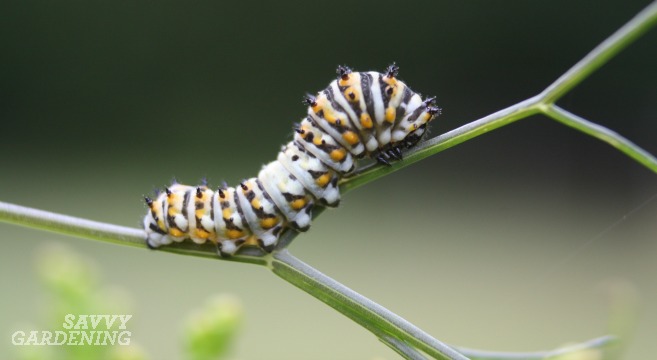
Eastern black swallowtail – Angelica, dill, fennel, Zizia, lovage, wild carrot
Pearly crescent – aster
Little wood satyr – orchard grass
Common wood nymph – bluestem, porcupinegrass
Mourning cloak – willow, cottonwood, birch, elm, hops, white ash, basswood
American lady – pussytoes, sagebrush, sunflower, lupine, nettle, Canada thistle, hollyhock, mallow
Viceroy – willow, birch, plum, hawthorn, serviceberry, cherry
American snout – hackberry
Metalmark – yellow thistle
Spring azure – plum, cherry, maple, hop, blueberry, viburnum, wingstem, and others
Gray hairstreak – false indigo, bush clover, lupine, clover, vetch, hibiscus, mallow hawthorn, and others
Banded hairstreak – oak, hickory, ash, walnut
Wild indigo duskywing – baptisia, wild lupine, crownvetch
Cloudless sulphur – cassia
Southern dogface – false indigo, clover, alfalfa

Step 3: Be mindful of nature’s way
While some of the caterpillars present in your caterpillar garden will reach maturity and pupate into adults, many of them will not. There are many insectivorous birds, amphibians, reptiles, and mammals who dine on caterpillars as they grow, and there are certainly plenty of predatory and parasitic insects who enjoy slurping down a caterpillar every now and then or using them to house and feed their developing young.
Though not all of the caterpillars in your larvae garden will survive, don’t be discouraged. That’s the way nature rolls. Some will make it, others won’t. Be mindful of nature’s way and try not to interfere. But, even if just one caterpillar survives to adulthood, you’ve made a difference in the life of an important and beautiful pollinator.
Plant a garden full of flowers that attract pollinators and feed a diversity of larval insects. Caterpillar gardening is butterfly gardening at its finest!
Check out the following video to learn about three great nectar plants for butterflies, too.
Related post: Reasons NOT to clean up the garden this fall

Do you have any larval host plants for butterflies? If so, what do you grow? Tell us in the comment section below. 

Great article! I’ve been adding caterpillar plants for a few years, mostly milkweed but started trying for swallowtails….I found a few giant swallowtail caterpillars on my lime and mandarin leaves. We had such a long and super warm November here in southern California, I counted 18 monarch caterpillars on the milkweed around Thanksgiving! So awesome. Going to look for Queen Anne’s lace and wild carrot, I added parsley… don’t really want my citrus to get eaten up😏
I planted six milkweed plants and happen to have one swamp weed for all the monarchs in my butterfly garden. They ate the swamp weed literally to death and didn’t touch the milkweed. What happened? Should I plant swamp weed instead?
That just happened to be where the adult monarch laid her eggs, that’s all. The swamp milkweed will be back next year, I promise. They eat mine to the nub every year and it always comes back the next spring. They do tend to prefer it to some other types, but I wouldn’t worry about it one bit.
I am the steward for a natural area restoration in a local park in Illinois. We were thrilled last week to find three Giant Swallowtail caterpillars on the Prickly Ash and Wafer Ash shrubs we planted three years ago. At home, I let a number of native weedy volunteers grow specifically because they appear to be so important to caterpillars based on the amount of leaf damage. Violets, asters and choke cherries get chewed to shreds, I’ve noticed, as well as our American elms and hackberry trees. I have tried to identify all of our weeds using iNaturalist and let most of the native ones stay. Our pollinator populations are definitely growing as a result.
Hi, I live in Southwest Florida and was very successful raising Monarchs inside the lanai last year. This year I placed the milkweed plants outside and even though I find monarchs visiting the plants, feeding on the flowers and laying their eggs, the caterpillars disappear promptlyand I have witnessed wasps getting the caterpillars and eating them. Is there something I can do to protect them from these predators?
Thank you for your help.
There is little you can do to discourage this natural predation. If you cage the plants, the monarchs won’t be able to get in to lay their eggs either.
I just found a bunch of caterpillars in my garden. I forget the plant but I know it’s a pollinator. Will they kill this plant by eating its leaves? I’m excited to see them there!
Larval caterpillars rarely outright kill a host plant (it’s not in their best interest to, after all). Even if the plant doesn’t look so great temporarily, it will rebound quickly.
I have a catapillar garden, but the praying mantises are ruthless. What can I do?
That’s such a challenge, I’m sure. Praying mantids are lovely, except most of the time, the ones we see in our gardens are introduced species – either European mantids or more commonly, Chinese mantids. There’s not much you can do other than relocate the mantids when you find them.