
This post may contain affiliate links. If you make a purchase through links on our site, we may earn a commission.
Cucamelons are the most popular crop in our vegetable garden with the long, slender vines yielding hundreds of grape-sized fruits that resemble tiny watermelons. Hence, their other name, ‘mouse melons’, or as they’re better known, Mexican Sour Gherkins. Most gardeners start their cucamelon plants from seed sown indoors in mid-spring, but the plants also produce tubers that can be lifted and stored over the winter. Growing cucamelons from tubers gives you a head start on the spring growing season, and results in an earlier and larger harvest.
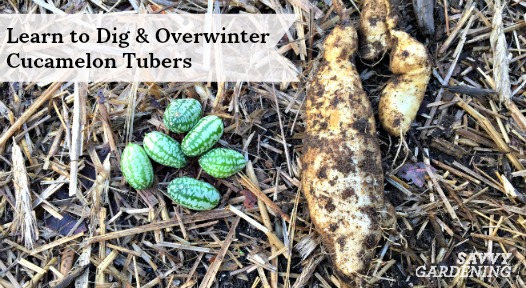
Cucumelons are native to Mexico and Central America and are open-pollinated, so you can save the seeds from year to year. But, as mentioned above, you can also save the tubers in late autumn by digging and storing them as you would a dahlia. The fleshy tubers grow 4 to 6 inches long, are white to beige in color, and each plant can yield several good-sized tubers.
Gardeners in zones 7 and up, can deep mulch their plants in autumn with a foot deep layer of shredded leaves or straw to overwinter them. In my cold climate garden, where the frost goes deep into the soil, cucamelons do not overwinter and I need to grow them from seed each spring or save the tubers.
Related Post: Growing Cucumbers Vertically

Digging Cucamelon Tubers:
Digging cucamelon tubers is easy. Once the plants have been hit by frost a few times, it’s time to dig them up. The fibrous root ball will be in the top foot of soil, but the tubers can extend a bit deeper. Don’t try to harvest the tubers by pulling the plants out. In my experience, this has resulted in damaged or broken tubers, which will not overwinter.
Instead, place a garden fork or shovel about a foot away from the main stem and dig, gently lifting to expose any tubers. Don’t see any? Dig deeper or use your hand to move the soil out of the hole to locate the tubers. Handle just-harvested tubers carefully to avoid bruising or damage. There’s also no need to wash them off as the tubers will be stored in soil.
Once you’ve gathered all the tubers, it’s time to store them. I use a 15 inch diameter plastic pot and a high-quality, pre-moistened potting soil. Add about 3 inches of soil to the bottom of the pot, and place a few tubers on the soil surface. Space them so that they do not touch. Add another layer of soil and more tubers, continuing to layer until you have no more tubers left. Be sure to sure to cover the last layer with a few inches of soil. Store the pot in a cool, frost-free spot for winter; an unheated basement, a modestly heated garage, or a root cellar.
Small-space and container gardeners who grow cucamelons in pots can also overwinter their plants. Just snip off the dead foliage and store the pot in a cool, frost-free area for winter. Come spring, the tubers can be removed from the pot and replanted in fresh containers.
Related Post: Unusual Cucumbers to Grow
Planting Cucamelon Tubers:
It’s time to re-plant the tubers in early April, or about eight weeks before the last expected spring frost. Gather your supplies; eight to ten inch diameter containers and high-quality potting soil. Fill each pot about two-thirds full with the pre-moistened soil. Place a tuber on the surface of the potting soil, and cover with another inch of the soil. Water well and move the pots to a sunny window or place them under grow-lights. Continue to water when necessary and fertilize with a balanced liquid organic food every few weeks.
Once the risk of frost has passed, harden off the plants and transplant them into the garden or in larger containers for deck growing. Cucamelons appreciate a sunny, sheltered site with compost-enriched soil.
Do you overwinter your cucamelon tubers?


Planted seeds, got 2 plants. Were grown on trellis in sunny, warm and sheltered spot. They were vigorous and produced plenty of flowers but only 1 fruit ( scary–the dearth of pollinators now). I did find a lot of tubers when pulling out the vines so will hold over winter in hopes of a better crop next year. (Coastal N. CA. )
Planted mine in a 10″ Hanging pot in my small greenhouse. They love being moist and do they ever produce. I pickeled mine with small round carrots as dill pickels. What a great novelty.
Do you need to keep tge tubers moist during over wintering? What do they look like after they have been stored for the winter? Do they dry out? Or are they dead if that happens?
I store them like dahlias – in lightly moist potting mix or vermiculite. I check them every month or so to make sure the tubers look good and there’s no rot over the winter. Don’t let them dry out completely.
I had a great harvest from four plants- dug up one of my plants but no tubers- any thoughts why?
They’re probably there – but they tend to be deep – at least a foot down. Carefully dig down a bit deeper and see if you find any. – Niki
I was excited to try the cucamelons, planted from seed. Germination rate was low but I got one plant. I put it in a container it was a slow grower that bloomed and seemed to have been fertilized but never actually produced any fruit. Any thoughts about why that happened? Also if there are any tubers would they be worth saving?
Thanks for any tips here.
Hi Tricia, It’s rare for cucamelons to not produce fruits but I would guess it’s related to pollinators. This is a crop that needs its flowers to be pollinated to produce fruits. Typically bees do the job. It’s hard to hand pollinate as the blooms are so small. Perhaps it also didn’t get enough light – too little light can affect fruit set. But so can wet/bad weather… our July weather wasn’t great so my plants were a bit later than usual. Assuming it’s poor pollination I would recommend planting bee-friendly flowers like zinnias, calendula, cosmos or nasturtiums at the base of your plants next year. That should bring in the bees. Good luck! Niki
Hi Nikki,
I’ve grown cucamelons for several years now – they are one of my “pet” plants that I always want around. This is the first year that I grew one in a pot, and was surprised to find tubers when I dumped out the soil! Do you happen to know if the cucamelon tubers are edible? They smell like jicama, which I so love…Thanks for the information!
First time growing cucamelons this year. Bought some seeds and planted about 8 seeds. Only 4 plants came up but 50% wasn’t bad for a first try. Grew 2 in the garden on a trellis and 2 in pots with a tomato cage. All 4 did really well! I had a fairly large crop. I picked the last few this morning as last night was the first frost of the season. Will winter the tubers and hope for an even bigger crop next year. We are in zone 5B.
I grew cucamelons for first time last year. Got an okay number of them nothing special. I dug up the tubers and tried to store them but they all rotted. I think my garage was too warm over winter. I also used coconut coir instead of soil so maybe they didn’t have enough nutrients in with them?
This year I great growth and expect to harvest my first ones soon. I really want to save the tubers this year for an earlier and bigger yield next year. I wanna try mulching but they are in a container. I can move it but being zone 8a winter is sometimes warmer and sometimes very cold. What is the ideal storage temperature range?
What can I try this year to hopefully have the tubers survive?
I live in 8b and plan to grow them in a pot, then leave the pot on my porch and only bring it inside when temps are predicted to go below 35 (to be safe). Then the pot goes back out until it goes that low again.
I live in Columbus, OH.. zone 6b. Have decent sized veggie garden that is active from May to Oct. This is my first time starting cucamelon and ivy gourd (tindora in India.. looks similar to cucamelon) plants from seeds.. was little over enthusiastic and started in Jan end itself. Its Feb end and plants are already 10 leaves and 3 ft tall. I am transplanting 2 plants into one 5 gallon cloth pot with trellis support.
My questions:
1. Is it ok to have 2 plants in one pot?
2. Are these self pollinating plants.. have both male and female flowers in single plant?
3. Should I bring them indoors in winter before frost or let it die and leave tubers in garage for next year?
Hi. Thanks for this info. I dug up some crazy looking roots on my test plants this fall, and now I understand that I missed an opportunity. Will try the tuber method next year. Any idea how many seasons you can recycle the tubers?
You can replant them for many many years and will even get smaller tubers you can separate.