
This post may contain affiliate links. If you make a purchase through links on our site, we may earn a commission.
While topping pepper plants is standard practice for some gardeners, others wouldn’t dream of snipping a single stem. In part, whether to top or not—and when and how to do it—depends on your local climate and the length of your growing season as well as the varieties of peppers you choose to grow. The bottom line is that trimming your pepper plants in the right spots and at the right time can make them more robust and more prolific. That means you could come away with many more peppers than you otherwise might. In this article you’ll learn all about topping pepper plants.

What is topping pepper plants?
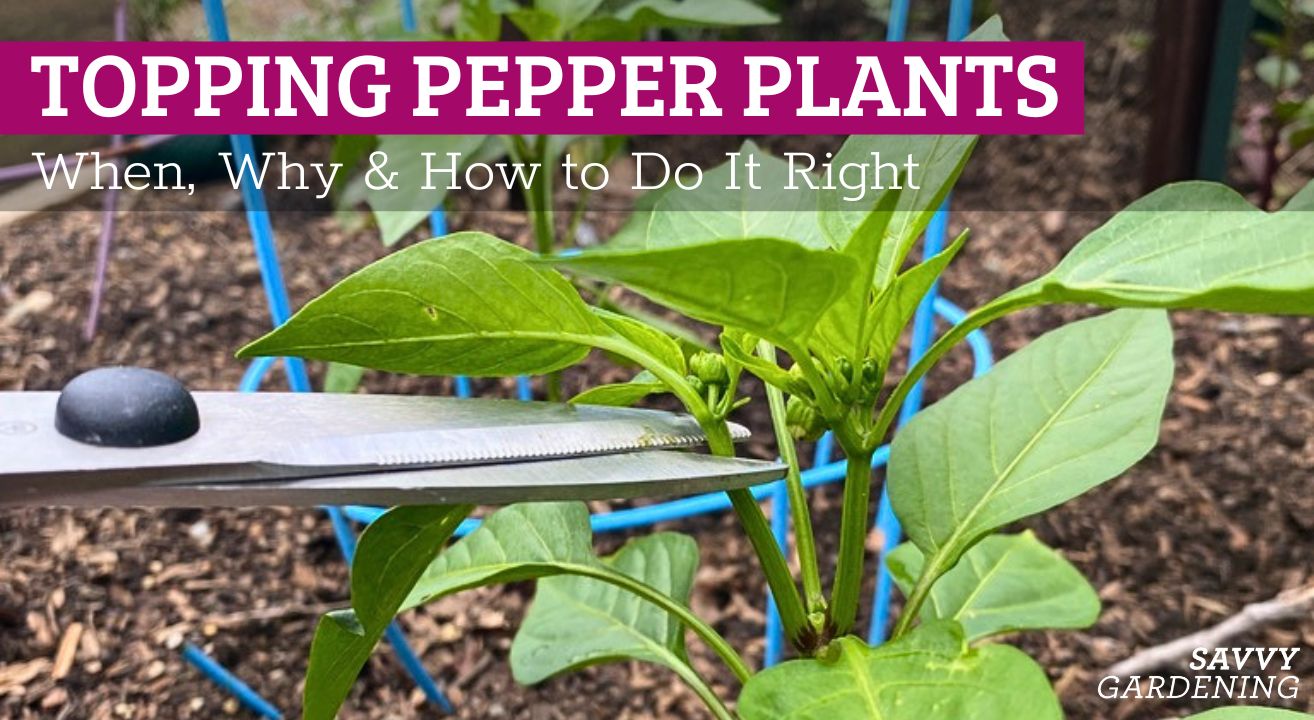
Topping pepper plants refers to the practice of trimming a small portion off of the tip of a pepper plant’s main stem. This tip is the plant’s apical bud which is responsible for upward growth. When it is removed, the plant gets the message to redirect its energy to its axillary buds.
Like the small suckers on a tomato plant, the axillary buds on peppers are positioned at a diagonal next to a protruding leaf. Together, these leaf-and-bud combos make up the knobby-looking nodes along the stem. And when these axillary buds kick into high gear, they create new branches along the sides of the main stem. This, in turn, makes for a more compact, bushier plant.
When to top pepper plants: Ideal timing
Generally speaking, the ideal time for topping pepper plants is when your plants have had several weeks to become established out in the garden and they’re about a foot tall. Just keep in mind that, after topping your plants, you may notice little to no new growth at first. Sustaining a cut does set your plants back initially and it can delay the onset of fruit by two to three weeks.

Why topping pepper plants is helpful
Topping pepper plants induces plants to become bushier with new growth in the form of side branches. And with all of that lateral growth via the pepper plants’ side shoots comes the potential for many extra flowers and, as a result, a more bountiful pepper harvest.
The only real drawback? Forcing a plant to divert energy to its axillary buds can delay fruiting by two or three weeks. If you live in a cold climate with a short growing season, those extra weeks might be too costly to bother with. But, if you have plenty of time—and plenty of hot weather—you can probably afford to wait for your bumper crop.
Removing the tops of your plants can also be helpful in the case of pepper seedlings that look very leggy. Plants that are tall and spindly with a lot of space between nodes eventually can become top heavy. At minimum, they’ll need to be staked or caged, but, even then, they are more susceptible to wind damage. By topping these, you can influence their growth habit so that your plants are bushier and more resilient in the face of stormy weather.

Should all types of peppers be topped?
Topping pepper plants is not actually helpful for all pepper varieties. For instance, if you’re growing larger types like banana, poblano, Cuban peppers (cubanelles), or bell peppers, you shouldn’t top these. That goes double for foot-long hatch chiles like NuMex Heritage Big Jim which the Guinness Book of World Records once designated the world’s largest chile pepper. To accommodate their large fruits and allow for enough air circulation, it’s better to allow these types to grow up rather than encouraging them to be more compact and bushy. Thai chiles, jalapeños, habaneros, and other smaller fruited peppers, on the other hand, can benefit from topping.
Tools and materials needed for topping pepper plants
To top pepper plants, you can use small pruning shears or scissors. Just be sure your tools are sharp and sanitized. (If you use tools that aren’t clean, you can introduce disease-causing pathogens into your plants.) To sanitize tools, wash them in hot, soapy water and then rinse with a 10 percent bleach solution. (That’s one part bleach to nine parts water.)

Pinching peppers: Two easy steps
Only top if plants are about a foot tall with several sets of true leaves.
- Step 1: First, identify the main stem. It’s the thickest, vertical growth at your plant’s center. Everything else emanates from the main stem, and the apical bud is visible at the main stem’s tip.
- Step 2: Make a 45-degree angle cut about three-quarters of an inch below the apical bud and discard the removed plant top. Over the next few weeks, lateral branches will form along any nodes which are present below your cut.
Aftercare: What to do after topping
Remember, after topping pepper plants, you’ll see a stall in their growth. This is normal. As plants redirect energy to grow lateral branches, be sure they have enough water. To check this, gently feel the top couple of inches of soil with your fingers. If it feels dry, add water. This is also a good time to apply a liquid organic fertilizer like fish emulsion to encourage lots of new growth.
You should also monitor your plants for damage from flea beetles, whiteflies, aphids, and other pests. When simple hand-picking and removal won’t do, apply an organic insecticidal soap.

Common mistakes to avoid
- Wrong angle—When topping pepper plants, cut them at a 45-degree angle so that the plant stem can more easily shed water. If you cut straight across, water is more likely to pool inside or around the cut, and this pooling can contribute to disease.
- Removing side branches—Don’t take off any side branches, since this is where future flowers and fruit will form. Instead, you’ll be removing the tip of the main stem.
- Cutting too much—Avoid removing too much plant foliage from small plants. After topping, your plant should have at least three sets of true leaves. Otherwise, it could have difficulty photosynthesizing enough to properly recover from the cut.
Top that!
Topping pepper plants can have real utility whether you’re a large commercial farmer, a serious homesteader, or simply a backyard gardener. Just remember, topping peppers isn’t for everyone and it isn’t for all peppers. Because removing the tops of your pepper plants does initially set their growth back, it can delay your overall harvest. So, if you live somewhere with a short growing season, proceed with caution. Also, topping pepper plants is only recommended for smaller pepper varieties like jalapeños, habaneros, and small cayenne types like Thai chiles. Large peppers—think bell peppers, banana peppers, and large hatch chiles—don’t really benefit from the topping treatment.
That said, trimming away the apical bud of a pepper plant can pay off with many extra peppers. That’s because the cut plant redirects its energy to make multiple side branches. This results in bushier plants with more flowers and potential fruits. In other words? Although harvest time might come a little later than it otherwise would have, it’s well worth the wait.
For more expert articles on growing peppers, check out these posts:

Leave a Reply