
This post may contain affiliate links. If you make a purchase through links on our site, we may earn a commission.
If you’re planning to plant canna lilies in your garden beds or containers, you first need to know when to plant canna bulbs. These beauties will bloom regularly throughout the summer with the right care, which begins at planting time. Unless you live in a tropical location, you’ll have to dig up each bulb—technically a rhizome—at the end of the growing season and replant them in the spring. Because canna rhizomes spread, you’ll be able to divide them before replanting and have even more bulbs to plant or to share. In this article, I’ll cover information about canna lilies in general, where and when to plant canna bulbs, how to plant them, and a little bit about general canna lily care.

Canna lilies: What they are and how they grow
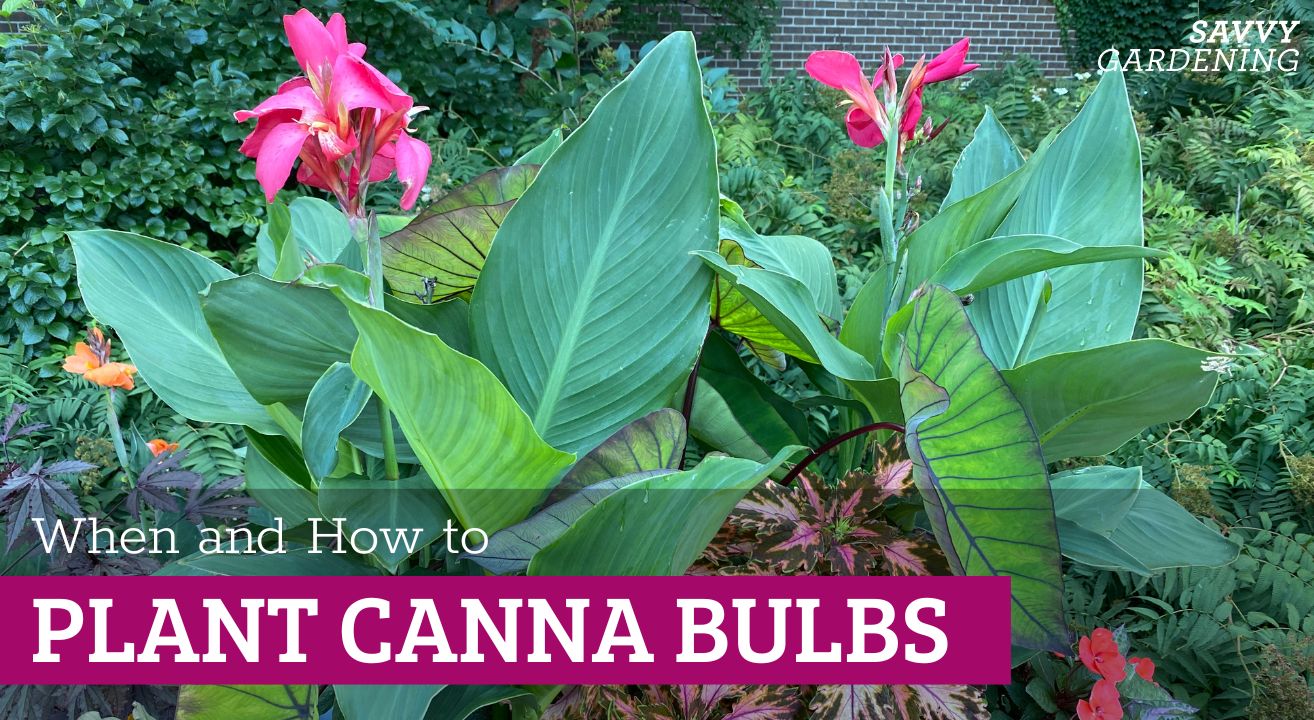
The colorful leaves and flamboyant blossoms of the canna lily makes this plant a show-stopper in gardens and containers. Varieties range from dwarf, 24-inch-tall cannas that are perfect for front-of-bed and container garden plantings to extraordinary, 8-foot-tall (or taller!) plants with paddle-shaped leaves up to a couple feet long that make great hedges.
Canna lilies are an attention-getter in the landscape for humans as well as for animals and birds. They are a forage source for wildlife, including deer who enjoy munching on the leaves.

Canna root is edible to humans, too. It’s sometimes called arrowroot, but canna root (Canna edulis) isn’t the same as the arrowroot from which we derive the baking powder (which is a different plant species, Maranta arundinacea). Canna root is starchy, like a potato, even though the plant itself is related to ginger and bananas, not potatoes.
Canna blooms are reminiscent of gladiolus flowers with their long, tall stalks of blooms that open from bottom to top. Varieties are available in a range of bloom colors, from pink to yellow, orange to salmon, and even bicolor or tricolor. Bumblebees love canna blooms, and the red flowers can bring hummingbirds into your garden. Even the leaves, in bronze, silver, green, purple, and burgundy, as well as variegated forms, are spectacular.

Understanding when to plant canna bulbs
Canna lilies are native plants in tropical East and West Africa and Central and South America. The specific tropical climate in these places makes knowing when to plant canna bulbs even more important. It makes sense that these tropical plants can’t withstand the cold, and they especially can’t tolerate a frost. If you plant your cannas too early, you risk the rhizomes rotting or the foliage being damaged by frost. If you plant too late, the growing season may not be long enough for you to see plenty of blooms. That’s why getting the timing right really matters.

Why the best planting time depends on where you live
Temperatures below 25° F will damage these tropical perennials. When to plant canna bulbs depends on your climate. Wherever you live, you want to wait until the danger of frost has passed to plant them. For me, in Pennsylvania, I can put my cannas in the ground in mid to late May, but if you’re in Los Angeles, it’s possible you could go for it as early as March.
Signs that determine when to plant canna bulbs
The primary sign that triggers when to plant canna bulbs is your last-frost date. This is even more important than knowing your USDA Hardiness Zone. While your USDA Zone tells you the average extreme low temperature for your area, it doesn’t give a timeline for that temperature. The other sign of when to plant canna bulbs is the soil temperature.

The best soil temperature
In general, bulbs that produce summertime flowers need warm soil to awaken and sprout. When your soil reaches 55° F or warmer is a good measure of when to plant canna bulbs. Soil will typically reach this temperature by the time your expected last-frost window has closed. You can keep an eye on the soil temperature in your garden using a soil thermometer.
Preparing canna lily bulbs for planting
Preparing canna lily bulbs for springtime planting actually starts the fall before. After your first frost, cut back the plants to 2 to 3 inches, and dig them from the ground or pot. Put them in a paper bag, box, or pot, buried in dry vermiculite, peat moss, or sand. Keep this container in a cool, dry place that stays around 40° to 50°F throughout the winter months, such as a cool basement, heated greenhouse, or attached garage.
Just as you prepare potatoes for planting by cutting the tubers into pieces and letting them cure, you’ll do the same for canna lilies come spring. Cut up the rhizomes so each piece has a growth point on it, and let the rhizome pieces dry for a few days. Now they’re ready for planting.

Starting canna bulbs early indoors
It’s possible (but not necessary) to give yourself a head start on these ornamentals by starting the canna bulbs indoors. This is especially important for gardeners in colder climates with a shorter growing season.
In late winter or early spring, 4 to 6 weeks before your average last frost, plant the bulbs in 3 to 4 inches of soil in pots. Care for these plants as if they were houseplants by potting them up in well-drained soil and keeping them in a warm, sunny location indoors. Transplant them out into the garden when the time is right.

Ideal site and soil prep
Canna plants can tolerate a surprising range of conditions but will do best with full sun and rich soil, especially when that soil drains away excess moisture. The more sun the plant receives, the more beautiful blooms it will produce, but even in a partial sun garden, the foliage is a worthwhile reward.
How to plant canna bulbs
If you’ve ever planted bulbs, you know how to plant canna bulbs. Whether they are new bulbs purchased from the store or bulbs you overwintered, for each one, dig a small hole with 4 to 6 inches of depth. Place each bulb—or technically, a piece of rhizome—1 to 3 feet apart with the growth nodes pointed upward. The bulbs will grow in diameter as well as height. Cover the bulbs with loose soil amended with compost or manure for the soil organic matter boost these plants want.

Surprise water plant
A useful canna lily trick for gardeners with a backyard pond: You can also grow cannas in standing water. First, start the canna rhizomes in pots submerged in water so they are accustomed to tolerating this condition, then when the time is right, transplant them out to the edges of your pond or place the pot into the pond’s water and weigh it down with rocks.
Care tips for cannas
Canna lilies offer their vibrant blooms through late summer into fall with the right care. Here are a few tips for maximizing flowers:
- Deadhead spent blossoms to keep the plants productive.
- Water regularly; daily if your cannas are growing in pots.
- Fertilize with a slow-release fertilizer in early spring, as the plants start to emerge. If you’re starting your canna bulbs indoors, fertilize when you plant them into your landscape. Take care of this task before the plant sets buds.
- Pay attention to the size of your canna variety, and follow planting instructions provided by the nursery. They can quickly become overcrowded when inadvertently planted too close together.
- Steady them with stakes and string if they are planted in a windy area. The tall varieties can topple in a strong wind.

Can-do cannas
The timing of when to plant canna bulbs is straightforward enough, though it does seem that around the time of the last frost is when a lot of garden tasks come due. Go ahead and add it to your list for late spring. Cannas’ lush foliage and blossoms make it worth your while to get their timing right.

For such showy plants, canna lilies are relatively low-maintenance, just asking to be planted in the right place at the right time and brought inside when the weather turns cold. Follow my advice for how and when to plant canna bulbs, and you can exponentially increase your garden’s tropical look.
For more insight on growing tropical plants, check out these articles:

Leave a Reply