
This post may contain affiliate links. If you make a purchase through links on our site, we may earn a commission.
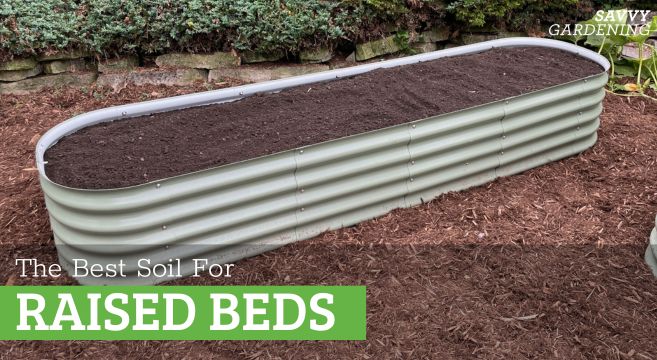
One of the major benefits of gardening in a raised bed is you get to control the soil that goes into it. This is especially advantageous for gardeners with a property that has hard-packed or clay soil, issues with tree roots, or concerns about pollutants. It also comes in handy if you want to place your raised bed on a patio or driveway. Since good soil is the foundation of a healthy garden, you want to make sure you’re setting your vegetables up for success. So, what is the best soil for a raised garden bed? In this article, I’m going to share some advice on figuring out how much soil you need, what to purchase, amending a soil delivery, and more.
Another raised bed benefit is that the soil will remain friable. In an in-ground garden, the soil can become hard-packed over time as you walk between the rows. We know there is a whole web of micro-activity happening in our soil, so it’s best not to disturb it. A raised bed allows you to reach in to weed and plant.

How much soil do you need?
Filling a raised bed will likely require more soil than you think. A soil delivery might make the most sense economically. For my gardens, I’ve put a tarp out on the driveway and had soil delivered in a giant pile that my husband and I work at diminishing over time with multiple wheelbarrow trips. There are some great soil calculators online that can help you figure out the amount you need so you don’t over or under order. Anytime I’ve ordered a bit too much, I’ve added the soil to my other garden beds.
Another option I’ve taken advantage of is a bulk soil delivery in one big bag. This is much better than purchasing multiple small bags of soil. I have simply marked where I want the soil to be delivered and a forklift has deposited it in place. This option is a bit less messy than a traditional soil delivery. The soil is covered and protected from the elements, and there when you need it.

How to save a bit of money on soil
There are some ways to fill in the bottom of a raised bed so you don’t need as much soil to fill it. For example, if you happened to cut out the sod underneath where your raised bed will go, flip the pieces, grass-side-down to fill the bottom. There is lots of soil attached and the grass will break down over time—especially after you cover it in fresh soil. You could also add yard waste, like leaves from a compost pile or big branches and sticks.
Another option is if you’ve moved soil around to create a garden, you can use that for the bottom, provided you amend the soil on top accordingly.

The best soil for a raised garden bed
When I built my raised beds, I called around and ordered what I thought would be a good-quality triple mix. In Ontario where I live, triple mix is generally top soil, compost, and peat moss or black loam. A 50/50 mix seems to be more common in the U.S., which is a blend of top soil and compost.
If you’re ordering a soil delivery, try to find out where your soil has come from. Topsoil is often taken from land being developed for new subdivisions. It might have sat for a long time and can be devoid of nutrients. Make sure what you’re getting is a blend that will nourish your plants.
If you’re purchasing bags of soil, look for labels like organic vegetable and herb mix or organic garden soil for vegetables and flowers.

Whatever soil you end up using, you want to make sure you amend it with compost. All that rich organic matter is an important component that will hold moisture and provide nutrients to your plants. Compost is an essential ingredient in the best soil for a raised garden bed, no matter which mix of ingredients you choose.
I filled my beds with about 3/4 triple mix, and even though it had compost in it, I top-dressed the garden with about ¼ compost. If you don’t have a compost pile, there are all sorts different types of compost on the market. Garden centers sell everything from mushroom or shrimp compost, to composted manure or bags labelled “organic vegetable compost.” Your municipality might even have free compost giveaway days in the spring.
Amending the soil in your raised bed
If you don’t have a compost pile, keep some compost on reserve throughout the gardening season. If you’re pulling out your spent pea plants mid-summer, for example, not only are you removing a bit of earth, but those plants will have depleted the soil of nutrients. Topping up your beds with compost will add nutrients back into the soil to prepare it for whatever you plant next.
I like to add chopped leaves into the soil in the fall. Run them over with your lawnmower and sprinkle them into your beds to break down over the winter. I have a compost pile where all the other leaves go. When they’re ready, I’ll use the leaf mold to spread in my gardens. To maintain the health of even the best soil for a raised garden bed, adding organic matter every year is essential.
In the springtime, I also will amend the soil with compost and/or composted manure. I find the soil levels in my raised beds are usually lower from the weight of the snow. A spring refresh fills them back up to the top, adding lots of fresh nutrients into the raised bed.
Additional soil advice
- Discover the various organic garden soil amendments you can add to your raised bed.
- It’s a good idea to do a soil pH test from time to time, so you can make the necessary amendments that will help your crops to flourish.
- If you have smaller containers to fill, check out Jessica’s recipes in her DIY potting soil article.
- Learn the difference between potting soil and garden soil.
- Growing cover crops is also a great way to add nutrients back into the soil.
- If you are growing berries, like strawberries and blueberries, which like a more acidic soil, you can purchase soil that’s been specially formulated to grow them, or adjust the level with elemental sulfur or aluminum sulfate.
Tips for building and planting raised beds
For more information about starting a raised bed project, check out my book Raised Bed Revolution, and my course, Raised Bed Basics for Savvy Gardening School. Both cover the importance of choosing good-quality soil, as well as lots of other advice.

Hi, Tara,
We killed our grass using the lasagne method and bought a couple of galvanized metal trough-style planters. The planter are one foot tall.
I like your idea of flipping the sod over to fill the bottom of the planter, but in your picture it looks like there might not be enough room for soil on top. Will it work with this much filler and whatever soil will fit on top? Or should we use less sod?
Hi Jill, If you’re planting this spring, you could probably use a little less sod, so you have more room for soil and compost.
I built a planter box about 3x6x 24” deep is that to deep for a box?
Hi Keith, As long as your garden drains well, your raised bed can be whatever height you customize it to be.
Hello,
I am preparing new raised beds and unfortunately missed your earlier comments about using the grass cut out at the bottom of the boxes for fill. I do have some cardboard boxes and grass clippings. Can I put that down first then add the triple mix soil? Would I still need 12 inches of soil on top of that?
Hi Laurie, yes, you can use cardboard, then grass clippings, then triple mix. And I would add some compost to the top for good measure.
Hi there, can I use my Christmas tree branches with pine needles still on it in the bottom of my raised bed? I have our tree outside since January. It’s a Silver Tip.
Hi Denise, I don’t have experience mulching with pine needles. I’ve read it’s possible they can acidify the soil, but i feel like they’re already partially broken down after being left out for the winter, so it should be okay to place them in the bottom and then cover with soil.
Do you have to change the raised bed dirt every year and if so what do you do with the old dirt can you compost it also how do you get all the dirt out of raised beds
Hi Teri, You can leave last year’s soil in the raised bed and add fresh nutrients by top-dressing the garden with compost.
I just built my first raised garden bed on the outside of my greenhouse i will be building then on the inside of the greenhouse as well. I have bagged raised gardenbed soil. I am going to mix in compost. My question is. Should I also add mulch to the top layer of the bed on the outside? And will the raised garden beds on the inside of the greenhouse need mulch as well?
Outside, mulch can help the soil retain moisture in the summer when the garden tends to dry out. It also can keep weeds down. I’m not sure it’s necessary indoors.
I am intimidated by making my own blend. Could I just buy bagged raised bed soil and mix in some compost or does bagged raised bed soil lack quality?
Hi Gina, It depends what you purchase. Look for soil that’s been formulated for veggie gardens. I would still amend that with a bit of compost. Depending on your raised bed size, you may need quite a few bags, so a soil delivery may also be a good option (look for 50/50 or triple mix blend). And I would amend that with compost, too.
I want to put my raised beds on top of composit decking, , with gaps for drainage, will this be ok? I have issues with moles , don’t want the moles getting into my raised beds.
Hi Matt,
As long as there is ample drainage, that should be fine. I’ve also seen gardeners use hardware cloth (like a chicken wire but with smaller holes) to keep moles out.
Hi Tara
Do you use Blood Bone in your soil? How much do I put in my soil?
do you use worm castings in your soil? How much do you use of that?
And mushroom manure how much do you use of that?
We have 9 raised garden beds 4 feet x 4 feet x 2 feet. I am picking up my composted horse manure in a couple days.
What do I Lay down first?
Just trying to figure out my soil blend.
Hi Ashley, This article on soil amendments may help to figure out how much to add to your soil base. https://savvygardening.com/garden-soil-amendments/
Hello, I’m building 2 raised beds 4’x6′ and making them 30″ tall. At the bottom I’ll start with a layer of cardboard, then fill 12″ with firewood, leaves and straw. Then I’m going to use “Mel’s Mix” 1/3 Peat Moss 1/3 Vermiculite 1/3 Compost (various sources) to fill the top 15″. I have used this mix in my previous raised gardens that were 10″ deep and it seemed to work quite well. Do you see any issues with my new plan? Other than cost which I know is more, do you think Mel’s Mix is a great mix or would you ammend the recipe? I have heard Peat can make the soil acidic. I’m located in Ontario Zone 5
Hi Steve,
The mix should work the same in your new beds. And I think it’s smart to fill the bottom a bit so you don’t have to order as much soil! For the firewood, I would stick to smaller sticks and twigs rather than logs.