
This post may contain affiliate links. If you make a purchase through links on our site, we may earn a commission.
Now that spring is on our doorstep, many of us are getting anxious to head out to the garden and clean things up. I know I am. We see all the dead ornamental grass stalks, the spent perennial stems, and the autumn leaves collected in our gardens and they give us spring fever. We want to bolt outside and spring clean the garden as soon as we can because we know that as the days get warmer, there will be more and more gardening chores to do. But, don’t head out with your favorite clippers and rake just yet! There’s a right way and a wrong way to do a spring garden clean up.
You may recall that last fall I wrote a post on all the reasons why you shouldn’t do a fall garden clean up. The post encouraged you to let your garden stand all winter in order to provide habitat for many of the beneficial insects and other creatures living in it. The post went viral (!!!). So now, spring has arrived, and if you didn’t do a fall garden clean up as I recommended in that post, you now have a big spring garden clean up facing you. Along the same vein as my fall post, I’d like to now offer you some spring garden clean up tips that encourage a similar level of habitat preservation for beneficial insects.
How to do a spring garden clean up the RIGHT way:
Step 1: Cut, bundle, and tie.
In early spring, many insects are still in diapause (a physiological state akin to hibernation). In other words, they’re still sleeping. Sometimes they wake up because the weather warms and sometimes they wake up because the day-length increases. Lots of beneficial insects, including pollinators like tiny native bees and pest-munching predators like syrphid flies, lacewings, and parasitic wasps, spend the winter hunkered down in hollow plant stems either as adults or pupae. Cutting down the dead plant stems too early in the spring will disturb them before they have a chance to emerge. Wait as long as you can to do your spring garden clean up. Ideally, you should wait until the daytime temperatures are consistently above 50 degrees F for at least 7 consecutive days. But, that being said, I’m well aware that gardeners like to cut down old plant stems before new growth starts, so as an alternative to delaying your spring garden clean up, here are two other options:
- Toss cut perennial and woody plant stems onto the compost pile very, very loosely, or spread them out at the edge of the woods. Many of the insects taking shelter inside the plant stems will still be able to emerge when the time is right. When you cut off the plants, leave about 8 inches of stubble behind. These hollow stems will serve as overwintering sites for future generations of insects and the new growth will soon hide them.
- Another option (and the one I prefer) is to take the cut stems and gather them into small bundles of a few dozen stems each. Tie the bundles together with a piece of jute twine and hang them on a fence or lean them against a tree on an angle. Again, the insects sheltering inside of them will emerge when they’re ready. An added bonus of this method: More insects, especially native bees, will move in to the stems and possibly use them as brood chambers all summer long.

Related post: Supporting native bees
Step 2: Do a CAREFUL leaf clean up
Again, waiting as long as possible to rake leaves out of perennial beds is the best idea. Hold off on your spring garden clean up until daytime temperatures consistently reach the 50s, if possible. Scores of beneficial insects – ladybugs, assassin bugs, and damsel bugs, for example – hunker down for the winter in leaf litter as adults. Others do so as eggs or pupae. And, adult butterflies, such as morning cloaks, question marks, and commas, nestle into leaf litter for the winter. Luna moths spend the winter in cocoons that look just like a crinkled brown leaf. As you clean up your leaves keep a sharp eye out for these insects and do your best not to disturb them.

Step 3: Don’t mulch… yet!
There are also many beneficial insects and pollinators who overwinter in soil burrows as either eggs, pupae, or adults. Some examples include the hummingbird clearwing moth, soldier beetles, and many native bees. Covering the ground with a layer of mulch too early in the spring may block their emergence. Hold off on mulching chores until the soil dries out a little and the weather warms.
Related post: 5 late-blooming pollinator friendly plants
Step 4: Prune with great care
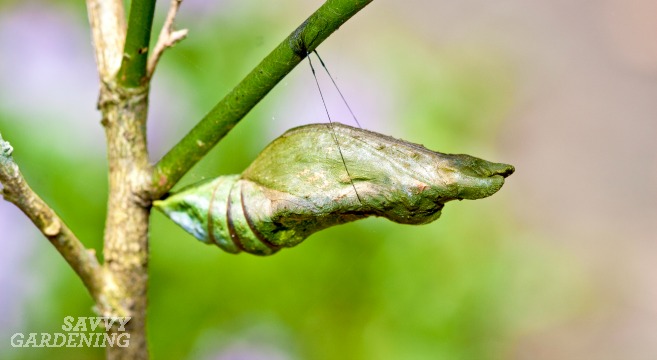
If part of your spring garden clean up involves pruning back woody perennials or shrubs, keep a sharp eye out for cocoons and chrysalises. Some of our most beautiful moths and butterflies spend the winter in a delicate cocoon dangling from a branch, including the swallowtails (see feature photo), the sulfurs, and spring azures. Allow any branches with a cocoon or chrysalis present to stay intact. You can always cut them back later in the season.
Related post: Flowers that attract butterflies: It’s not just about the grown-ups

A proper spring garden clean up should NOT be a destructive process. By taking your time and doing it right, you and your garden can reap the many benefits of a healthy population of pest-munching beneficial insects and pollinators.
Do you have any other tips for conducting an insect-friendly spring garden clean up? Share them with us in the comment section below.
Pin it! 

I have lots of untamed leaves, a large perennial bed, many hostas as well as a vegetable garden that all needs spring cleaning. The problem is that our city yard waste pick up is scheduled for March 24. Is there anything I can safely do now? It will probably be at least 3-4 weeks before the temps are consistently above 50 degrees.
This is a helpful post. Thanks for sharing this post with us.
I loved this article and think it is vitally important to share.
Back-saver tip when you do your clean-up.
Buy a ‘bedding fork’, a plastic one. Hardwares, TSC, or co-ops sell them. It looks like a shovel, but has about 15 tynes instead of a blade. Cost is $25 to $30, less on sale. Mine is a Garant, but there are other makes.
Mine is about 20 years old now, and good as new. It is light, but far more rugged than I imagined. It has added that many years to my gardening career. One can do the same for you, I expect, and add greatly to your comfort.
Hi Jessical
SO here is my dilemma. I love the idea of protecting good pollinators and beneficial insects, naturally, but in the vegetable garden (and I garden in a old, three generation veg garden as you know) we have many non-beneficial insects as well – and most if not all of these are either managed either by insecticide (not an option) or by strategy -meaning- outsmarting them as most if not all either winter-over in garden debris or underground in plant material that is either dormant or decaying. I’m building a list of damaging insects first that are most problematic such as wireworm (that firm, 1 inch orange, segmented worm one often finds in sod or acidic soils that plagues everything from the Maine potato growers to home perennial borders with Phlox paniculata, Asters and dahlia tubers. The worms live up to three or four years before pupating but winter over in roots of weeds and garden plants that are annuals particularly brassicas. So no keeping kale over through the winter for me. The only cure according to University of Wisconson and Rutgers is to clean the garden as best as you can every fall as even insecticides work well. This same topic keeps coming up in my talks as well particualrly with cabbage root fly maggot, that the UMASS studies show now winter over as eggs or adults at the base of all brassica crops (even arugula) in late autumn in debris or soil, and emerge in their first flight around May 5th here in New England. Their recommendation is first crop rotation every 5 years (not practical for home growers with raised beds) and cleaning the garden in the fall to remove old plant material where adults and eggs winter over. This is such a destructive insect – and one with at least 7 flights throughout the summer, its this first flight that does the most damage so removing all brassicas that are dead in fall has always been my best practice. Then, there are plenty of ‘bad’lepidoptera that winter over in ornamentals (iris borer and others that lay eggs in October with bearded Iris unless the foliage is cut off). so you can see my point, right? So while I totally embrace not cleaning up my wild areas or meadow areas, when it comes to ornamentals and the veg garden – I am still struggling with this trend. I havent even mentioned viruses, fungi AND worms in mulch as we now suffer with the Japanese Jumping Worm that loves mulch and leaf litter. We avoid it by allowing the ground to go fallow for some years keeping it perfectly clean as the eggs winter over and hatch in April. I don’t know – I mean I ‘get it’, the love and ‘feel-good’ actions of not cleaning up to save some beneficial insects, but is anyone telling the whole story out there? (Don’t tell me that it’s going to be me, either! I’m only presenting both sides in my next book !!) – I just would like to see presented the entire story, which sometimes has an answer that no one wants to hear. I thought that I would raise this other side of the issue. It reminds me of one question I got at a lecture recently where a woman asked me how I could stop the caterpillars from eating her pollinator trees!
Hi Matt – It’s a big question, isn’t it? What’s important to realize is that all that debris not only shelters potential pests but it also shelters many species of beneficial insects that help manage those pest. When we clean up both ornamental and vegetable gardens, we’re also removing overwintering sites for beneficials like ladybugs, lacewings, syrphid flies, parasitic wasps, big eyed bugs, damsel bugs, and many more. So, if we don’t cut the garden back and clean it out, in the spring, when the pests emerge, so do the beneficials — and those beneficials have an early food source and they manage pests more effectively when they can start early in the season. Because of the biology of animals, prey insects (such as many of the herbivorous pests in our vegetable garden) always reproduce at a faster rate than the predators (such as the beneficials I listed above), so without the beneficials around early in the season to help manage them, the pests can quickly reproduce to levels that are damaging to plants. It’s all about achieving a balance. Leaving the garden stand is a first, simple step in regaining the balance between pest/prey insects and predators. It’s a subject that I dive deeply into in my book with Timber Press, Attracting Beneficial Bugs to Your Garden. You may find it a useful read if you’d like more information about how cleaning up the garden affects the natural balance (including lots of research on the subject).
Love the autumn article and this follow-up. I saw more than one chrysalis while doing some light cleaning! Question though: when is it safe to aggressively clean up? I live in N.C. Zone 6-7.
A good rule of thumb is to wait until you have a week of consistent daytime temperatures in the 50’s before doing any cleanup.
I had previously asked a question, but perhaps it did not post properly. Do the beneficial insects winter over in rose canes? The ideal time to prune roses is much earlier, before they awake from dormancy, and the only info I can find on roses is about pests like cane borers.
While some beneficial insects may overwinter in hollow rose canes, it’s typically only inside of stumps left behind by the previous season’s pruning. They typically can’t get inside of fully intact stems such as those on roses, so you can safely prune roses early in the growing season without worry.
Thank you! This is very helpful! I did some garden clean up already, not having read this. Will try to spread out the dead stalks in the woods so the insects can more easily emerge. Wish I had left the leaves in the garden, though!
I have been leaving garden clean up until spring for the last few years with outstanding results. Gardens ARE beautiful in winter when you leave them be. Mother Nature doesn’t “tidy up” and neither should we.
Enjoyed the article. Wonder on your ideas about ornamental grasses? I have had Mexican feather grass in the past. I never cut it off; I just waited until it started to show green at the base and then after a good rain or watering, I would put on heavy gloves and tease the dead grass out. I see so much ornamental grass cut off that does not regrow.
I always cut my ornamental grasses back in the spring. I leave “stumps” about 10-12 inches tall. Since the bloom stalks of many grasses are hollow in the center, these cavities make great brood chambers for many of our smaller native bees.