
This post may contain affiliate links. If you make a purchase through links on our site, we may earn a commission.
Now that spring is on our doorstep, many of us are getting anxious to head out to the garden and clean things up. I know I am. We see all the dead ornamental grass stalks, the spent perennial stems, and the autumn leaves collected in our gardens and they give us spring fever. We want to bolt outside and spring clean the garden as soon as we can because we know that as the days get warmer, there will be more and more gardening chores to do. But, don’t head out with your favorite clippers and rake just yet! There’s a right way and a wrong way to do a spring garden clean up.
You may recall that last fall I wrote a post on all the reasons why you shouldn’t do a fall garden clean up. The post encouraged you to let your garden stand all winter in order to provide habitat for many of the beneficial insects and other creatures living in it. The post went viral (!!!). So now, spring has arrived, and if you didn’t do a fall garden clean up as I recommended in that post, you now have a big spring garden clean up facing you. Along the same vein as my fall post, I’d like to now offer you some spring garden clean up tips that encourage a similar level of habitat preservation for beneficial insects.
How to do a spring garden clean up the RIGHT way:
Step 1: Cut, bundle, and tie.
In early spring, many insects are still in diapause (a physiological state akin to hibernation). In other words, they’re still sleeping. Sometimes they wake up because the weather warms and sometimes they wake up because the day-length increases. Lots of beneficial insects, including pollinators like tiny native bees and pest-munching predators like syrphid flies, lacewings, and parasitic wasps, spend the winter hunkered down in hollow plant stems either as adults or pupae. Cutting down the dead plant stems too early in the spring will disturb them before they have a chance to emerge. Wait as long as you can to do your spring garden clean up. Ideally, you should wait until the daytime temperatures are consistently above 50 degrees F for at least 7 consecutive days. But, that being said, I’m well aware that gardeners like to cut down old plant stems before new growth starts, so as an alternative to delaying your spring garden clean up, here are two other options:
- Toss cut perennial and woody plant stems onto the compost pile very, very loosely, or spread them out at the edge of the woods. Many of the insects taking shelter inside the plant stems will still be able to emerge when the time is right. When you cut off the plants, leave about 8 inches of stubble behind. These hollow stems will serve as overwintering sites for future generations of insects and the new growth will soon hide them.
- Another option (and the one I prefer) is to take the cut stems and gather them into small bundles of a few dozen stems each. Tie the bundles together with a piece of jute twine and hang them on a fence or lean them against a tree on an angle. Again, the insects sheltering inside of them will emerge when they’re ready. An added bonus of this method: More insects, especially native bees, will move in to the stems and possibly use them as brood chambers all summer long.

Related post: Supporting native bees
Step 2: Do a CAREFUL leaf clean up
Again, waiting as long as possible to rake leaves out of perennial beds is the best idea. Hold off on your spring garden clean up until daytime temperatures consistently reach the 50s, if possible. Scores of beneficial insects – ladybugs, assassin bugs, and damsel bugs, for example – hunker down for the winter in leaf litter as adults. Others do so as eggs or pupae. And, adult butterflies, such as morning cloaks, question marks, and commas, nestle into leaf litter for the winter. Luna moths spend the winter in cocoons that look just like a crinkled brown leaf. As you clean up your leaves keep a sharp eye out for these insects and do your best not to disturb them.

Step 3: Don’t mulch… yet!
There are also many beneficial insects and pollinators who overwinter in soil burrows as either eggs, pupae, or adults. Some examples include the hummingbird clearwing moth, soldier beetles, and many native bees. Covering the ground with a layer of mulch too early in the spring may block their emergence. Hold off on mulching chores until the soil dries out a little and the weather warms.
Related post: 5 late-blooming pollinator friendly plants
Step 4: Prune with great care
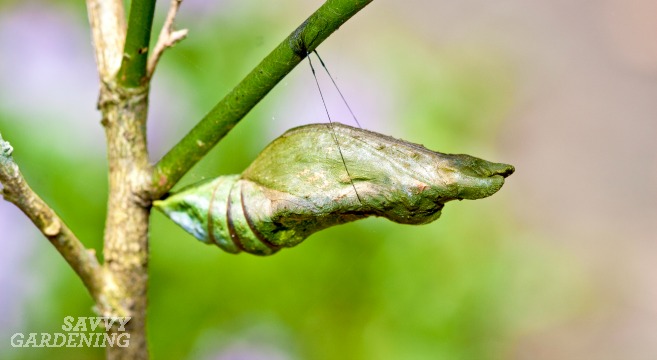
If part of your spring garden clean up involves pruning back woody perennials or shrubs, keep a sharp eye out for cocoons and chrysalises. Some of our most beautiful moths and butterflies spend the winter in a delicate cocoon dangling from a branch, including the swallowtails (see feature photo), the sulfurs, and spring azures. Allow any branches with a cocoon or chrysalis present to stay intact. You can always cut them back later in the season.
Related post: Flowers that attract butterflies: It’s not just about the grown-ups

A proper spring garden clean up should NOT be a destructive process. By taking your time and doing it right, you and your garden can reap the many benefits of a healthy population of pest-munching beneficial insects and pollinators.
Do you have any other tips for conducting an insect-friendly spring garden clean up? Share them with us in the comment section below.
Pin it! 

Great article. I sent to my gardening friends, AND to the guy who does some yard work for me. We definitely need to educate the professionals!
I save all my leaves in the fall, shred them, and apply thickly as a natural mulch in all gardens. It looks lovely and makes it so you don’t have to take up your leaves in the spring. Bugs can hibernate safe and sound!
Dear Reia,
I know it is difficult NOT to fall clean up ‘cuz it feels great to have your garden all tucked in and neat for the winter, but what you are doing is chopping up the overwintering insects, moth and butterfly eggs or pupae, etc. If we chop leaves in the fall instead of waiting until late spring when it’s warm enough for ALL the critters to have come out, we will have no moths or butterflies, nor will the baby birds have caterpillars to eat. There is tremendous loss of habitat and we are contributing to it by over-zealous tidying in addition to the invasive plants along the roads and in other unattended areas, exotic non-natives in our gardens which native insects can’t eat, plus overabundant deer in the forest destroying the understory that insects have plummeted 45% in the last 30 years. If we keep disposing our leaves and removing them from their host trees and cutting back perennials in fall, we are breaking the circle of life and making our ecosystem unhealthy. With the loss of insects we may find ourselves in the future unable to pollinate our crops, a very scary possibility.
Thank you for this article! I would also say keep leaves in the bed–keeps nutrition in your bed, feeds soil organisms which feeds the plants and creates better soil conditions. In the spring, I simply move the leaves off the tops of plants if they have gotten too think. Many plants are able to push up through the leaves, and the leaves settle nicely around the plant. Here’s a pic of tiny carpenter bees overwintering I had discovered when I accidentally stepped on a stem, and it broke open. I put them in a very protected area and loosely layered leaves/stems over them and am hoping they survive, but it really shows that these animals need a place to wait out winter.
Good post. But why take the leaves away at all? They serve to protect the soil and soil-dwelling organisms, provide “bird food,” and eventually become soil. Also, mulch is WAY overdone: 70% of native bees nest in the ground (they actually burrow into earth like ants do). Mulching everywhere prevents them from getting through layers of mulch to reach soil or may destroy their nests if they’re already nesting), so it’s best to leave some bare soil.
Great comments, Eileen. We agree that leaving the leaves in place is great for your garden (and all the critters living in it), as long as they don’t pile up too thickly over the crowns of your plants. And we also agree that over mulching disrupts native, ground-nesting bees. Here are two other articles you might find interesting that talk about habitat gardening for pollinators and other beneficial insects:
http://savvygardening.com/6-reasons-not-to-clean-up-your-garden-this-fall/
http://savvygardening.com/supporting-native-bees/
I agree 100% Eileen. I never use mulch, leave some leaves and just weed when I have to. When I moved to my new place the person who sold the house to me had all of those white marble stones all a long the house. I got rid of them worked the soil and now have some beautiful plants.
I am fortunate to have an area across the street where there is room under some shrubs to put the stems and grasses I cut back each spring. There are several spaces, so the piles don’t get high enough to get hot. I have also been cutting a bit higher on some of the stems.
I am in SE Nebraska, and have taken the top layer of leaves from our curb beds, and cut back the plants in our curb area. I still left some of the plant that had seedheads the birds may still be eating from. We have pasque flowers blooming now!
Thanks, Jess. I’ve always wondered about the right time to do this part.
Another thought – cut higher. Leaving 12-18″ of stem will often preserve stem-nesting critters but still give a tidy garden appearance.
Brilliant post – shared with all my friends.
Thanks for the timely post! Always good to keep the critters in mind.
Awesome article! Thank you for making us more conscious of our environment!
Great article. I also cut stems high for safety reasons. Cut too low you may not see them, it is a trip & fall hazard.Especially as we get older.
Safety is no accident!