
This post may contain affiliate links. If you make a purchase through links on our site, we may earn a commission.
If you’re looking for an easier way to garden, elevated raised bed gardening may just be your new best friend. With this technique, you can harvest oodles of fruits and veggies, armloads of flowers, and endless bunches of herbs with minimal effort. It’s seriously easy to garden in elevated raised beds! To help us share the joys of this super-simple method of growing, we’ve teamed up with Gardener’s Supply Company, a Vermont-based, employee-owned company that manufactures beautiful raised planter boxes and lots of other tools to make gardening both fun and trouble-free.
Introduction to elevated raised bed gardening
Gardening in elevated raised beds is basically a hybrid gardening technique. It’s half container gardening and half raised bed gardening. Traditional raised beds lack a bottom and are fairly large in size, while containers have a base to contain the soil and are far smaller than a raised bed. Elevated raised bed gardening combines the best of both worlds.
With this method, the soil is completely contained and the growing area is substantially sized. Then, to put the proverbial icing on the cake, elevated raised bed gardening gives the gardener a literal leg up by raising the planting area up to working height.
As you’re about to learn, there are multiple benefits of gardening in raised planters—and getting started is a snap!

The benefits of elevated raised bed gardening
The perks of gardening in elevated raised beds are many. Aside from the obvious advantage of never having to bend over or kneel to plant or pick your peppers and pansies, gardening in an elevated planter box means you’ll be able to enjoy the following:
- No weeds (take that, bittercress!)
- No ground-dwelling pests to nibble plant roots
- No soil-borne fungal diseases to contend with
- No rabbits and groundhogs munching on your lettuce
- No need to set up a sprinkler or drip system to water
- No issues with water-logged clay soil or fast-draining sandy soil
- No need to leave the deck or patio to harvest
- No back aches, creaking knees, or inflamed hip joints (goodbye, ibuprofen!)

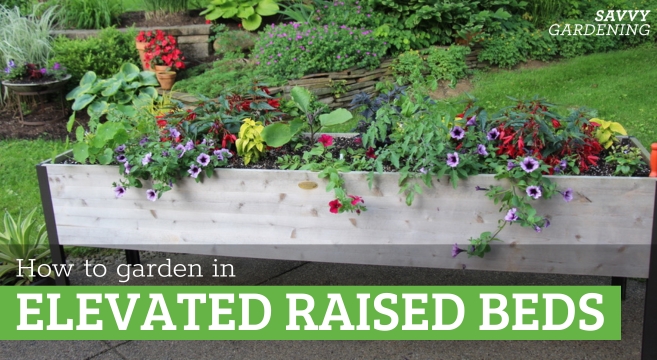
This elevated raised bed from Gardener’s Supply Company is perfect for growing a wide array of plants. The height makes it super easy to maintain. Photo courtesy of Gardener’s Supply Company
Selecting raised planter boxes/elevated raised beds
When shopping for an elevated raised bed, here are a few traits to keep in mind.
1. First and foremost, look for a planter that has drainage and is made from materials that will last for many years. The beautiful elevated raised bed from Gardener’s Supply Company shown above and below, for example, is made from naturally rot-resistant cedar boards with sturdy, rust-proof aluminum legs. It will weather many seasons without issue, and the legs can support hundreds of pounds of soil and plant material. They also offer different sizes and a self-watering option. I have had mine for several years now, and it still looks great! The wood has weathered quite nicely. I currently grow strawberries in mine, though I’ve also grown vegetables and fruits in it during previous seasons.

2. Make sure your raised planter box is a safe place to grow food. If you plan to plant edibles, it should be free from plastics, harmful paints and stains, and chemically preserved woods.
3. Next, consider the planter’s size. Elevated raised bed gardening means the roots of your plants will be restricted by the dimensions of the bed. Make sure the raised planter you choose is deep enough to handle root crops, like carrots and parsnips, and provides plenty of room for the roots of larger plants, like tomatoes, eggplants, sunflowers, and others. The dimensions of the planter box featured in this article are 92″ long, 24″ wide, and 10″ deep—perfect for a wide range of flowers, fruits, veggies, and herbs!
4. The total height of your elevated raised bed garden is important, as well. If it’s too tall, you’ll get tired of reaching up, but if it’s not tall enough, the constant slight bend in your back will have you at the chiropractor’s in short order.
5. Lastly, it’s important to consider the planter’s maintenance needs. Elevated raised bed gardening is supposed to make your life easier, not complicate it. Skip planter boxes that require yearly painting or staining, or those that will rust, warp, or become brittle with constant exposure to sunlight.
Placing your elevated garden planter
Once you’ve selected the elevated raised bed that’s right for you, it’s time to put it in place. These planters are heavy when filled to the brim with soil, so don’t fill the planter box until you’re happy with its placement.
Most fruits and veggies require at least 6 to 8 hours of full sun. Gardeners planning to grow edibles when elevated raised bed gardening need to place the planters in full sun. If you’re growing sun-loving annuals, the rule is the same. But for shade-lovers, a nice spot in the shade or part shade will do just fine.
In addition, make sure your raised planter box is close to a spigot or rain barrel to make watering a snap. Lugging watering cans to a distant location every day can be a real drag. Another easy option is to use a self-watering elevated planter bed like this one. Keeping your garden close to the kitchen door is a plus, too!

Filling your raised planter box
As with in-ground growing, the secret to successful elevated raised bed gardening is in the soil. While most elevated planter boxes are sturdy, they aren’t built to hold heavy, clay-based garden soil. Instead, they’re designed to be filled with a mixture of high-quality potting soil and compost. Mix 2/3 potting soil with 1/3 compost, toss in a few handfuls of organic granular fertilizer, and you’ll be ready to grow! (Unless, of course, you’re going to be growing cacti and/or succulents in your raised planter; in that case add coarse builder’s sand to the mix, instead of compost.)

What to grow when elevated raised bed gardening
When it comes to gardening in raised planters, the possibilities are endless! There are so many plants that will do wonderfully in such an environment.
- Plant an elevated raised bed full of compact vegetable varieties, including ‘Tumbling Tom’ tomatoes, ‘Fairy Tale’ eggplants, ‘Mohawk Patio’ peppers, and ‘Thumbelina’ carrots.
- Or how about growing an herbal paradise? ‘Spicy Globe’ basil, creeping thyme, lemongrass, rosemary, and parsley will perform to perfection.
- Small-statured berry plants, such as ‘Strawberry Shortcake’ red raspberries, ‘Top Hat’ blueberries, and strawberries, are beautiful and productive in an elevated raised bed.
- Flowers are another lovely option. Most annuals do quite well in raised planters, just be sure to include a few trailing varieties to spill over the bed’s edge.
- Fairy gardens and miniature plants are another unique option, especially since they’ll be at eye-level for curious little hands and eyes.
- You can even plant dwarf flowering shrubs and small-statured evergreens when gardening in an elevated raised bed. Doing so will make a great privacy screen between close balconies, patios, and porches.
We hope you enjoyed this in-depth look at the many advantages of elevated raised bed gardening and all the possibilities it brings to the landscape. A big thank you to Gardener’s Supply Company for allowing us to feature their elevated planter and share this exciting and oh-so-easy style of gardening with our Savvy Gardening readers.

Hello
I recently purchased an elevated cedar planter for my veggies this year. 6*2*2. Do I need to line the bottom of the planter with anything? Like cardboard? Or can I put soil directly into box? Do I need drainage holes? Thanks for your help .
You can put the soil directly into the box. Or you can line it with landscape fabric or plastic with holes punched into it.
Can I grow a 3 sisters garden in a raised garden bed like this one?
You could give it a try, but you’ll need a lot of corn plants for them to cross-pollinate (corn is wind pollinated so there has to be a lot of it in order for ears to form).
I purchased a cedar raised planter… 4 feet by 18 inch by 34 inches, although the raised part inside is about 12 inch deep. It also came with a plastic liner, and there are no holes yet. I plan to use 13″ x 13″ grow bags inside, as this is for my seasonal home (trailer site). I am wondering, should I remove the plastic liner, since I am using the grow bags, or leave the plastic liner, and just make a couple holes for drainage?
I don’t think you need the plastic liner if you plan to use the grow bags.
We live in Minnesota. This is our first winter with a 2’ x 8’ elevated garden in the back yard. How do we prepare it for the “arctic blast” of winter?
There’s no preparation needed if you’ve harvested all of the plants out of it and it’s made from frost-proof materials (wood or metal). Perhaps covering with plastic would be a good idea to keep the water out which could freeze and cause the frame to crack. However, this isn’t a necessary step. Fall would be a good time to paint, stain, or seal the wood for added longevity.
My backyard has a hill and the previous owner built steps to go from the lower section to the upper section. On each side of the stairs, there are flower planters built with side walls and a some type of cloth between the walls to hold soil in which to plant flowers. The wooden walls are about 6 inches apart and the cloth used to hold the soil sags about 12 inches. The walls are 2 feet high. The stricture makes a nice flower bed on each side of the stairs. I don’t know how long ago these flower beds were built. I’ve had the house for 6 years. This year the cloth has ripped and needs to be replaced. I’m at a loss as to what kind of material to use to replace the original fabric. I’ve tried looking but it seems that the only material that would work is provided for pre-built flower beds. I just need material by the yard. Do you have any suggestions?
Pete
I would head to a large landscape supply center and ask them for geotextile fabric. It’s often used beneath landscape pavers and will work for your needs.
My daughter just had a raised box built for my birthday. We never even discussed what material to use to build it. It was made with pressure treated wood. I planned on using it for produce. Is there anything I can place inside the box that would make it alright for edibles?
Pressure treated lumber has come a long way. It’s no longer treated with Chromium copper arsenate (CCA), so that’s good. Modern pressure treated lumber isn’t as bad as the “old stuff” but you still may want to consider lining the container with food-grade plastic before filling it with soil.
Hi Jessica –
I just purchased the 2’ x 8’ Elevated Cedar Planter Box from Gardener’s Supply Company. We lined the bottom with the landscaping cloth it came with and filled it with an organic raised bed potting mix and planted vegetables. Some of the plant leaves are a little yellower than I’d like. I have stopped watering too frequently which could have been part of the issue (down 3x a week now). Wondering if we needed to have drilled a few holes in the bottom? The bottom cedar boards that hold the soil are lined up next to each other with tiny spaces in between. I have yet to mix in the plant food. Just concerned about root rot or other moisture issues. Thank you!
That’s the planter I have. Water drains just fine between the slats, but the soil is often wet further down, even when the top of the soil is dry. Stick your finger way down in before deciding whether or not you need to water. Fertilizers get washed out pretty quickly, so you might want to opt for a twice-monthly liquid fertilizer application. I like liquid kelp.
Hi Jessica, I also bought an elevated planter. I didn’t think of the wood rotting but I don’t want the water to drip on my patio floor through the wood panels. Can I layer the bottom with thick plastic and make a hole on each end. Catch the runoff water with a cup underneath each hole? But then the wood on each end will rot.
You need to make a drainage hole of some sort, but if you’re worried about protecting your patio, I think your catch basin idea would work. Another option would be to put a heavy-duty grill mat beneath it to protect from staining.
Love this article! I’m new to gardening and I have raised cedar vegetable beds on legs. I also live in Maine. In the Winter, Will it be OK to leave them exposed to the snow? Also should I cover them with something? Thank you, Irma
Yes. Cedar is weather-resistant and will do find outdoors in the winter.
I just got an elevated planter box made for my balcony. We’ve lined it w/ landscape fabric et al but someone else is below me and I don’t want water from waterings to drip down to her. Do you suggest a self water system of sorts so there is a reservoir and there is no overwatering and hence no drips down below to worry about?
Rather than doing something fancy like this, I recommend purchasing an expensive grill mat (it goes under barbecue grills to catch the grease drips) and putting it under the elevated raised bed. If you can find one with raised edges, even better.