
This post may contain affiliate links. If you make a purchase through links on our site, we may earn a commission.
If you’re looking for an easier way to garden, elevated raised bed gardening may just be your new best friend. With this technique, you can harvest oodles of fruits and veggies, armloads of flowers, and endless bunches of herbs with minimal effort. It’s seriously easy to garden in elevated raised beds! To help us share the joys of this super-simple method of growing, we’ve teamed up with Gardener’s Supply Company, a Vermont-based, employee-owned company that manufactures beautiful raised planter boxes and lots of other tools to make gardening both fun and trouble-free.
Introduction to elevated raised bed gardening
Gardening in elevated raised beds is basically a hybrid gardening technique. It’s half container gardening and half raised bed gardening. Traditional raised beds lack a bottom and are fairly large in size, while containers have a base to contain the soil and are far smaller than a raised bed. Elevated raised bed gardening combines the best of both worlds.
With this method, the soil is completely contained and the growing area is substantially sized. Then, to put the proverbial icing on the cake, elevated raised bed gardening gives the gardener a literal leg up by raising the planting area up to working height.
As you’re about to learn, there are multiple benefits of gardening in raised planters—and getting started is a snap!

The benefits of elevated raised bed gardening
The perks of gardening in elevated raised beds are many. Aside from the obvious advantage of never having to bend over or kneel to plant or pick your peppers and pansies, gardening in an elevated planter box means you’ll be able to enjoy the following:
- No weeds (take that, bittercress!)
- No ground-dwelling pests to nibble plant roots
- No soil-borne fungal diseases to contend with
- No rabbits and groundhogs munching on your lettuce
- No need to set up a sprinkler or drip system to water
- No issues with water-logged clay soil or fast-draining sandy soil
- No need to leave the deck or patio to harvest
- No back aches, creaking knees, or inflamed hip joints (goodbye, ibuprofen!)

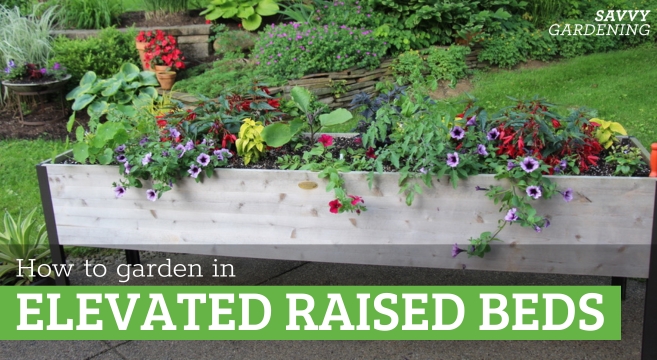
This elevated raised bed from Gardener’s Supply Company is perfect for growing a wide array of plants. The height makes it super easy to maintain. Photo courtesy of Gardener’s Supply Company
Selecting raised planter boxes/elevated raised beds
When shopping for an elevated raised bed, here are a few traits to keep in mind.
1. First and foremost, look for a planter that has drainage and is made from materials that will last for many years. The beautiful elevated raised bed from Gardener’s Supply Company shown above and below, for example, is made from naturally rot-resistant cedar boards with sturdy, rust-proof aluminum legs. It will weather many seasons without issue, and the legs can support hundreds of pounds of soil and plant material. They also offer different sizes and a self-watering option. I have had mine for several years now, and it still looks great! The wood has weathered quite nicely. I currently grow strawberries in mine, though I’ve also grown vegetables and fruits in it during previous seasons.

2. Make sure your raised planter box is a safe place to grow food. If you plan to plant edibles, it should be free from plastics, harmful paints and stains, and chemically preserved woods.
3. Next, consider the planter’s size. Elevated raised bed gardening means the roots of your plants will be restricted by the dimensions of the bed. Make sure the raised planter you choose is deep enough to handle root crops, like carrots and parsnips, and provides plenty of room for the roots of larger plants, like tomatoes, eggplants, sunflowers, and others. The dimensions of the planter box featured in this article are 92″ long, 24″ wide, and 10″ deep—perfect for a wide range of flowers, fruits, veggies, and herbs!
4. The total height of your elevated raised bed garden is important, as well. If it’s too tall, you’ll get tired of reaching up, but if it’s not tall enough, the constant slight bend in your back will have you at the chiropractor’s in short order.
5. Lastly, it’s important to consider the planter’s maintenance needs. Elevated raised bed gardening is supposed to make your life easier, not complicate it. Skip planter boxes that require yearly painting or staining, or those that will rust, warp, or become brittle with constant exposure to sunlight.
Placing your elevated garden planter
Once you’ve selected the elevated raised bed that’s right for you, it’s time to put it in place. These planters are heavy when filled to the brim with soil, so don’t fill the planter box until you’re happy with its placement.
Most fruits and veggies require at least 6 to 8 hours of full sun. Gardeners planning to grow edibles when elevated raised bed gardening need to place the planters in full sun. If you’re growing sun-loving annuals, the rule is the same. But for shade-lovers, a nice spot in the shade or part shade will do just fine.
In addition, make sure your raised planter box is close to a spigot or rain barrel to make watering a snap. Lugging watering cans to a distant location every day can be a real drag. Another easy option is to use a self-watering elevated planter bed like this one. Keeping your garden close to the kitchen door is a plus, too!

Filling your raised planter box
As with in-ground growing, the secret to successful elevated raised bed gardening is in the soil. While most elevated planter boxes are sturdy, they aren’t built to hold heavy, clay-based garden soil. Instead, they’re designed to be filled with a mixture of high-quality potting soil and compost. Mix 2/3 potting soil with 1/3 compost, toss in a few handfuls of organic granular fertilizer, and you’ll be ready to grow! (Unless, of course, you’re going to be growing cacti and/or succulents in your raised planter; in that case add coarse builder’s sand to the mix, instead of compost.)

What to grow when elevated raised bed gardening
When it comes to gardening in raised planters, the possibilities are endless! There are so many plants that will do wonderfully in such an environment.
- Plant an elevated raised bed full of compact vegetable varieties, including ‘Tumbling Tom’ tomatoes, ‘Fairy Tale’ eggplants, ‘Mohawk Patio’ peppers, and ‘Thumbelina’ carrots.
- Or how about growing an herbal paradise? ‘Spicy Globe’ basil, creeping thyme, lemongrass, rosemary, and parsley will perform to perfection.
- Small-statured berry plants, such as ‘Strawberry Shortcake’ red raspberries, ‘Top Hat’ blueberries, and strawberries, are beautiful and productive in an elevated raised bed.
- Flowers are another lovely option. Most annuals do quite well in raised planters, just be sure to include a few trailing varieties to spill over the bed’s edge.
- Fairy gardens and miniature plants are another unique option, especially since they’ll be at eye-level for curious little hands and eyes.
- You can even plant dwarf flowering shrubs and small-statured evergreens when gardening in an elevated raised bed. Doing so will make a great privacy screen between close balconies, patios, and porches.
We hope you enjoyed this in-depth look at the many advantages of elevated raised bed gardening and all the possibilities it brings to the landscape. A big thank you to Gardener’s Supply Company for allowing us to feature their elevated planter and share this exciting and oh-so-easy style of gardening with our Savvy Gardening readers.

I just purchased a raised bed with 30″ legs. It came with a black plastic liner with small holes throughout the liner. I worry that the holes will eventually fill with dirt and not provide proper drainage. This is a cedar box. Could I add aged leaves rather than the liner?
I would suggest lining it with something inorganic to keep the wood from rotting. You can always make the holes in the liner larger if you’d like. Or use landscape fabric.
I am about to purchase the elevated planters. They asked if I wanted to have holes at bottoms.
It’s ceder wood elevated planter box of 6ft X 2ft and 2ft height.
Do we need the holes and if we do how many would be suggested?
Thank You!
I would say yes to drainage holes. For a 6 foot bed, 3 or 4 should do.
Can you remove the wood bottom of an elevated bed and replace with 1/4” heavy wire screening and landscape fabric? Removing the extra weight from the planter would be nice so if I wanted to move it. Would the wire/landscape fabric with support be ok or would it cause too much moisture to escape?
I would worry that the screening or fabric would not be strong enough to support the weight of all that soil. If it would tear or rust, or you couldn’t fasten it securely enough, you would have quite a mess.
Do you put layer of rocks in bottom of the elevated garden?
No. Contrary to popular believe, rocks in the bottom of a container do not improve drainage.
What methods do you use for watering? I have a soaker hose in mine but I feel like the water just runs right through the soil and out of the box as soon as I turn the water on. I’m worried the Water isn’t having enough time to soak through the soil for an even watering.
I water mine from the top with a soft rain wand. Soaks in really well. If you allow the soil to get too dry between waterings, you’ll have a lot of run off. Try to keep the soil consistently moist to prevent this.
What is garden soil temperature in elevated raised beds? Is soil temperature 7-10 degrees less than ground soil? Is the soil temperature sane as air temperature?
Good question. I’m honestly not sure. If you want to warm the soil earlier in the spring, I suggest covering the bed with dark plastic to absorb more heat. Would be an interesting experiment to do if you have a soil thermometer.
So is planter box with great ceder wood with a plastic lining not healthy for the veggies. About to purchase and dont want to make the wrong room. Def want to grow organic.
The use of plastic is really a personal choice. If it’s food grade, it’s considered safe, but personally you may want to avoid it. The use of plastic is allowed under the National Organic Standards in the US.
I was in a local Rural King store and came across their raised animal watering troughs. It was the perfect height for me and at about $130, the price was reasonable. The size inside was 9 feet long by 22 inches wide and 10 inches deep. Just perfect. It just needed to have holes drilled into the bottom. It was set on a metal frame that should provide years of functionality.
I bought three and arranged it in the shape of a “U” making it just perfect for easy accessibility. A new wire fence was being installed in the back yard so I had them install some extra fencing around my garden area creating a room away from the dogs. My big dog is not opposed to pulling up the plants. The fenced room was ten feet wide and 20 feet long that made the fit perfect for the beds. The fence can also be utilized for anything that is grown that will vine and need support.
Thank you for this interesting post. I’m just getting into gardening and am particularly interested in raised beds for a number of reasons. I’m wondering what material for the planter to choose: the post says, no plastics if it’s for foods, but I saw Niki in a video saying she’d been using the Lee Valley Vegepod Containter Garden for food crops. I’d really appreciate your thoughts on this. All be the best!
BPA-free food-grade plastics are best, if you choose to grow in plastic containers. It’s up to the individual. I don’t like to grow food in plastic, though plenty of folks do.
Where do you get this compost soil? We have our own compost, but not at the capacity that it would turn into soil. Can you purchase this ready to go?
I use the leaf compost our municipality gives away each spring. If I can’t get it from them, then I purchase it in bulk from our local landscape supply company. You can also purchase it in bags from a garden center or even online. Here’s a bagged compost I recommend: https://www.amazon.com/Dr-Earth-803-Purpose-Compost/dp/B005MIC5HG/ref=as_li_ss_tl?keywords=compost+bagged&qid=1559321935&s=gateway&sr=8-1&linkCode=ll1&tag=savvygarde-20&linkId=60f5e12ca7dd82512c4e620d6050d8d5&language=en_US