

This post may contain affiliate links. If you make a purchase through links on our site, we may earn a commission.
While having the correct light levels and watering properly are two of the most important steps in growing healthy indoor plants, houseplant growers also have to constantly monitor their plants for signs of pests. There are many types of houseplant bugs, and arming yourself with a little information goes a long way toward preventing or eliminating an infestation. In this article, I’ll introduce you to some of the most common houseplant pests and hand you tips to prevent and control them.

Preventing all types of houseplant bugs
Certain houseplants are definitely more prone to pest issues than others, but houseplant bug problems are often prevented by following a few simple steps.
- Carefully inspect all new plants before bringing them into your home. Many types of houseplant bugs piggyback their way into your house from the nursery where the plants were grown. Before buying new plants (or taking in “strays” from friends and family), be sure to examine the plant from top to bottom, looking on leaf undersides, along the stems, and even in the soil for signs of the common houseplant insect pests I’m going to introduce you to below.

Carefully inspect new houseplants for pests before you bring them home from the garden center. - Even if you think a new plant is pest-free, it may have pest eggs or young pests that you can’t yet see. Before putting any new houseplants with ones you already have, put it in solitary confinement in a separate room for a few weeks. Watch it carefully for signs of houseplant insect pests and only put it in close contact with other plants after it’s been confirmed to be pest-free. You can also place a few yellow sticky cards just above the top of the plant. Many pest insects are attracted to the color yellow, and they’ll quickly get trapped on the card. Check the card every few days for any insects. If you have some on the card, you probably have many more on the plant itself.
- Before moving them back indoors, do a “detox” on any houseplants that have spent the summer outside. While most houseplants love to be outside during the warmer months, they often come back inside with several different types of houseplant bugs hitch-hiking on them. The day before moving houseplants back indoors, spray the entire plant – including the lower leaf surfaces and stems – with a sharp stream of water from the hose, using a spray nozzle that emits a forceful spray. This is often all that’s needed to dislodge any pests before moving the plant inside.

Check all leaf surfaces carefully for signs of pests. You’ll need to use a sharp stream of water from the hose to dislodge them, not a hand sprayer. - Keen observational skills definitely allow you to control many types of houseplant bugs before their populations explode. Examine plants weekly throughout the year, checking for both the insects themselves and signs of their damage.
- Another sign that indicates you may have one of several different types of houseplant bugs is the presence of a sticky substance on the plant itself, or on the surface of the table or floor beneath the plant. This shiny, sticky substance is called honeydew, and it’s the excrement of several different pests, including almost all of the houseplant pests mentioned below. The presence of honeydew is a clear sign of pest issues.
Types of houseplant bugs
The warm, consistent temperature of most homes is ideal for rapid pest breeding. Plus, without ladybugs, parasitic wasps, and other beneficial insects in your home to keep pests in check, houseplant insect pests can go from numbering just a few to an all-out infestation in no time flat. Here are five of the most common types of houseplant bugs and what to do about them.
Fungus gnats
Adult fungus gnats are super annoying. These minuscule black flies are the classic example of a nuisance pest. When an infested plant is disturbed, a cloud of tiny flies lifts off the soil. Mature gnats life for about a week, and although they’re a pain, they don’t damage your plants. Neither do the larvae, who largely feed on the fungi that naturally grows in potting soil. Because the eggs and larvae need water to survive, fungus gnat infestations are frequently the result of overwatering. A simple reduction in watering is often all that’s needed to control this common houseplant pest. But, if that doesn’t do the trick, beneficial nematodes added to the soil will definitely take care of the problem.

Scale
Another of the more common types of houseplant bugs, scale is sometimes difficult to spot. There are many different species, each with a unique appearance, but the most common houseplant pest scales look like little bumps and are found along the stems and on leaf undersides. The species that attacks ficus trees, looks more like little flecks (see the Pinterest image at the top of this article). Scale insects often have a hard, shell-like covering that makes them difficult to spot and control. They can be gray, black, brown, or even fuzzy.
Most scales leave behind the honeydew I mentioned above, so if you see a shiny glaze on the plant, check it for scale. When it comes to houseplant bug problems, scale is probably the most difficult to control. I like to wipe them off my plants with a special cotton pad soaked in isopropyl rubbing alcohol. Physically wiping the pest off the plant multiple times over the course of a few weeks offers the best control. But, another option is to use an organic, neem-based pesticide. Take the plant into a garage or outdoors to apply it, and be sure to follow label instructions.

Whiteflies
This common houseplant pest does not survive freezing winter temperatures, so it’s typically troublesome outdoors only in southern regions. But, whiteflies are one of the most problematic types of houseplant bugs because when they’re indoors, the insects are protected from freezing temperatures and their populations can grow quite rapidly. Whitefly issues frequently originate via a plant purchased at an infested greenhouse, which makes a careful inspection of any new plants extra important.
These tiny, white, moth-like flies are found on leaf undersides and will quickly fly off the plant when it’s disturbed. Since whitefly reproduce so rapidly, their sap-sucking behavior can leave plants wilted, and with stunted growth and yellow foliage. Whiteflies are readily trapped by placing yellow sticky cards just above plant tops. Applications of insecticidal soap and horticultural oil are also effective. Since all three of these products work best when they contact the insect pest directly, try not to disturb the plant when applying, and be sure to cover both upper and lower leaf surfaces.

Aphids
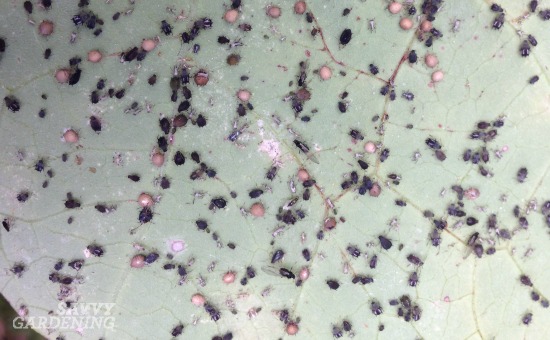
Though they’re small in size, aphids can cause big problems. Of all the types of houseplant bugs discussed here, aphids are the ones I encounter the most frequently on my own houseplants. Tiny and teardrop-shaped, aphids can be black, green, red, yellow, or brown. Sometimes they have wings and sometimes they don’t, but they’re most often found grouped together on new growth or on the undersides of leaves.
As they suck plant sap through their needle-like mouthparts, aphids cause deformed and stunted plant growth. Small infestations are easily wiped off of plants with a soft, plant-friendly cloth soaked in water, but as with all types of houseplant bugs, when there’s a big infestation, other measures may be warranted. Aphids can also be controlled organically with horticultural oil, or insecticidal soap. Be sure to apply these products so they come in direct contact with the aphids themselves for the best results.
Spider mites
There are many types of houseplant bugs, but spider mites may just be the ones with the biggest “heebie jeebie” factor. Actually, these guys aren’t bugs at all. Instead, they’re close relatives of spiders. These teeny-tiny houseplant pests cause major issues, not just for plants but also for the homeowner facing the infestation.
Though you can barely see them without the help of a magnifying glass, once you know they’re in your house, it’s hard to get them off your mind. Spider mites spin a fine, silky webbing, and collectively, they can cover the entire plant with it. If you look carefully, you’ll see tiny specks crawling around on the webbing; those are the mites themselves. The featured image of this post shows a spider mite infestation on an indoor palm tree.
But, before you toss your spider mite-infested ivy or palm plant into the garbage, there are a few steps you can take to get this common houseplant pest in check. First, take the plant outdoors or into the shower and “wash” it off with a spray of water. Spider mites are tiny and are easily washed off the plant. Be sure to rinse both upper and lower leaf surfaces. Then, after the plant has fully dried, use a light-weight horticultural oil to smother them. Reapply the horticultural oil every 10-14 days for two more applications for the best control.

Other types of houseplant pests
Though there are a handful of other indoor plant pests that may occasionally prove problematic, these five types of houseplant bugs are by far the most common. But, by following the five preventative steps featured at the beginning of this article and using the suggested mechanical and organic product controls, you’ll be able to keep most of these little buggers from causing any real issues.
Remember, arming yourself with a little information goes a long way toward growing healthy, pest-free houseplants. Be smart about your choice of plants. For apartment dwellers, our list of the best houseplants for small spaces offers plenty of great plant choices. Healthy houseplants are better able to fend off pests, too. We’re sure you’ll find our guide to houseplant fertilizer basics very useful, too.
More posts about managing pests
- Our guide to vegetable garden pests
- Grub worm: Organic control tips for the lawn
- Pests of roses and their organic control
- How to prevent pests in the garden: 5 strategies
- Identifying garden pests: How to figure out who is eating your plants
Which types of houseplant bugs have you faced? How did you control them? Tell us about your experience in the comment section below.

Hi Jessica!
None of the above examples look or sound familiar.
Living in the soil of some of my large indoor houseplants (fig, poinsettia) that otherwise seem to be healthy and thriving are small 4-5cm brown powdery straight-bodied winged insects– maybe a moth of some kind? I don’t see any evidence of leaf munching.
Any idea how to get rid of something like these?
Is it possible that they would be clothes or pantry months that are sitting on the soil of your houseplants to access moisture? I would put out a pantry moth trap (available on Amazon or other online sources) next to the houseplants and see if you catch any moths. If they go into the trap, which is pheromone-based, then you know that’s what you have.
I think i found one singular thrip on my alocasia (one tiny tiny skinny black bug) — there’s no damage so far, but should I spray down the entire plant with neem to be sure? I haven’t found any other bugs on it, and I’ve inspected every leaf with a flashlight.
I would avoid spraying unless you know there’s a clear infestation. Most times the presence of a single bug does not mean your plant is doomed. Watch it carefully for more insects and should more happen to arrive, try hand squishing or washing the plant off before using any pesticides, organic or otherwise.
Hi l notice on some of my indoors plants got like a tiny cotton ball..is a small as a pin head..when l squeeze it there is blood..l try to spray them with soap and water but l cannot get rid of them..please help ..
This sounds like a type of cottony scale. Follow the advice for managing scale in this post.
Hi! I just noticed these tiny red bugs have taken over my string of pearls. They’re only on the foliage stems, not soil (as far as I can tell), and they don’t move at all! Any ideas what they are and how I can get them gone? I have so many house plants and only two large windows so my plants are all in close proximity. Please Help!!! Thank you!
If they aren’t moving, it sounds like it may be a type of scale. Follow the management instructions in the scale section of this article and that should solve the problem.
I just noticed tiny dark brown things that move like an inch worm. They seem to be hanging in air. A Web maybe. But is on a philodendron plant in my house. Help! Any suggestions? I’ve had this plant for 4 years and never saw them before. I’ve had my plant hanging in the same place since I got it. Thanks, Michelle
If there’s just one or two of them, I wouldn’t worry about it. Probably just piggybacked indoors. They don’t sound like any common houseplant pest, so I doubt they’re feeding on the plants.
I have small mites on my Elephant ears that i thought were spider mites, but they haven’t woven any webs and there’s no evidence of any threads. They’re perhaps half a millimeter in length and have a round almost chubby beetle like shape. They are a very light yellow color and slightly transparent, however a small few amount are a darker almost black. They have three pairs of legs and look to have two horns on the rear of their back? They haven’t caused much visible damage yet. I’m concerned that the mites could be doing more long term damage, and cause the plants to not survive this upcoming winter.
I am not sure what they could be, and It has been bothering me for some time now. I haven’t been able to specify what they are, as everything contradicts itself in the research I’ve done on the internet.
~Here’s some extra information that may or may not be useful:
About maybe 5 months ago in spring I had bought the two Elephant Ear plants (Bikini Tini variant) from a nursery that looked very happy and healthy. I had originally planted them in plant pots outdoors. Where I live has high elevations, due to this it is very windy, dry as well. Since these conditions prove fatal to Elephant Ears, I decided to move them indoors. They’ve been sitting by south-west facing windows and seemed to be doing great the first couple of weeks to months I’ve had them.
Awhile ago I had noticed that they’ve seemed sad and I looked closer and noticed small mites on the undersides and the tops of the leaves, partially along with the stems (I suspect the mites were dormant in the base of the stem until this point and came out). Without doing much research, I had sprayed flying bug pesticide on the leaves. Regrettably I found my leaves basically dead the next morning. But a few weeks after, the plants grew maybe 4 more stalks with healthy leaves, however i still saw the mites. I did more research and decided to wipe it down with water for several days, which seemed to work. They had still come back in small numbers inside the stems and on the leaves between cleanings. I had missed some days and forgotten to do that, and found that they had grown to a slightly concerning amount.
The mites haven’t seemed to have caused too much damage, but the plants do seem reasonably sad, and the edges of the oldest leaves, at most were a month old, have become brown and crumble off if disturbed. The leaves also lose their resistance to water a few weeks after sprouting. Not mite wise, I have been watering them every time the soil starts to feel dry, and been spraying water in the air and on the plant to try to keep its native humidity. The pot that they are in is around 2 feet in diameter, and perhaps 12x the size that their original enclosed pots I had bought them in. I don’t think that I’ve lacked in nurturing it, so I believe that it is being caused by the mites.
So far I’ve only seen the mites on my Elephant ears, as i planted several small Impatients in the pot originally with them, although I did see several directly below the Elephant Ear leaves that might have fallen down. I have a small potted Basil plant on the windowsill less than a foot away that i have inspected multiple times and I haven’t seen a single mite on it. I have other plants within the house that haven’t ever been seen to have mites and seem all okay.
I don’t think you have mites on your Elephant Ears; I think you have an aphid infestation. The two “horns” (called cornicles) at the back end of the insect are a defining feature of aphids. No other insects have cornicles. Follow the instructions for management in the aphid section of the above article and that should remedy the issue.
Hi,
I have indoors plants and I saw like fruit flies on the soil. I changed the soil but I still have the same problem. The soil I use is organic soil and I water the plants twice a week. Hope you can help.
Sounds like fungus gnats. Follow the instructions above for managing this pest and definitely cut back on your watering. Twice a week is far too frequent for most houseplants.
Hello, I bought new plants from a stranger and now all my plants seem to be infested 🙁
Not sure what it is…. tiny things fly around some of my plants when I move them. I’ve been using the soap and water technique…. my plants also seem to have white or yellowish rock formations? And tiny egg like things…. I’m kinda wore about that. I pop some and some are dry and others seem to have something. I don’t know if it’s some fertilizer? Maybe? I doubt it though.
If the small white or yellowish things you describe are perfectly round and they’re in the soil, then, yes, they’re probably some type of slow release fertilizer. I doubt very much they are eggs of any sort. As for the things flying when you move the plants, that’s probably fungus gnats. Follow the instructions above for managing fungus gnats.
Hello,
I’ve been having a major problem with mealybugs. It started from a plant that I purchased at HD, at that time I never in my life seen or known about mealybugs. And I thought I was fighting with some sort of fungus or meldew. I found out about them when half of my houseplants were infected, and I have over 20 plants. I talked with the people at the nursery and used their suggestions, but no luck with completelygetting rid of them.
I used an insect sprays and oil sprays, and DIY soap sprays and DIY neem oil sprays, I used soil insect control pellets, I spray hosed them all outside periodically, but nothing seems to remove them for good. They keep coming back!!!
A couple plants became clean, a few of my lovely plants died and some are badly damaged and still fighting, specially my cornplant.
What else can I due?
Mealybugs are very difficult to control as you have to get rid of eggs and nymphs, too. The best way to be rid of them is to physically remove them with a cotton ball or swab soaked in rubbing alcohol by wiping off every stem and leaf (both under and upper surfaces). This is a big chore and my not be worth the effort, depending on how attached you are to the plants. Soap and oil sprays aren’t very effective against mealybugs due to their waxy body covering. Those products may do more harm than good when trying to control mealybugs depending on the sensitivity of the plant. Neem-based products are your best bet, though I do not recommend those you mix up yourself. I would suggest a combination of a weekly physical removal and a spray regimen using a commercial preparation of a neem-based pesticide applied every 21 days for 4 applications. Consistency is key and be sure to treat all plants, not just a few. Always take the plant outside to apply the neem and follow all label instructions exactly. Good luck!
Jessica is right, I had to remove them with a swab with alcohol, one by one, every day, every plant. Every day I will find them again, until I didn’t see them anymore. I hate them.
Hello,
I have a lot of little black bugs that fly in my house plants, especially the spider plants. I think they might be fungus gnats based on previous despcription however they look a bit different than the photos. They look a bit like fruit flies and live in the soil. How do I find a balance between watering enough and over watering and attracting bugs?
Hi Luna. Yep; it sure sounds like you have fungus gnats. There are several different species, which may be the reason why yours look a bit different from the one in the photo. Describing them as looking like fruit flies that live in the soil is an excellent description! Finding a balance between watering too little and watering too much is a challenge, but one that’s doable. I would start by extending the number of days between waterings by three. So, if you watered once a week, try watering every 10 days. If you notice a plant wilting, try 9 days for that particular plant. If the plant doesn’t wilt, try extending it to 12 days between waterings. Each plant species has different water needs, so each plant will have its own watering schedule ideally. Plus, in the wintertime, most houseplants are not in a state of active growth and therefor require less water. So, you can definitely go a bit longer between waterings during the winter time.
Hi Jessica and Luna,
One strategy for dealing with fungus gnats is to water your plants from the bottom, versus watering from the top. This keeps the top layer of soil a bit drier, making the plant a less attractive host for the gnats.
You can also get yellow sticky traps to attack them. And cinnamon also works to keep them away. They hate cinnamon.
Thank you!