
This post may contain affiliate links. If you make a purchase through links on our site, we may earn a commission.
For backyard blueberry growers, winter means it’s time to break out the pruning shears and folding saw. Pruning blueberries is a task best performed yearly, when the plants are dormant. Closely tied to crop production, plant health, and fruit quality, pruning too aggressively – or not aggressively enough – impacts your blueberry’s performance.

Reasons for pruning blueberries
Pruning blueberries is an essential winter chore for several reasons.
- Proper pruning maintains an open growth habit, which improves air circulation, opens the center of the plant to sunlight, and reduces disease.
- Annual pruning maintains productivity by encouraging the growth of new fruit-producing stems.
- Pruning removes dead or damaged branches.
- Pruning increases fruit quality because the shrub is able to put more energy into producing the fruit, not more leaves.
The goal of good blueberry pruning is to remove enough old growth to encourage the production of new. And to do so without negatively impacting the berry production for the coming season.

When to prune blueberries
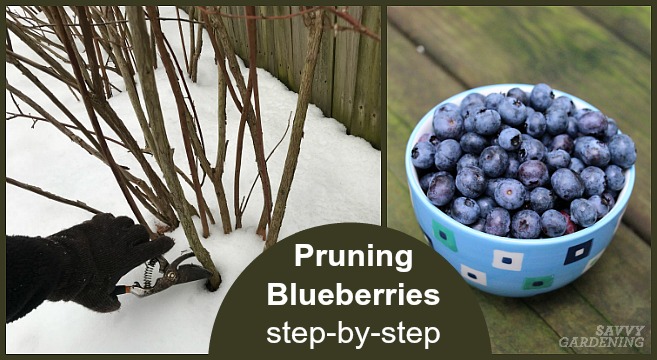
As with most other fruit-producing trees and shrubs, blueberry pruning takes place in mid to late winter. It’s easy to see the structure of the plant more clearly then and discern which branches are to be removed. In winter, the old branches look very different from the new in color and texture (see photos below). Plus, dormant-season pruning causes the plant less stress. The bush is not in an active state of growth, and no carbohydrate-producing foliage is being removed.

The regions where blueberries grow well are those with a dormant season of December through early March. Blueberry shrubs are extremely hardy. Some varieties survive down to -35 degrees F. In fact, blueberries need a set number of hours below 45 degrees F (called chill hours) in order for their flower buds to open and produce berries. Without ample cold weather, blueberries do not produce fruit.
Each blueberry type and variety has a slightly different number of required chill hours. Low-chill blueberry varieties require 200-800 chill hours and are best for southern regions. High-chill selections need 800-1000 hours and are ideal for the north. When buying blueberry plants, select a variety that’s suitable to your region.

Pruning blueberries can take place as early as late December. However, I recommend waiting until late February or very early March for this task. You’ll be able to prune off any stems that suffered winter injury or breakage due to heavy snows. Plus, the chance of winter injury has largely passed.
The different types of blueberries and their pruning needs
There are many different types of blueberries, including high-bush, low-bush, rabbit-eye, and lots of assorted hybrids. In the north, ‘half-high’ varieties are among the most popular. They are the result of the hybridization of high-bush and low-bush types, and are a great fit for most backyards. They grow 3 to 4 feet in both height and girth, and bear plenty of fruits. Southern gardeners should opt for ‘Rabbit eye’ blueberries as they are more heat tolerant and need fewer chill hours.
Don’t forget that you’ll need at least two different varieties of blueberries to get fruit. Most varieties require a cross-pollination partner. (Those listed in the article linked here, however, are self fertile.) Blueberries are primarily pollinated by our native bumblebees because the vibrations these large bees generate are required for loosening and transferring the pollen in the bell-shaped flowers of blueberries.
Regardless of which type of blueberries you grow, the task of pruning blueberries is the same.

Tips for pruning blueberries
How to prune blueberries depends on whether the plant is new and relatively young or old and overgrown. Below you’ll find step-by-step blueberry pruning instructions for both situations. However, I’d like to share a few key points about pruning blueberries first.
- Never shear back blueberries and turn them into the shape of a meatball. Their fruiting buds are located in the outermost 2-3 inches of stem growth. Shearing back the plants removes all the flower buds.
- If you don’t properly prune your blueberry bushes, the existing branches will age, but new, fruit-producing branches will not be formed. Older, unpruned blueberry bushes tend to produce more leaves than berries, and any berries that are produced are small and produced only on the outermost stems.
- Be sure to use clean, sharp pruning equipment. To avoid the spread of disease, disinfect all pruning equipment before moving from one bush to another. I use a special spray pruning disinfectant that doesn’t gum up or rust your equipment, but you can also dip your tools in a 10% bleach solution or use Lysol spray.
- Blueberries produce their flowers on old wood, meaning that the buds for each year’s berry crop are formed during the summer and autumn of the previous season. Protect your blueberry bushes from deer in the winter or they may strip all the buds off the stems.

Pruning blueberries step-by-step
Step 1:
Stand back and evaluate your blueberry bushes one at a time. Begin by cutting off any dead or damaged branches. Cut these stems off all the way back to where they join a thicker branch. Do not leave a stump behind as it serves as an entryway for disease. If the entire branch is dead, cut if off back to the ground.

Step 2:
After any damaged stems are removed, cut out any crossed branches, particularly those that rub against each other. After pruning is complete, you want an open structure with no crossed branches. Cut crossed branches off all the way down to the base of the plant.

Step 3:
For young blueberry bushes or those that have been properly pruned in the past: Cut one-third of the remaining branches all the way down to the ground, choosing the oldest and thickest ones for removal. This encourages new, productive canes to emerge from the roots. Yes, that means cut 1 out of every 3 branches clear to the ground to stimulate new stems to emerge from the roots. Do this every winter and you’ll always have excellent blueberry production.

For mature blueberry plants that are unpruned and overgrown: Perform a careful renewal pruning to encourage new stem production by cutting half of branches back all the way down to the ground. Always cut off the oldest, thickest ones. This forces new canes to grow from the roots. When a branch is seven or eight years old, production is greatly reduced. If you don’t remove old branches, the plant fails to generate new, more productive stems.
Over the following two to three years, remove the remainder of the oldest branches a few at a time until only newly produced ones remain. The plant continues to produce a moderate crop while the bush is being slowly rejuvenated. Heavily pruned, overgrown bushes take a few years to rebound, but your efforts pay off in the long run with many years of terrific production after the plants are regularly pruned.

Pruning blueberries is emotional
There’s no doubt that pruning blueberries is an emotionally taxing job. It’s particularly difficult to see all the buds being cutting off. But, don’t feel guilty about removing branches with potential fruit. If your goal is to increase your blueberry’s long-term productivity and grow larger fruits, then pruning properly is a must. Just have some wine on-hand for after the job is complete!
Blueberry pruning is an annual chore. Mark your calendar so you don’t forget!

Post-pruning fertilization
When spring arrives, here’s how to fertilize pruned blueberry bushes to adjust the soil pH or add an acid-specific organic granular fertilizer, such as HollyTone. Then, mulch the bushes with one to two inches of pine straw, shredded hardwood bark, or shredded leaves. Do not over-mulch. Blueberries have shallow, fibrous root systems that resent thick layers of mulch.
By following these blueberry pruning instructions, you’ll have productive plants for years to come!
For more on growing backyard fruit, check out these articles:
- Organic apple growing using fruit bagging
- Berries in containers: How to grow a small-space fruit garden
- Growing kiwi fruit: It’s easier than you think
- How to grow citrus in pots using 8 simple steps
- 5 mini melons for small gardens and containers
Do you grow blueberries? Which varieties are your favorites?

Vaccinium corymbosum `Patriot`50-60 4.5L
Vaccinium corymbosum ‘Polaris’ 30-40 2L
Hi,
Are these two a good mix? How much space does blueberries need? And how much space for spacing the above? When I buy them, Polaris will be about 30cm high and Patriot 60cm high. i plan to plant this near our driveway as hedges (a little on a slope), will it survive?
Much thanks!!
Those are two great varieties. I grow them both myself. Patriot produces really large berries. I would space them about 4 to 5 feet apart.
Hi – we recently purchased some land with a couple hundred very old blueberry bushes on it. A former u-pick stand. We are hoping to rejuvenate the bushes and run our own u-pick stand. They have not been pruned or maintained for a couple of years. The bushes are 20+ years old. Do we have any hope of having fruit this summer? We are willing and able to start the pruning process. Is it too late? Please help us!
At this point, I would wait until next winter to do your pruning. See how they do this season. Then, next winter, go in and really prune them hard, removing one-third to one-half of the branches from each plant, removing them all the way down to the ground as described in the article. This will encourage new, fruitful stems to emerge. Even though they’ve been a bit neglected, they will do great. Blueberries live a very long time and produce for decades. Don’t give up on them, just be sure to prune them properly from here on out.
Hello, we are moving our blueberries to a different location. It is mid April … they have bloomed and fruit is evident. When my yard fellow dug them up, the roots were compromised and maybe a 1/4 are severed in places. Plus, they have also become quite leggy over the years. My fault since I have neglected pruning.
Are these bushes worth salvaging? Should I just cut all the canes down or is it a lost cause?
Much appreciate your advice on this matter!
Best,
Liz
Memphis zone 7b ish
They are definitely worth salvaging. I would prune them back now, removing 1/3 of the branches by cutting them all the way down to the ground. Yes, you’re sacrificing this year’s fruit, but the root system will not be large enough to support such big plants until it can rebound. The remaining branches can be cut back by another third. Keep them plants well-watered this season and consider removing all the fruit to give the plant a season to recover.
My son cut the branches way too low on a few plants. All the branches were cut to the ground. He’s a kid, so it’s my fault for turning my back. Will the plants come back or are they done for?
They’ll come back. It will be a few years until they’re large enough to bear fruit, but if the root systems were established, they’ll be fine.
It’s late March and I am just now getting around to pruning. Is it too late??
It’s not too late, as long as the plants aren’t in flower yet. You still have some time, but I wouldn’t delay any longer.
Hi,
I have a blueberry bush ‘Goldtraube’ that I bought at the end of the summer last year and I placed in a large pot and left inside our home (we don’t have a garden). When I bought the plant it had gorgeous blueberries hanging from the branches (so I know it’s able to produce fruit) but as the plant has been inside all summer, the leaves never turned red and never fell off. Now it’s nearly spring and the plant looks healthy, but I’m afraid I will not bear fruit as it hasn’t gone dormant. Is it possible that my plant will bear fruit even though it has not gone dormant?
It will likely not bear fruit as almost all blueberries require some number of chill hours in order to set fruit. I would advise planting it out into the garden in the spring in a permanent location. It won’t fruit this year, but should the following season. I also recommend planting a second variety nearby for cross pollination.
How should I prune whips that develop half way up and near top of blueberry plants. They tend to want to go straight up …taller and taller. I cut some back, but new growth still wants to go up. What is making my plants develop these whips near the tops of plant? Should these be removed entirely?
Thank you.
When you prune too much from the top (instead of removing entire branches all the way down to the plant’s base), “whips” like the ones you describe will form. Instead of pruning from the top down, always prune blueberries from the bottom.
Have new canes 5 feet high. 2 or 3 years growing. No branches. No berries. Should i cut them in half? Will they then branch ?
Yes. That is what I would suggest doing. This will force side buds to develop and branch.
I was cleaning up the garden in late September and trimmed the blueberry bushes of 3 oldest canes each, will they be OK? I realized after I usually do this in early Spring.
Ideally, it should be done in late winter/early spring, but your plants will be fine. They just won’t push out any new growth until next year.
Hello,
Thank you for this helpful summary. Is it OK to cut out clearly dead branches in the summertime or will this stress the plant even if the entire branch is dead?
Yep. It’s always okay to cut out dead wood.