
This post may contain affiliate links. If you make a purchase through links on our site, we may earn a commission.
I’m all about experimenting in the garden. I love to conduct my own little “studies” and compare different gardening techniques and products to see which ones work best for me. As scientifically-casual as these experiments are, I often wind up discovering a good bit of worthwhile information. Case in point: growing organic apples with the fruit bagging technique.
If you’re interested in growing organic apples – or almost any other tree fruit, for that matter – then you’re going to want to listen up. I experimented with bagging fruit on trees on a small scale last year, but this year, I’ve gone all-out and developed a “study” of my own. Last year, I only bagged a few apples, just to see what the results would be, and I was blown away. Here’s what I’m doing this year.
An Experiment on Growing Organic Apples
Bagging fruit on trees is not a new technique. Fruit growers around the world have been growing organic fruit for decades using this method. Peaches, pears, apricots, and plums are among the easiest fruits to grow organically when fruit bagging is involved, but I think apples are the easiest of all. So, for that reason, I chose to conduct my experiment on one of my apple trees (though I couldn’t help myself, and I bagged a few peaches, too!).
The idea is to block common fruit tree pests, such as plum curculios, coddling moths, and apple maggots, from attacking the developing fruits by covering them with a physical barrier; in this case, a “bag” of some sort. Bagging fruit on trees also deters many fungal diseases as well, such as fly speck and sooty blotch.
There are several different materials you can use as fruit bags… and that’s where my experiment begins.
Related post: Prevent squash vine borers organically
Materials for Bagging Apples
For 15 years I used a multitude of sprays for growing organic apples. Every year, I’d conduct a series of eight to ten yearly applications of kaolin clay-based products, dormant oil, soap shield, lime-sulfur, Serenade, and other organic fruit tree pest and disease controls. I ran a market farm for five of those years and sold my organic fruit to customers at two different farmer’s markets. It was a lot of work, and I got sick of being beholden to the backpack sprayer. When we left the farm and moved to our current house, I gave up on spraying so much, and my fruit trees suffered.
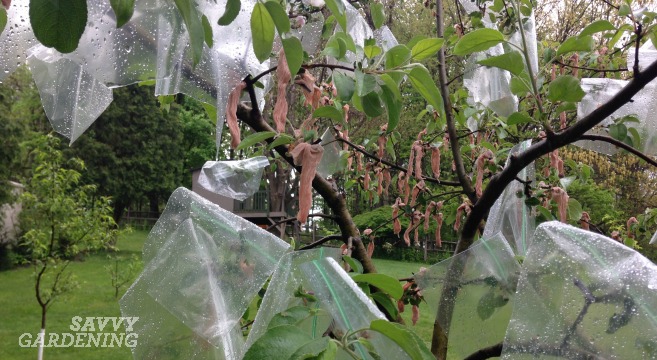
But, this experiment could change all of that. Instead of a backpack sprayer filled with organic pesticides and fungicides, I’m using plastic zipper-top baggies and nylon footies to grow organic fruit. I’ve done a lot of reading on the fruit bagging technique, and here are the steps I’m following for my experiment.

Step 1: Purchase your materials
I know fruit bagging works because I tried it on a small scale last year. But, I didn’t experiment with different types of “bags” to see if one type is more successful than another. So this year, I used nylon footies over one-third of the apples on my tree, plastic zipper-top baggies over another third, and the final third are my unbagged “control” apples. I purchased two boxes of nylon footies from Amazon, along with 300 twist ties. Then, I bought two boxes of 150 cheap, zipper-top, sandwich baggies from the grocery store. I spent a total of $31.27 – waaayyyy less than I ever spent on organic pesticides and fungicides, that’s for sure.
You can purchase special Japanese fruit bags for growing organic apples, too, but I thought they were kind of expensive, so for this year, they aren’t part of the experiment.
Related post: Plant vs. pest: 3 ways to victory!
Step 2: Prepare your materials
There’s not much to be done for preparation here, except to cut the bottom corner off of each of the plastic, zipper-top sandwich bags. Condensation builds up inside the bag, and it needs somewhere to drain out. This does the trick, and you can cut a dozen bags at a time with a sharp pair of scissors.
Step 3: Thin your fruits
This is an incredibly important step in growing organic fruit trees, whether you’re bagging the fruit or not. If too many fruits remain on a tree, the branches become too heavy, the mature fruits will be small, and the tree will only produce a decent crop every other year. For good annual production, thin fruits to one per cluster for apples and pears, or one per every six inches of stem for peaches, plums, and other stone fruits. This should be done when the largest fruit in the cluster is about the size of your thumbnail. If you wait too long, fruit tree pests will be active and you may find your fruit has already been damaged.
Fruit thinning a tough process, trust me. I almost cry when I do it every year, but it MUST be done. Use a scissors to snip off all but the largest apple per cluster. I find a glass of wine is a big help.

Step 4: Bag the remaining fruits
Bagging apples and other fruits with zipper-top bags simply involves opening an inch or so of the zipper, right in the dead center. Slip the opening over the young fruit and seal the zipper around the stem. To use the nylon footies, open them with your thumb and forefinger, and slide the footie over the young fruit. Fasten it closed around the fruit’s stem with a twist tie.

Pros and cons of my bagging fruit experiment
At this point, two-thirds of the fruit on my apple tree has been bagged for one week. I’ll be posting the results of this experiment after harvesting my apples in the autumn, but I’ve already noticed a few pros and cons.
- If you think it takes too much time to bag tree fruit, think again. Yes, it takes some time, but according to my watch, it took me just under an hour and a half to put zipper-top baggies over 125 apples and nylon footies over another 125. It took me a few tries to get the hang of it, but once I did, the process was much faster than I’d expected. When I sprayed with organic fruit tree pesticides eight to ten times a season, it took me way longer than an hour and a half in total time.
- Though the plastic zipper-top baggies were much easier to put on, and took less time, a good dozen of the apples inside of them have already fallen off the tree. But, not a single nylon footie-encased apple has dropped. I think this is because the baggies act like little flags and the force of the wind is snapping the apples off. Still, I’ll loose some of the fruits to “June drop” anyway, so this might not be an issue. Time will tell.
- Condensation definitely builds up in the plastic bags on sunny days. It will be interesting to see if any rot problems develop as the season progresses.
- I’ll be removing all the bags and footies three weeks before the apples are ready for harvest, to allow them to develop their full color. This will add more time to the technique, possibly making it more time-consuming than spraying. I’ll keep track and let you know if this is the case.

Final thoughts on growing organic apples with fruit bagging:
I’ll be keeping track of the following items throughout the season and will issue a final “report” when the results are in!
- Which “bags” stay on better?
- Do the bagged fruits have less pest damage than the unbagged “control” apples?
- Is there a difference between the plastic baggies and the nylon footies when it comes to preventing pest damage?
- Does one fruit bagging technique yield more fruits than the other?
- Does one fruit bagging technique yield bigger fruits than the other?
- Does this method also deter squirrels and deer?
And one final note: If you don’t believe that this technique works, here’s some information from the University of Kentucky stating how effective bagging apples can be.
Do you already grow organic fruit by bagging apples, pears, or other fruits? If so, tell us about your results.
Update!
Now that the growing season has ended, I have a few items worth sharing and some great lessons-learned.
First, even with the bags and nylon footies in place, the squirrels will still find your apples. I lost several nearly full-grown apples to one crazy squirrel who figured out how to pluck the bags and footies from the trees and tear them open. We had to trap him in a live animal trap to remedy the situation.
Next, the earwigs found their way into the plastic baggies through the stem opening, but they didn’t get through the nylon footies. Next year I will put a strip of Tangle-Trap around the trunk of the tree to keep the earwigs from crawling up into the branches.
I lost nearly all of the “unbagged” apples to apple maggots and codling moths, but I managed to harvest a few dozen apples that were covered. Aside from the earwig and squirrel issues, the plastic baggies did far better than the nylon footies did at protecting the apples. BUT, the nylon footies worked way better on a few peaches I used them on. I harvested a handful of absolutely perfect peaches because they were covered with nylon footies. On the apple tree, however, the plum curculios had no problem chewing right through the nylons.
Next year, I will use all plastic baggies on the apples and all nylon footies on the peaches. I’ll use a strip of Tangle-Trap on the apple tree’s trunk and start watching for the squirrels a little earlier in the season. All in all, it was a very successful experiment!
Pin it! 

I leave the bags on – as I pick the apples the bags protect them, especially the Honeycrisps as they bruise easily. I take the bags off when I wash and sort prior to storage or gift giving.
My relatives in Taiwan use paper bags to protect fruits. The paper looks very much like parchment paper we use in the kitchen. I use just newspaper to protect apple and plum. I use Canadian national newspaper, Globe and Mail. The paper is quite resistant to rain. The un-protected apple and plum would be 100% damaged by insects. I also use newspaper to protect squash from rabbit damage.
Excellent idea, David! Thanks for sharing.
Hi, v helpful thank you. Could you tell us when you take your bags off the apples? Few weeks before ripening? Thanks.
Hi Veronica –
I take them off about three weeks before I think they’re ready for harvest. That helps them color up. But, if you don’t want to go through the effort, you can leave them on until harvest. They just won’t have color quite as full.
For a couple of years now I have been sewing my bags with environmental cloth and using them to cover apples, threading string through the top an using a toggle to secure the bag around the fruit. The result is perfect fruit. I use it for apples, grapes, nectarines. I even sew little bags for strawberries. Keeps the fruit insect and bird free, allows sun in and doesn’t stay wet, as the material is a polyester fabric, for about 50c a meter (yard)
What a terrific idea, Louise! What dimensions do you make the bags?
This is the second year I use lunch bags. In some, I still have coddling moth, sometimes earwigs despite the traps on the trunk and even main branches. Moisture is a problem in some because it may condense on the bag but not be enough to run out the cut edges. But fruit damage is way down. To prevent the coddling moth larva entering along the stem, I might try next year some tape from each side to have a tighter but flexible seal on the stem. Earwigs through openings will still remain a problem. I also use some homemade traps (1 gal container with cider/molassis/detergent solution), in which I catch quite a few moths.
Hi from Nova Scotia
I’ve been using 6″ x 10″ white nylon gift bags to protect my apples from the apple maggot for a few years. It works well and they are easy to put over the apples because they have a draw string that you can pull around the stem. I bought the bags in bulk from u-line- a packaging company. And they can be re-used year after year.
Great idea! Thanks for sharing.
This article is fantastic. Thank you for your diligent approach. Have you had any issues with some bugs getting to the fruit despite the bags? I am bagging for the first time this year and have found on a handful of bags that they still get bitten. Upon closer inspection I have found something bite a hole through the Ziploc bag near the stem. I have a picture if you want to see. I also noticed some earwigs getting in but realized they were coming in through the drain hole rather than by the stem. They seem to be able to walk on the surface of the bags. I am trying new bags with much smaller drain holes.
Dealing with plum curculio right now on my peaches, so I’m trying the nylon! Why do you think the nylon worked in your peaches but not the apples? Thanks for this article!
That’s a good question, Kevin. I think the nylons did not prevent the apple maggot flies from laying eggs on the apples because of the small openings in the nylon fabric.
Do you think you could use a brown paper bag to bag the fruit???
Yes; you could. But eventually they’ll disintegrate. Unless you can find paper bags that are wax-coated. Those would probably work better.
Love this Story & will try this year. I have a question. Aren’t you suppose to thin the small fruit rather than the bigger fruit as noted? Anyone help with this??
I think you may have read it wrong, she wrote, “Use a scissors to snip off all but the largest apple per cluster.” You keep the largest fruit, usually the center one of a cluster, and snip off all of the others.
good article just one point do you really feel confident to say its organic fruit if you’re using plastic bags which WILL leach chemicals into the fruit? Thanks.
Hi Corin – Thanks for your comment. This is a great question. At this time, the National Organic Program’s standards do allow for the use of plastic in certain applications (weed control, packaging, etc) on certified organic farms. You can use plastic sheeting down crop rows to manage weeds, as long as it’s lifted and discarded at the end of the growing season. You can also use plastic in your packaging (ever see how the organic apples, lettuce mix, broccoli heads, and carrots are packaged at the supermarket? All plastic.). Right now, there are no specific rules in the handbook that I could find that reference fruit bagging specifically, but for a home gardener, this practice is certainly considered organic. A certified organic farmer, however, would have to check with their particular certifying agency for confirmation, but I do believe it’s allowed. Again, excellent question. And if it’s something that concerns you, opt for wax-coated or brown paper bags instead of plastic in your home landscape.