
This post may contain affiliate links. If you make a purchase through links on our site, we may earn a commission.
If you’ve ever had the misfortune of accidentally encountering a gray, papery nest full of bald-faced hornets or running your lawn mower or string trimmer over the entrance hole of a nest of ground-dwelling yellow jackets, you’re well aware of how defensive paper wasps can be. Particularly in the autumn. But you’d be defensive too, if you thought your queen was under attack and you knew that the survival of your queen meant the survival of your species.
All about paper wasps:
- Members of the paper wasp family (Vespidae) are notorious for their seemingly aggressive behavior in the autumn. These social insects are often mistaken for bees, which they are decidedly not. Though the ground-dwelling species of yellow jackets are commonly called “ground bees”, they are actually wasps.
- Nests of all species of yellow jackets and hornets are large and paper-like. Ground-nesting yellow jacket species build their papery home underground in an old animal burrow, while hornets build their nests on tree branches or buildings.
- Almost all species of paper wasps have colonies that do not survive the winter. Instead, they all die at the end of the season and only the fertilized queen survives the winter and goes on to establish a new colony the following spring.
- Each nest is used only once and is completely abandoned in late fall. Both hornets and yellow jackets are territorial and are not likely to build a nest near an existing one (whether it’s occupied or not). So, if you have an abandoned nest hanging in a tree or stuck to the eaves of your house, let it be. Its presence may prevent a new colony from setting up house nearby. In fact, you can purchase fake nests (like this one or this one) to hang in a shed or porch to prevent hornets or other paper wasps from moving in.
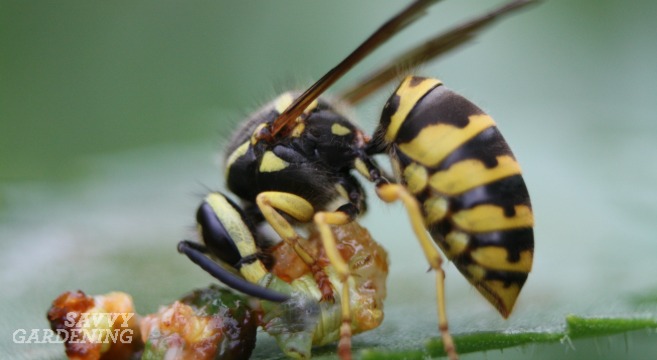
- In general, yellow jackets and hornets are considered to be very beneficial to the garden. Adults consume nectar, and they collect both live and dead insects to feed to their developing young. The yellow jacket in the featured picture is dissecting a cabbageworm and carrying the pieces back to the nest. Paper wasps are important members of nature’s clean-up crew.
What to do about paper wasps:
The next time you encounter a nest, try to avoid destroying it, if at all possible. Cordon off the area to prevent human contact, giving the insects a wide berth to move in and out of the nest. Remember, all but the queen will die as soon as winter arrives and the nest will be abandoned. If it is not possible for you to avoid the area until freezing weather arrives, have a professional remove the nest. Some species of paper wasps release an “attack pheromone” when the nest is threatened. This can lead to a mass attack on the intruder, causing multiple, painful stings.


Pin it!

Paper wasps are amazing creatures. Read up on them. Apparently they are second only to the chimpanzee in facial recognition capabilities.
This means they are highly functioning creatures. We never disturb them, and actually encourage them to colonize around our home which is way out in the country. The ones that colonize our French doorways can actually be tamed. Well, sort of, they actually will not be aggressive if they get used to your movements.
We keep a large tract of unimproved land for the purpose of letting nature do its thing and get a lot of pleasure out of watching all types of critters, wasps are part of the equation. Strongly encourage leaving them alone.
We don’t have ground nesting yellow jackets here in the desert, but grew up on the East Coast where they were the scourge of fall wood harvesting.
Paper wasps are more dignified… Ha ha!
My two year old got stung by one it was the saddest experience ever!! Luckily I had some activated charcoal on hand and mixed it in some honey. She was instantly better! The swelling was gone in less than an hour. If you have wasp in your yard definitely keep some of this in your medicine cabinet.