
This post may contain affiliate links. If you make a purchase through links on our site, we may earn a commission.
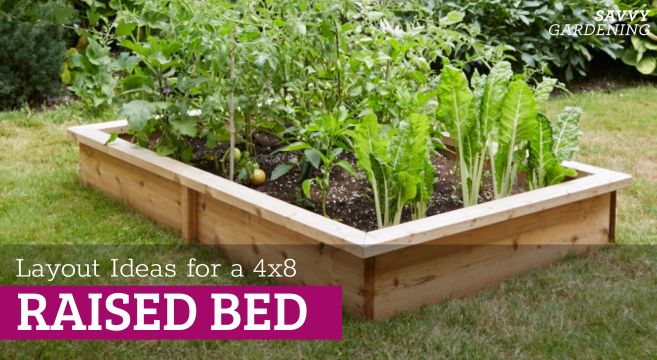
You’re excited to grow a vegetable garden. You’ve built your raised bed in a space that gets at least six to eight hours of sunlight a day, and filled it with soil. How do you figure out how much to grow? I thought I would put together a 4×8 raised bed vegetable garden layout to show how much can be planted in a raised bed. I ended up creating a couple because I had fun planting all those virtual veggies!
Deciding what to plant in a small vegetable garden layout
I like to recommend starting with your grocery list. What items show up week after week? For me, that means lettuce and other greens, like spinach, Swiss chard, kale, and baby bok choy, cucumbers, onions, a variety of herbs, peppers (I usually plant at least one hot pepper to make habanero jelly, and a variety of other sweet peppers), the odd root veggie, like beets and carrots. One thing that doesn’t show up often on my grocery list are tomatoes. But that’s not because I don’t like them. They just can’t compare to the ones you grow yourself (or get at the farmers’ market in the summer). So tomatoes are always on my list to plant. And I often grow way more than I need—any extras get frozen for winter meals.

I also recommend planting at least one new-to-you veggie. It’s fun to watch it grow and then give it a taste test at the end of the season. While it’s easy to get carried away and want to grow all the things, you only have room for so much. I always seem to end up with more seedlings and seeds than I have space for. That’s why my raised bed collection and assortment of pots has increased over the years. What to do with any extra seedlings you have? Don’t let them go to waste! Tuck them into a perennial garden or a pot.
Figuring out spacing in a raised bed
Read your seed packets (or plant tags) carefully. They should provide the height and width of mature plants, as well as spacing recommendations. Keep in mind one of the benefits of raised garden beds is you can plant veggies more closely together (this is called intensive planting or gardening), rather than in rows, like a traditional in-ground garden. This also helps keep the weeds down and can reduce the need to water as often. You do want to keep an eye on your garden and thin plants as they grow to maintain air circulation, which helps prevent diseases.

Many gardeners find Mel Bartholomew’s square foot gardening method helpful. In your raised bed, you divide the space into a grid of 1- x 1-foot squares. Then you follow his plan for how many plants or seeds should be added to each square. The density is based on the plant size. So that might mean one tomato or several carrots. It’s a helpful way for beginners to get organized.
Tips for your vegetable garden plan
*Assess which direction the sun comes from and make sure that you don’t plant tall crops in front of shorter ones. I learned this lesson the hard (funny?) way years ago. A packet of Pastel Dreams zinnias seemed like the perfect flowers to plant them along the front of my one raised bed. For some reason I didn’t read how tall they would get. Well the answer is three to four feet tall! Which means they cast a bit of shade on the veggies behind them at certain points throughout the day. I’m very careful about planting shorter varieties now.
*I always plant columnar basil near some of my tomatoes (I included it in my grocery list plan). It grows to be nice and high, doesn’t get lost in the shade of the tomatoes, and makes a LOT of pesto! Of course there are lots of great varieties of basil to discover.
*Choose compact varieties of plants that sprawl. They may have been bred with containers in mind, but they’re also perfect options for raised beds. If you plant, say a winter squash in your raised bed, it could easily take up the entire garden! However, a compact variety won’t be as much of a hog, and if you strategically plant it, it will cascade over the side. You could also plant your squash in front of the peas… once they’re done, the same trellis can be used to train the squash.
*Use tomato cages around bush varieties of cucumbers that will use the structure to climb.

Sneak in some flowers to attract pollinators and combat plant pests. Some of my faves include alyssum, marigolds, and nasturtiums.
Plan for succession planting
A lot of new green thumbs don’t realize that the veggie planting season doesn’t end when you plant your heat lovers, like tomatoes, cucumbers, and melons. Spaces created in a garden from peas, for example, can be used later in the summer to plant root crops or greens, like Swiss chard and kale, for fall harvests. This is called succession planting.

Also, when you’ve removed, say, your spent pea plants or garlic in the summer, and are getting ready to plant something else, add some compost to the raised bed. This will add some nutrients back into the soil. And now you’re ready to plant more!
I like to plant garlic in one of my raised beds in the fall, but keep in mind you won’t be able to plant in that garlic space until about July, after the garlic is harvested. Thankfully, there are plenty of options you can plant in a new raised bed garden after garlic is pulled, including bush beans, kale, Swiss chard, carrots, and more.
A 4×8 raised bed vegetable garden layout of my grocery list faves
Okay, let’s get to the layout. There are eight rows in this raised bed. For the rows of onions, greens, and root veggies, the photos don’t represent the exact amount planted. They’re just a placeholder to indicate where they go. Based on my grocery list, I would plant two rows of onions; one row with two tomato plants and a columnar basil; one row with three pepper plants (one hot, one snack, one bell—or all the same); a row of kale, spinach or Swiss chard (from seed); a row with two cucumber plants (patio varieties); and a couple of rows of root veggies (from seed). In the diagram, I included beets and carrots, but you could add turnips or radishes. I also snuck in a couple of herbs a curly parsley and a flat-leaf parsley.

A 4×8 raised bed vegetable garden layout for a family
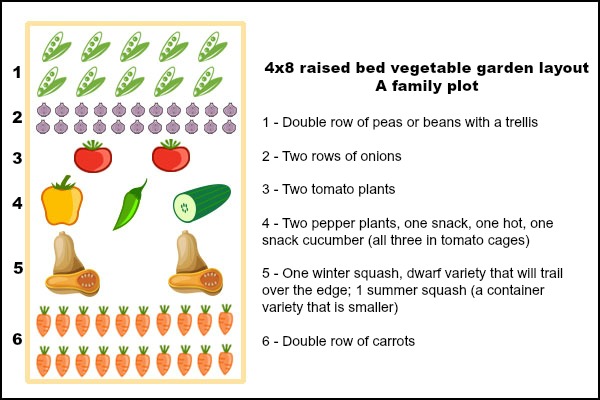
Here’s another layout idea for a family plot. Sow a double row/band of peas or beans with a trellis on the north end. Then, add two rows of onions, a row with two tomato plants (maybe a cherry variety and an slicing tomato), a row with two pepper plants (one hot and one snack), and one snack cucumber (all three in tomato cages), a row with one winter squash (dwarf to go over the edge) and summer squash (plants or seeds)—I loved Burpee’s Lemon Drop squash—and a double row of carrots (from seed).
More raised bed articles:
- Raised bed designs for gardening
- How deep should a raised bed garden be?
- The best soil for a raised bed garden
- Planting a raised bed
- Learn raised bed basics at Savvy Gardening School

Great info!
Are the beds directly on dirt or do you put a liner to keep weeds off? And if not how do you manage weeds from invading the garden
Thanks
The beds are directly in the soil. Some people will put landscape fabric down (I have for one of my beds), but I’ve found it can affect drainage. You could put cardboard at the base of the raised bed to cover (and hopefully smother) weeds and put the soil overtop. Bindweed is an exception as it will find its way out no matter what!
Hi! I’m planning to do an 4X8 raised tomato garden. I’ll like to grow both determinate and indeterminate varieties (more indeterminate). How many plants can I fit? It’s just two of us but we LOVE tomatoes!
I had a friend plant 8 this year and her plants were all huge – it was a jungle! I would say probably 6, and then you can interplant with plants, like basil. But it also depends how you stake them. Here are some tips: https://savvygardening.com/tomato-growing-secrets/ https://savvygardening.com/how-far-apart-to-plant-tomatoes/
Thank you, Tara for your response.
Hi Tara.
I was thinking of starting a raised bed for next spring..it is 9/5 now. I have a lot of container plants that are finished and I was thinking of dumping the soil into the bed and just working in some other things and letting it sit over winter till next spring? Can I use my leftover container garden soil for this? Would adding things like lime, pulvarized leonardite, glacier rock dust and/or espoma plant toner be good??? I have all theses things just aren’t really sure how to use them properly.
Hi Michelle,
I have used the soil from pots to fill up my raised beds, but keep in mind, at the end of the summer, they’ll likely be quite sapped of nutrients. You’ll also want to amend the soil with compost. You can also add in chopped leaves if they fall in your yard to break down over the winter. As far as the other additives you mentioned, I would read the package to determine if your soil’s conditions warrant their use!
Hi Tara!
Thank you so much for the information and diagrams. All so helpful! Attempting my first veggie garden and just got my first 6ft long x 3ft wide x 10” depth raised bed. I think I bought way more plants than I need so I may need a second raised bed! My question is, is it too much of I plant the all the plants listed below in my bed?
Husky cherry tomato (determinate)
1 2qt tomato
3 20 oz bell peppers
1 Eggplant
1 full grown Jalapeño
2 celery & 1 carrot (grown from roots)
I also read it’s good to stagger them? I plan on putting the full grown jalapeño, tomatoes and eggplant on the back row. All except for the bell peppers are growing fruits and veggies!
Thank you so much for your guidance!
Hi Charmaine,
I think all these plants will fit just fine. You could have a row of peppers, a row with the tomato, jalapeño and eggplant, a row of celery and a row of carrots. You can stagger them a bit so that you have room for cages or stakes.
My family and I just built our first raised garden bed off the ground. However I’m a tad concerned as I used MCA (Micronized Copper Azole) treated wood, but from what I’ve read newer treated wood is harmless and doesn’t leech in to the wood like the older pressure treated. After spending all day building my garden box, I’m curious if I should at some point replace, at the very least the sides (majority of dirt touches), to make it safer. Thoughts?
Hi Jeff,
I’ve found a couple of articles that might help put your mind at ease as far as the risk. Furthermore, one thing you could do is line the sides (not the bottom) of your raised bed with plastic, to minimize any leaching that might occur from wood to soil.
https://www.finegardening.com/article/are-pressure-treated-woods-safe-in-garden-beds
https://ask.extension.org/questions/409600
I am using 2 pallets as my 1st ever “raised” bed. I’ve removed several of the wood pieces so there are 6 equal “holes” in each pallet. I have the pallets side by side with 2 tomato cages between them. I layed landscaping fabric down first, then the pallets and then newspaper. I plan to cover the newspaper with soil and then plant. My question is, will that be deep enough for my vegetables to grow well? I have peppers, tomatoes, zucchini, cucumbers, spinach and onions.
Hi Jennifer, how many inches do the plants have to grow?
Hello Tara!
I am interested in planting my first 4×8 Bed, and was interested in the family plot that you laid out… I was curious, is late May still okay for that sort of layout for Growing zone 7A? I was unsure if carrots were an option during the summer, or if maybe I should swap out and do a couple of cabbages there instead? Thank you for the wonderful guide for us noobies!
Hi Isaac, You’re not too late. You can still plant all the heat lovers, as well as the carrots. Happy planting!
Thanks so much Tara!
Hi!
I want to follow your first small plan. My bed lies east -west. What direction should I plant at the top/ bottom, onions/carrots ?
Hi Keani, I would watch where the shadows fall throughout the day – from your house, trees, fence, etc. Plant the onions and carrots on the side that gets the least amount of shade throughout the day.