
This post may contain affiliate links. If you make a purchase through links on our site, we may earn a commission.
Many gardeners across the eastern two-thirds of the U.S. and southern Canada will start to notice damage from four lined plant bugs (Poecilocapsus lineatus) in mid to late spring. Appearing as tiny, round, sunken pockmarks on the foliage of such plants as forsythia, viburniums, Shasta daisies, lavender, oregano, geraniums, sage, mums, basil, peonies, mint, and many others, the damage is as distinctive as the insect itself.
Identifying four lined plant bugs
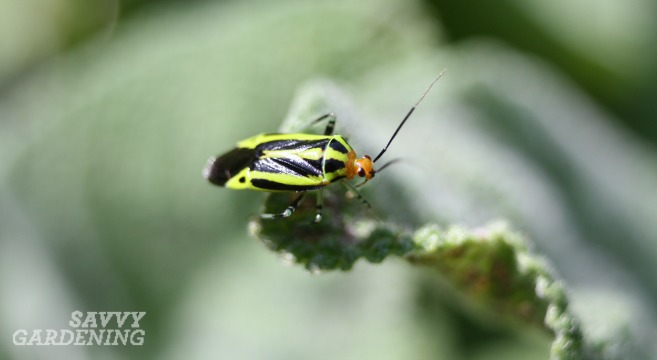
This true bug measures a quarter-inch in length at maturity, and both looks and acts like a little speed demon. Four, black longitudinal “racing stripes” grace the otherwise electric yellow-green wing covers of the adults (see feature photo). And with the ability to scuttle beneath foliage in a flash, these little buggers are difficult to spot and nearly impossible to capture.
Four lined plant bugs overwinter as eggs inserted into plant stems. Tiny, reddish-orange and black, rounded nymphs (see picture below) hatch in early spring and pass through five growth stages over the course of four to six weeks. As the young nymphs feed, little damage is evident, but as they reach maturity, you’ll start to notice the distinctive pockmarks they leave behind. Damage from the adult bugs is usually spotted in late May through June and perhaps into early July.

Organic control of four lined plant bugs
Fortunately, the adults feed for only one month before “finding love”, laying eggs, and then biting the dust. There is only one generation per year. Because the feeding period of the four lined plant bug is so brief – and the damage is largely aesthetic – control measures are seldom warranted, though insecticidal soap, horticultural oil, and neem oil are moderately successful against them, especially if the product comes in direct contact with the nymphs.
In my own garden, I don’t bother trying to control four lined plant bugs with any products. I simply prune or pinch off spoiled plant growth in early July, when the insects are gone. This encourages the growth of new foliage that will remain unaffected by this insect for the rest of the season.

For more information about managing pests in your garden, without turning to synthetic pesticides, check out the following articles:
- Our Guide to Managing Vegetable Garden Pests
- Preventing Pest Outbreaks
- Tips for Identifying Garden Pests

Have you spotted four lined plant bugs in your garden? Tell us about it in the comment section below.
Pin it! 

I have these bugs on my Montauk daisy, zucchini, Shasta daisy, oregano and a few others.
I’ve sprayed Neem oil and it seems to help.
I’m going to try trimming the damage.
most interesting – I am north shore of Boston, just south of New Hampshire, and these guys are out of control this year! I also planted chocolate mint and they went crazy on it last year and I think the ensuing generation is all over my garden this spring. It must be their favorite mint or something.
My favorite product for most bugs is something called “Einstein Oil” which has Neem, garlic and other stuff and works really well. I mixed up a batch and sprayed and 90% of them are gone, will spray again in a week.
Normally I ignore these guys but it’s obvious there is some kind of population boom this spring that is doing more than cosmetic damage, some of the plants are getting devastated.
They are destroying COMFREY and mullein, I didn’t know this was possible. The damage was mostly confined to my chocolate mint in the past, but this year they’re everywhere and on everything. They’ve been destroying my entire garden for a solid month plus. I’m on the coast of Maine – I don’t think I’m the only one having a tough year with these guys.